

Why California Notary Bonds Are Essential for Your Commission
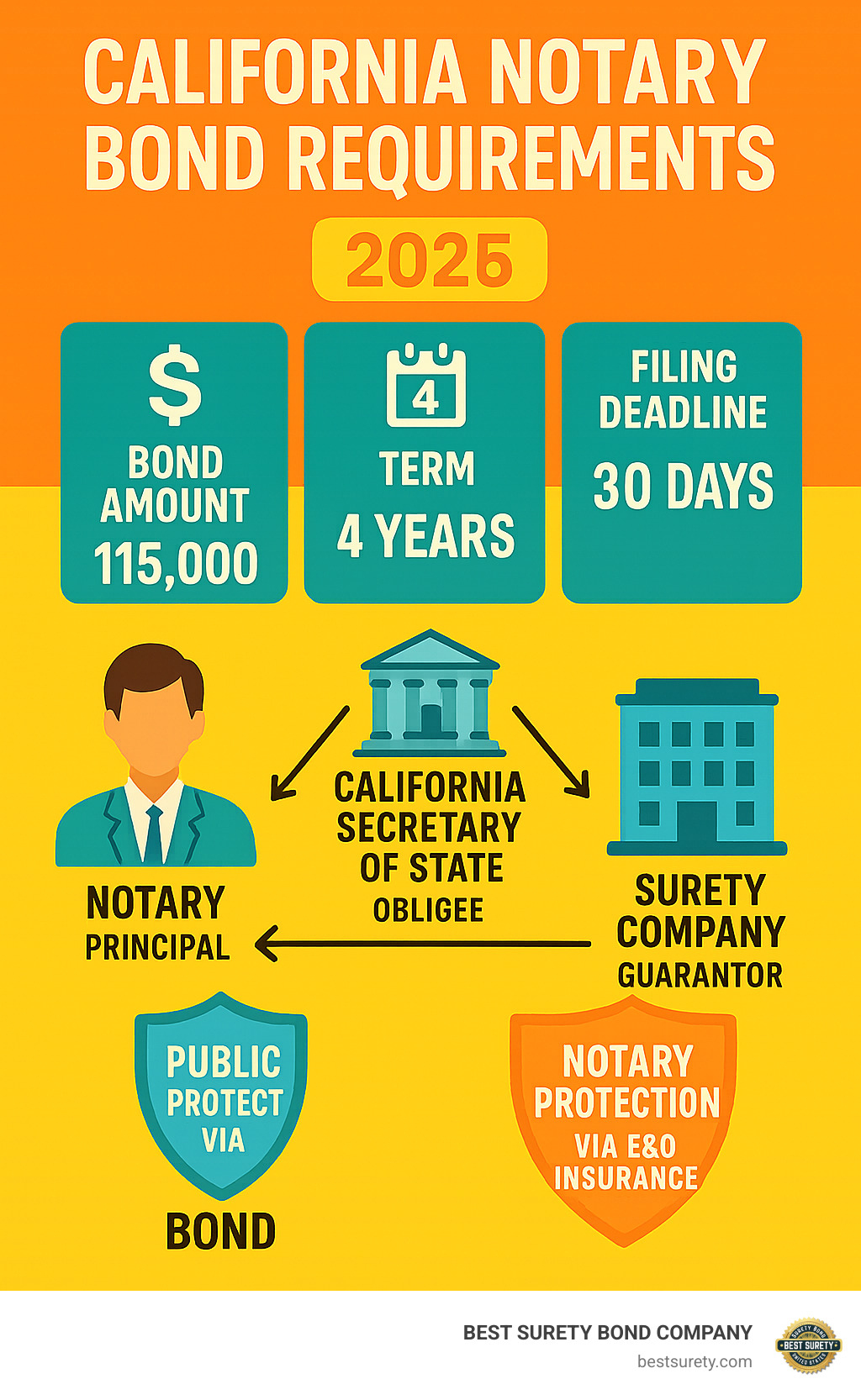
A notary bond in California is a mandatory $15,000 surety bond required by the California Secretary of State for all notary public commissions. This bond serves as a financial guarantee that protects the public from losses caused by notary errors or misconduct during your 4-year commission term.
Quick California Notary Bond Facts:
- Bond Amount: $15,000 (required by law)
- Term Length: 4 years (matches your commission)
- Cost: $38-$50 for the full 4-year term
- Filing Deadline: 30 days from commission certificate date
- Filing Location: County clerk’s office where your business is located
- Purpose: Protects the public, not the notary
- Credit Check: Not required by most providers
The bond works as a three-party agreement between you (the principal), the California Secretary of State (the obligee), and the surety company. If you make a mistake that causes financial harm to someone, they can file a claim against your bond for up to $15,000. However, you remain personally liable to repay the surety company for any claims paid out.
California’s strict 30-day filing deadline means timing is critical. As one county clerk’s office warns: “This 30-day period cannot be extended” – making it essential to understand the process before your commission arrives.
I’m Haiko de Poel, and I’ve helped thousands of small business owners steer complex bonding requirements across multiple industries, including securing notary bonds in California for professionals who need fast, affordable solutions. My experience with surety bonds and regulatory compliance has shown me that understanding your bond requirements upfront saves time, money, and stress later.
Notary bond in California helpful reading:
What is a California Notary Bond and Why is it Required?
Before you can begin your work as a notary, you need a crucial item: a notary bond in California. This bond is a financial guarantee that helps keep the public safe.
This bond is a must-have, mandated directly by the California Secretary of State. Its main job is to act as a protective shield for the public. It ensures that if there’s a mistake, error, or misconduct on a notary’s part that causes someone financial harm, there’s a way for that person to be compensated. It’s a financial safety net, making sure the public is protected from potential losses.
The requirement for this bond is written into California law. Specifically, California Government Code sections 8212-8213 outline why this bond is so important. Without this essential bond, your journey to becoming a commissioned notary public in California simply can’t begin.
A surety bond is an agreement between three key players:
- The Principal: That’s you, the notary public. You promise to follow all rules and laws when performing notarial acts.
- The Obligee: This is the California Secretary of State, which requires the bond to protect the public’s interest.
- The Surety: That’s us, your trusted bond company. We guarantee to the Secretary of State that we will pay claims up to the $15,000 bond amount if you cause financial harm. However, you are responsible for reimbursing us for any claims paid.

The Purpose of a Notary Bond
The purpose of your notary bond in California is to build public trust. It provides financial recourse if a notary public’s actions cause someone a financial loss, ensuring you perform your duties with integrity and within the law.
Imagine a situation where a notary’s error, like failing to properly verify an identity, leads to a fraudulent transaction. The person who suffered the financial loss can then file a claim against the notary’s bond. This bond, up to its $15,000 limit, provides the funds to compensate the victim. Notaries hold significant responsibility, and their errors can have large financial impacts, so this safeguard is vital.
Your bond is not insurance for you, the notary. It protects the public, not your personal finances. If the surety company pays a claim, you are legally required to reimburse them. The ultimate financial responsibility for your actions remains yours.
Who Regulates Notary Bonds in California?
The primary authority overseeing notaries and their bonds in California is the California Secretary of State. This office is responsible for:
- Making sure all notaries public are properly appointed and commissioned.
- Setting all the rules and regulations that notaries must follow.
- Deciding on the required bond amount and its term length.
- Overseeing how notaries conduct themselves and ensuring they follow all state laws.

While the California Secretary of State requires the bond, the actual filing of your official oath and bond happens at your local County Clerk’s Office. You’ll need to file these documents in the county where you primarily conduct your notary business. The county clerk’s office plays a key role in processing these documents and ensuring you meet strict state deadlines. This dual oversight means notaries are commissioned by the state and held accountable in their local community.
Key Requirements for Your Notary Bond in California
To become a notary public in California, you must follow the state’s bond requirements. These guidelines are designed to ensure public protection and professional competency.
California mandates a $15,000 bond amount for all notary publics. This figure is calculated to provide meaningful financial protection for the public while remaining accessible. Your notary bond in California must be issued for a 4-year term, which aligns with your notary commission period, so you won’t have to worry about renewing them separately.
Obtaining your bond is accessible. Most providers don’t require a credit check, so your financial history won’t be a barrier. The process involves a one-time premium payment for the entire four-year term, with no monthly payments or hidden fees.
California takes notary education seriously. New applicants must complete a comprehensive six-hour education course that covers state laws and best practices. This course prepares you for the state exam and for real-world situations you’ll encounter.
If you’re renewing your commission, the state requires a three-hour refresher course to ensure you stay current with any changes in laws or procedures. This ongoing education requirement reflects California’s commitment to maintaining high standards in the notary profession.
How Much Does a California Notary Bond Cost?
Securing a notary bond in California is affordable. While the bond provides $15,000 of coverage, the cost to you is much lower.
The actual cost for your four-year bond typically ranges from $38 to $50 for the entire term. This small, one-time investment covers your complete four-year commission period with no monthly payments or hidden fees.
What makes this even better for the public is that there’s no deductible when someone files a valid claim. If a member of the public suffers financial harm due to your notarial error, they can receive compensation up to the full bond amount without paying anything out of pocket.
Many notaries purchase their bond as part of a notary supplies package that includes their official seal and journal. While these packages offer convenience, the standalone bond remains budget-friendly. At Best Surety Bond Company, we offer competitive rates to help California professionals get bonded quickly and affordably, whether you’re in Los Angeles, San Francisco, or anywhere else in the Golden State.
Who Needs to Obtain a Notary Bond in California?
Every person who wants to become or remain a notary public in California must obtain this bond. It is a non-negotiable prerequisite for your commission, mandated by law.
All new notaries must secure their $15,000 bond before they can legally perform any notarial acts. Without it, you cannot be commissioned, regardless of your exam performance or education.
Renewing notaries face the same requirement every four years. When your commission expires, you’ll need a new bond for your new term. This is a continuous commitment to public protection that ensures every active notary in California is financially backed by a surety company.
This requirement is so fundamental that it’s the first item on the Official California Notary Public Checklist from the Secretary of State. This bond is your gateway to providing professional notary services in California.
How to Get and File Your Bond in 4 Simple Steps
Getting your notary bond in California is a straightforward, four-step process. We aim to make securing your bond smooth and stress-free by offering fast approvals and easy online quotes to get you bonded quickly.

Step 1: Complete State Requirements and Receive Your Commission
Before getting your bond, you must fulfill California’s core requirements. This includes being at least 18 and a legal resident, completing the mandatory six-hour education course (or a three-hour refresher for renewals), passing the state exam, and undergoing a background check with Live Scan fingerprinting.
Once you’ve cleared these steps and your application is approved, the California Secretary of State will send your official Commission Packet. This packet contains your Commission Certificate, which is essential for the next steps.
Step 2: Purchase Your $15,000 Surety Bond
Once you have your commission details, purchasing your notary bond in California with us is quick and effortless. We offer instant online approval and fast issuance, so you can get bonded in minutes.
To get started, visit our secure online system. You’ll need to provide your name, address, county, and commission date. After your purchase, you’ll typically receive a copy of your bond instantly via email, with the official bond delivered based on your shipping preference. We are committed to providing low-cost surety bonds and the best rates for this mandatory part of your notary journey.
Step 3: Take the Oath and File Your Bond
This step is crucial and has a strict deadline. You have a firm 30-day window from your commission’s commencement date to file your bond and take your Oath of Office. This period cannot be extended, so timing is vital.
You’ll need to go to the County Clerk’s office in the county of your principal place of business to file your bond and take your oath. While California statutes allow for filing by mail, we highly recommend submitting your oath and bond in person. This guarantees timely filing and allows you to correct any minor issues on the spot, preventing your commission from becoming void.
Step 4: Renewing Your Commission and Bond
Your commission and notary bond in California are valid for four years. To ensure uninterrupted service, begin the renewal process at least six months before your current commission expires to avoid any gaps in your notary status.
The renewal process involves several familiar steps:
- Completing the three-hour refresher education course.
- Passing the notary public exam again.
- Undergoing another background check and fingerprinting.
- Obtaining a new $15,000 bond for your next 4-year term. A new bond is required for every renewal.
We make it easy to renew your bond with us. Once you process your renewal payment, we’ll promptly issue and send you a new surety bond form for a seamless transition into your next commission term.
Notary Bond vs. E&O Insurance: A Critical Distinction
Here’s a common head-scratcher for many new notaries! It’s super important to understand the big difference between your notary bond in California and something called Errors and Omissions (E&O) insurance. While both are about being responsible in your notary role, they truly serve different masters.

Think of it this way, using that helpful image above: your notary bond is like a strong shield that protects the public, while your Errors and Omissions (E&O) insurance is your personal shield, protecting you, the notary.
When someone makes a valid claim against your bond due to your mistake or misconduct, the surety company (that’s us!) will pay up to $15,000 to the person who was harmed. But here’s the kicker: you, the notary, are still on the hook. You’re legally required to pay that money back to the surety company. That means your personal savings or assets could be at risk. E&O insurance, however, is specifically designed to step in and protect your wallet from those situations.
Does the California Notary Bond Protect Me?
This is a question we hear a lot, and it’s a super important one to get right! The short answer is a clear and resounding no, your notary bond in California does not protect you, the notary public. This isn’t a subtle point; it’s a fundamental truth about how these bonds work. Its whole reason for existing is to act as a financial safety net for the general public, shielding them from any financial damage caused by your notarial errors or misconduct.
Let’s walk through an example to make it crystal clear. Imagine you accidentally notarize a document without thoroughly checking the signer’s ID, and it turns out to be a case of fraud. Someone loses a significant amount of money – say, $15,000. That person can then file a claim against your bond. As the surety company, we would pay that $15,000 to the person who was harmed. But here’s the crucial part: we then turn to you, the notary, to get reimbursed for that $15,000. So, while the bond ensures the public gets paid, you’re ultimately responsible for that payment. Your personal assets could be on the line.
Is Errors and Omissions (E&O) Insurance Required?
Good news! Errors and Omissions (E&O) insurance is not required by the state of California for notaries public. You won’t find it on any official checklist as a mandatory item. However, and this is a big “however,” it is highly recommended as an optional coverage. Why? Because, as we just discussed, your notary bond isn’t there to protect you. E&O insurance steps up to fill that very important gap.
Think of E&O as your personal safety net. It’s there to protect you from financial headaches if you make an unintentional mistake or are accused of negligence in your notarial duties. This coverage can be a lifesaver. For example, it can potentially help with legal fees if you’re ever sued, even if the lawsuit against you is totally baseless (defending yourself can cost a fortune!). It can also cover damages if a legitimate claim is made against you – perhaps one that goes beyond your bond amount, or if you need help reimbursing the surety for a bond payout.
You can choose different levels of E&O coverage, often ranging from $15,000 all the way up to $100,000 or even more. This lets you pick the amount of protection that feels right for you and the kind of notarial work you do. While it’s an extra cost, most notaries find it a super smart investment for real peace of mind, knowing their personal finances are better protected.
Frequently Asked Questions
What happens if I don’t file my notary bond on time in California?
Missing the 30-day filing deadline for your notary bond in California and Oath of Office has serious consequences. Your commission becomes completely void, with no exceptions or extensions.
I’ve seen this happen to notaries who assumed they had more time. The California Secretary of State’s policy is strict: the 30-day window from your commission certificate date cannot be extended. If you miss it, you must restart the entire application process.
This means retaking the six-hour education course, passing the state exam again, submitting new fingerprints, and paying all the fees again. This is an expensive and time-consuming setback. This is why we emphasize getting your bond quickly and filing in person at your county clerk’s office.
How do I change the information on my bond?
If you need to update your bond information due to a name change, new address, or a change in your principal county of business, we can help make the process smooth and compliant.
The first step is to contact your surety provider—that’s us! We understand California’s requirements and can guide you. Depending on the change, we might issue an endorsement to your existing bond or provide an amended bond form.
Name and address changes are common. If you change your principal place of business to a new county, it requires more coordination with the new county clerk’s office for future filings.
The key is to act quickly. Keeping your bond information current is required to maintain compliance with state regulations. We make these updates as painless as possible.
Can I perform remote online notarizations (RON) in California?
California does not currently allow Remote Online Notarizations (RON), where the notary and signer are in different locations connected by video.
However, California notaries can perform in-person electronic notarizations, where the signer is physically present but you use electronic documents and digital signatures. Your notary bond in California covers these transactions.
Interestingly, California does recognize RONs that were legally performed in other states. A document notarized remotely in a state that allows RON, like Texas or Virginia, is valid in California.
The legal landscape is changing, so we recommend monitoring the California Secretary of State’s website for updates. When RON becomes legal in California, your existing bond will likely cover those activities, but we will keep you informed of any changes. For now, stick to in-person notarizations, knowing your bond provides the required protection.
Conclusion
Securing your notary bond in California is more than just checking off a legal requirement—it’s your gateway to serving your community with confidence and professionalism. Throughout this guide, we’ve walked through the essential details: the mandatory $15,000 bond amount, the critical 30-day filing deadline, and the important distinction between public protection through your bond and personal protection through E&O insurance.
The most crucial takeaway? Timing is everything. That strict 30-day window from your commission date isn’t negotiable, and missing it means starting your entire application process over again. We’ve seen too many aspiring notaries learn this lesson the hard way, which is why we emphasize getting your bond secured and filed as soon as you receive your commission packet.
While your notary bond in California protects the public from your potential errors, you remain personally liable for any claims paid out. This is exactly why we strongly recommend considering Errors and Omissions insurance as your personal safety net. It’s the difference between sleeping soundly at night and worrying about every document you notarize.
At BEST SURETY BOND COMPANY, we understand that getting bonded shouldn’t be complicated or expensive. Whether you’re in Los Angeles, San Francisco, or anywhere across California, we provide fast approvals, competitive rates, and the personal service you deserve. Our online platform makes it easy to get your instant quote and secure your bond in minutes, not days.
We’ve helped thousands of professionals across Texas and nationwide steer their bonding requirements, and we’re here to make your California notary journey just as smooth. From our home base serving Houston and the greater Texas market, we’ve built a reputation for reliability and speed that extends coast to coast.
Ready to take the next step in your notary career? Don’t let paperwork delays hold you back from serving your community.
Get Your Instant California Notary Bond Quote Today
