

Your Guide to Getting Paid
If you’re wondering how do you file a payment bond claim, here’s a quick overview of the essential steps:
- Get the Bond Details: Secure a copy of the payment bond for the project.
- Send Preliminary Notices: Deliver any required preliminary notices by the specified deadlines.
- Prepare and Submit Claim: Draft and send your official claim notice, along with supporting documents, to the correct parties.
- Meet All Deadlines: Strictly follow all deadlines for submitting your claim and filing a lawsuit if necessary.
Dealing with unpaid work is challenging, especially on public construction projects where mechanic’s liens aren’t an option. Payment bonds provide a financial safety net, ensuring subcontractors, laborers, and suppliers get paid even if the general contractor defaults.
Knowing how to file a claim against these bonds is key to protecting your business. This guide will walk you through the process, making it clear and straightforward.
As CEO of MASS IMPACT®, Haiko de Poel, Jr. is a marketing strategist who helps contractors and suppliers steer complex payment systems. His experience includes guiding businesses through the intricacies of how do you file a payment bond claim to secure timely payments.
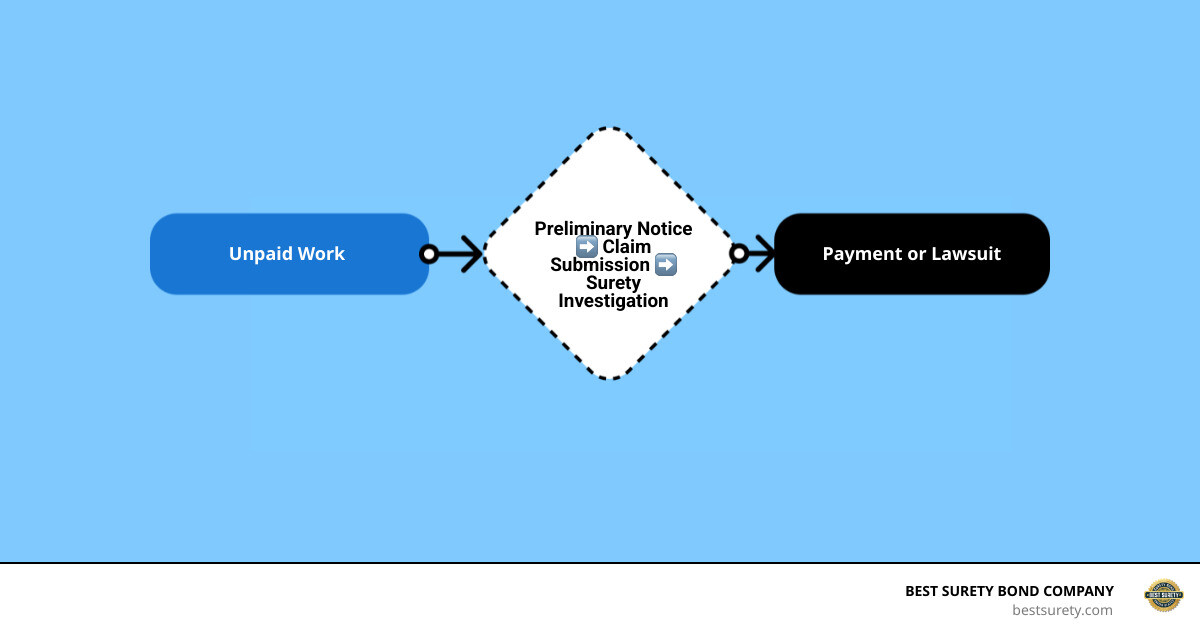
How do you file a payment bond claim terms to remember:
Payment Bond Fundamentals: What You Need to Know
Before diving into how do you file a payment bond claim, let’s cover the basics. A construction payment bond is a type of surety bond—a financial guarantee from a surety company on behalf of a contractor. Its primary purpose is to ensure that all parties on a project, including subcontractors and material suppliers, are paid for their services and materials. This is a critical safety net, especially for public projects where traditional mechanic’s liens are not permitted.
This three-party agreement includes:
- The Principal: The general contractor who purchases the bond and is obligated to pay subcontractors and suppliers.
- The Surety: The company (like BEST SURETY BOND COMPANY) that issues the bond. If the Principal fails to pay, the Surety covers legitimate claims and then seeks reimbursement from the Principal.
- The Obligee: The entity requiring the bond, typically the project owner (e.g., a government agency). The bond protects them by ensuring project participants are paid, which helps prevent delays.
On private construction jobs, an unpaid party can often file a mechanic’s lien against the property. However, you cannot place a lien on public property like government buildings, roads, or schools. This is where payment bonds are essential, serving as the primary method for payment protection on public projects.
Under The Miller Act, federal projects valued at $100,000 or more require the main contractor to secure a payment bond. Many states have similar laws, known as “Little Miller Acts,” for state and local public projects.
Payment bonds are often purchased with performance bonds, but they serve different functions:
| Feature | Payment Bond | Performance Bond |
|---|---|---|
| Purpose | Guarantees that subcontractors, laborers, and suppliers will be paid. | Guarantees the contractor will complete the project according to the contract terms. |
| Who it Protects | Subcontractors, suppliers, and laborers. | Project owner (Obligee). |
| What it Covers | Unpaid labor, materials, or services. | Contractor default, failure to perform, or project abandonment. |
| Trigger Event | The contractor fails to pay subcontractors or suppliers. | The contractor fails to meet contractual obligations. |
| Relation to Liens | Serves as the payment remedy on public projects where mechanic’s liens are not allowed. | Not directly related to liens; focuses on project completion. |
| Typical Cost | Often bundled with performance bonds. Rates are typically 1-3% of the bond amount, based on project size, credit, and financial history. | Bundled with payment bonds, with a combined cost of 1-3% of the project value, depending on the contractor’s financial health and experience. |
How Do You File a Payment Bond Claim: A Step-by-Step Guide
When payment is outstanding, filing a claim is a clear process to get what you’re owed. Understanding these steps will significantly improve your chances of success.

Generally, subcontractors, material suppliers, laborers, and equipment lessors can file a claim, as they do not have a direct contract with the project owner. General contractors cannot claim against their own bond.
Step 1: Gather Your Documents and Obtain the Bond
This first step is critical. You cannot file a claim without knowing the surety and the bond’s specific requirements. Your first task is to obtain a copy of the payment bond. Request it in writing from the general contractor or the project owner. Many contracts, like those using AIA Contract Documents, require the GC to provide a copy upon request.
Once you have the bond, read it carefully. It will define what constitutes a “Claim” and outline the exact steps to follow. Missing a step could lead to a denial.
Next, gather all supporting documentation to prove your work and the amount due. This includes:
- Contracts and subcontracts
- Unpaid invoices
- Approved change orders
- Proof of delivery (signed tickets, photos)
- Relevant correspondence about payment
- A sworn statement of account (notarized summary of amount owed)
- The date you last performed labor or supplied materials
The more organized your documentation, the stronger your claim.
Step 2: Send a Preliminary Notice
A preliminary notice is a professional heads-up that informs the project owner, GC, and surety that you are working on the project. Even if not required by your state, it’s a best practice that secures your right to file a claim later.
Deadlines for these notices vary by state. For example, California often requires a 20-day preliminary notice, while Florida may require a notice within 45 days of your first day of work for those without a direct contract with the GC. Missing this deadline can forfeit your claim rights, so research your state’s specific requirements.
Step 3: Prepare and Submit Your Official Claim
This is your formal assertion of your right to payment. The claim notice, sometimes called a demand letter, must be precise and include all information required by the bond and state law. A formal claim notice typically includes:
- Your company’s legal name and contact information
- The name of the party you contracted with
- Project name, location, and description
- A detailed account of labor or materials furnished
- The final date you performed work or supplied materials
- A financial summary of the amount owed
- A copy of your contract or purchase order (often required)
Send the claim to the surety company and the general contractor (the principal). Some states may also require sending a copy to the public entity that awarded the project. Use certified or registered mail with a return receipt requested to get undeniable proof of delivery. Send it to the address specified in the bond document.
Step 4: Adhere to Strict Deadlines
This is the most critical step. Bond claim deadlines are firm cut-offs, and missing one can mean losing your right to payment.
There are two key deadlines:
-
Claim Deadlines (Notice Deadlines): The timeframe to submit your formal claim notice. This varies by state and bond. For example, under the common AIA A312-2010 Payment Bond, notice is often required within 90 days of your last day of work. In Florida, the claim must be delivered to the surety and GC within 90 days of your last work day.
-
Lawsuit Deadlines (Enforcement Deadlines): If the claim isn’t resolved, you must file a lawsuit within a specific timeframe. This is often one year from your last day of work, but some states are more restrictive. For example, in California, a suit may need to be filed within 6 months after the Stop Notice period expires. In Texas, it could be as short as 60 days after giving notice of the claim.
Always consult state-specific resources or legal counsel to confirm the exact deadlines for your project’s location. An oversight here can have severe consequences.
The Impact of “Little Miller Acts”: State-Specific Rules
While the federal Miller Act governs bonds on federal projects, each state has its own version for public works undertaken by state and local governments. These laws are known as “Little Miller Acts,” and understanding them is critical when determining how do you file a payment bond claim.

These state-specific acts are essential because you cannot place a mechanic’s lien on public property like a city hall or school. They establish key requirements, including:
- Monetary Thresholds: The minimum contract value that requires a payment bond. In Pennsylvania, it’s projects over $5,000. In Texas, the threshold is $50,000 for municipal projects under the Transportation Code and $25,000 for other government projects.
- Bond Amounts: Often 100% of the contract value.
- Notice Requirements: Specific rules for preliminary notices and formal claims.
- Enforcement Periods: The strict timeline for filing a lawsuit if a claim is not paid.
Texas, for example, has famously intricate rules. The state uses a “recurring bond claim process,” which may require you to submit a claim for each month a payment dispute exists. Texas law requires “monthly 2nd- and 3rd-month notices.” The 2nd-month notice is due by the 15th day of the second month after providing labor/materials, and the 3rd-month notice (the actual bond claim) is due by the 15th day of the third month. A crucial Texas detail: if the 15th is a weekend or holiday, the notice must be sent before that date, not after.
Failing to follow your state’s specific Little Miller Act can jeopardize your entire claim. It is paramount to adhere to these local requirements.
After the Claim: What Happens Next?
You’ve learned how do you file a payment bond claim and submitted it. Now, the surety company’s claims department begins its investigation to determine if your claim is valid.

First, the surety will acknowledge receipt of your claim and may request more information from you and the principal (the general contractor). The surety will then review all documents, project contracts, and the bond agreement to assess whether all parties met their obligations. Sureties have a duty to investigate claims fairly and may use legal, construction, and accounting experts for complex cases.
Based on its investigation, the surety will either approve or deny your claim. It can use any defenses the principal might have (e.g., defective work) or its own defenses (e.g., you missed a deadline).
- If your claim is approved, the surety pays you. The surety will then seek reimbursement from the principal. This is a key difference from insurance and motivates contractors to resolve disputes directly.
- If your claim is denied, the surety will provide its reasons. You may be able to negotiate a resolution. As a last resort, you can file a lawsuit to enforce your claim, but you must adhere to strict deadlines. Consulting a construction law attorney is recommended at this stage.
From the contractor’s perspective, if a claim is filed against them, they should respond promptly to the surety, cooperate fully with the investigation, and try to resolve the issue directly with you to avoid having the surety pay out, which can impact their future bonding capacity.
Contractors can prevent claims by:
- Meticulous Documentation: Keeping clear records of contracts, change orders, and communications.
- Clear Communication: Talking openly with all parties to address issues early.
- Strong Financial Management: Ensuring timely payments to subcontractors and suppliers.
Frequently Asked Questions About Filing a Payment Bond Claim
Here are answers to common questions about how do you file a payment bond claim.
How do you file a payment bond claim if you don’t have a copy of the bond?
If you don’t have the bond, you can still proceed. First, send a formal written request to the general contractor. If that fails, contact the public entity that awarded the contract. As the “obligee,” they are required to keep a copy on file, which you can often obtain through a public records request. Document all your attempts to get the bond, as this shows due diligence.
What’s the difference between a payment bond claim and a mechanic’s lien?
While both are tools to get paid, they apply to different project types.
-
A mechanic’s lien is a claim against private property. If you are unpaid on a private project (e.g., an office building or home), you can file a lien that encumbers the property itself, making it difficult to sell or refinance until you are paid.
-
A payment bond claim is a claim against a surety bond, not property. These are used on public projects (e.g., schools, roads) where you cannot lien the property. The bond acts as a financial guarantee from a surety company to ensure you get paid.
In short: mechanic’s liens are for private projects, and payment bond claims are for public projects.
How do you file a payment bond claim without damaging your business relationships?
Filing a claim is a standard business practice, not a personal attack. It is simply enforcing your contractual right to payment. The bond exists for this exact purpose.
To preserve relationships, maintain professional communication at all times. Stick to the facts and avoid emotional language. Often, a formal claim is what prompts a resolution, as it creates pressure for the general contractor to settle the debt to protect their relationship with the surety and their future bonding capacity. Approaching the process professionally demonstrates that you are a serious business that expects to be paid for your work, which can earn respect in the long run.
Conclusion: Secure Your Payments and Your Business
Understanding how do you file a payment bond claim is an essential skill to safeguard your business, especially when working on public construction projects. It is your financial safety net, ensuring you are compensated for your labor and materials.
The key takeaways are:
- Be Proactive: Get a copy of the bond early and send preliminary notices on time.
- Document Everything: Your records are your strongest asset in a payment dispute.
- Meet All Deadlines: Deadlines are non-negotiable and missing one can invalidate your claim.
- Follow the Rules: Adhere precisely to the bond’s terms and state laws.
At BEST SURETY BOND COMPANY, we do more than provide fast approvals and low rates. We empower you with the knowledge to protect your business. Whether your projects are in Texas or nationwide, we are your local experts with national authority, combining online convenience with the personal touch of licensed agents.
Don’t let unpaid invoices jeopardize your business. Take control of your financial future.
Get your fast, affordable contractor bond today and partner with a surety that understands your needs!
