

Why Probate Bonds Matter for Texas Estates
Probate bonds in Texas are court-required financial guarantees that protect beneficiaries and creditors when an executor or administrator is appointed to manage a deceased person’s estate. Here’s what you need to know:
Key Facts About Texas Probate Bonds:
- Required by default in dependent administration unless waived.
- Cost is typically 0.5% to 1.5% of the estate’s personal property value.
- Protects against executor/administrator misconduct or negligence.
- Must be filed within 21 days of court appointment.
- Paid annually until the estate is closed.
When someone dies in Texas, the probate court often requires the appointed executor or administrator to post a bond. This bond acts as an insurance policy, providing financial compensation if the person managing the estate makes mistakes or acts dishonestly.
The bond amount is set by the court based on the value of personal property plus expected income for the next 12 months. Real estate is not typically included unless it will be sold during probate.
Most executors and administrators can get bonded quickly through a surety company, even with less-than-perfect credit. The process usually takes 1-2 business days after you receive your court order.
I’m Haiko de Poel. I’ve helped thousands of clients with complex bonding requirements, including extensive work with Texas probate bonds. My experience helps make these often-confusing processes simple and fast.
What is a Probate Bond and Why is it Required in Texas?
When a loved one passes away, managing their estate involves many legal responsibilities. A probate bond in Texas is a critical part of this process. It acts as a financial safety net, protecting the interests of beneficiaries and creditors by ensuring the estate is handled fairly and correctly.

Defining the Probate Bond
A probate bond in Texas is a type of court bond, also known as an executor bond, administrator bond, or fiduciary bond. Its purpose is to guarantee that the personal representative (the person managing the estate) will perform their duties honestly and faithfully, following the will and Texas law.
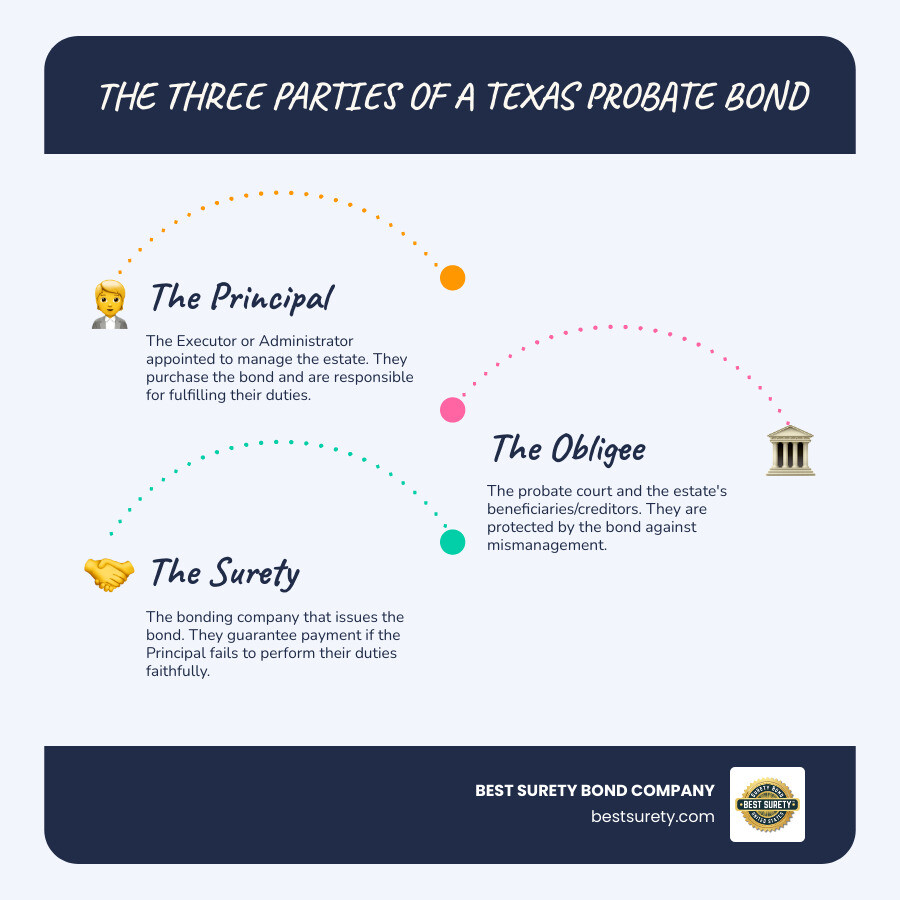
There are three parties involved: The personal representative is the “Principal.” The probate court, beneficiaries, and creditors are the “Obligee”—the protected parties. The surety company is the “Surety,” providing a financial guarantee to the court. If the Principal causes financial harm to the estate, the Surety pays the Obligee up to the bond amount. Crucially, this is not insurance for the personal representative. If the surety pays a claim, the Principal must reimburse the surety. The bond guarantees faithful performance.
How a Probate Bond Protects Beneficiaries and Creditors
Texas courts require probate bonds to provide a vital layer of financial protection. Without a bond, a negligent or dishonest executor could mismanage assets, commit fraud, or fail to pay debts, leaving beneficiaries and creditors with no way to recover their losses.
A probate bond safeguards everyone by:
- Preventing Mismanagement and Fraud: The bond is a powerful deterrent, encouraging the personal representative to act ethically and fulfill their fiduciary duty. It provides a clear path for heirs to recover losses and protects their assets.
- Ensuring Debt Payment: Creditors are assured that legitimate estate debts will be paid before assets are distributed. If not, creditors can file a claim against the bond.
- Providing Financial Recourse: In cases of misconduct, the bond offers a direct financial remedy for affected parties, giving heirs peace of mind that their beneficiary rights and inheritance are protected under the Texas Estates Code.
The Difference Between an Executor Bond and an Administrator Bond
While the terms are often used interchangeably, the key difference between an executor bond and an administrator bond in Texas depends on whether the deceased left a valid will.
| Feature | Executor Bond | Administrator Bond |
|---|---|---|
| Will Present? | Yes, the deceased left a valid will. | No, the deceased died “intestate” (without a will). |
| Appointed By | Named in the deceased’s will. | Appointed by the probate court. |
| Role | Manages the estate according to the will’s instructions. | Manages the estate according to Texas intestacy laws. |
| Bond Requirement | May be waived by the will (though court can override). | Almost always required, as there’s no will to waive it. |
| Alternative Names | Fiduciary bond, probate bond, personal representative bond. | Fiduciary bond, probate bond, personal representative bond. |
An executor is named in a will, while a court appoints an administrator when there is no will (an intestate estate). Sometimes, a “trustee bond” is also needed for a trust established in the will. Regardless of the title, the bond’s purpose is to protect the estate and its stakeholders.
When is a Bond Required for Probate in Texas?
Knowing when a probate bond in Texas is required can save you time and money. While the rules can seem complex, we’ll walk you through the key scenarios so you know what to expect.
The General Rule: Dependent Administration
Most Texas probate cases require a bond by default under what’s called “dependent administration.” This means the personal representative needs court approval for major decisions, such as selling property or distributing assets. In dependent administration, the court closely supervises the process but still requires the extra protection a bond provides. This ensures that even with oversight, creditors’ claims will be honored and mistakes can be rectified.
The Texas Estates Code defaults to protecting unsecured creditors and beneficiaries through bonding. For legal specifics, Chapter 305 of the Texas Estates Code outlines how personal representatives must qualify.
Common Exceptions to the Bond Requirement
Fortunately, there are several situations where a bond may be avoided:
- The will specifically waives the bond requirement. This is the most common exception, used when the deceased trusted their chosen executor.
- A corporate fiduciary, like a bank or trust company, is appointed. These institutions are heavily regulated and considered inherently trustworthy.
- All adult heirs agree in writing to waive the bond. This is common in intestate cases (no will) but requires unanimous agreement, which can be challenging.
When the Court Can Override a Waiver
Even with a waiver, a Texas judge can still require a bond to protect the parties involved. A court may order a bond if:
- A complaint of mismanagement is filed. If an executor is slow to pay debts or beneficiaries suspect wasted assets, a bond provides a safety net.
- Creditors’ interests need protection. If there are significant unpaid debts and creditors have not waived their right to bond protection, a judge will likely require one.
Local court practices can also vary. For example, the Harris County Probate Court has specific local rules. The bottom line is that even if you believe you are exempt, it’s wise to be prepared. We can get you approved quickly and affordably, ensuring you’re ready for any court decision.
Understanding the Cost and Amount of Probate Bonds Texas
When appointed to manage an estate, a common question is, “How much will this cost?” The cost of a probate bond in Texas is not a fixed fee but a premium calculated from several factors, mainly the court-set bond amount. We’ll break it down for you.
How the Probate Bond Amount is Determined
The probate court judge determines the bond amount using a specific calculation designed to fully protect the estate. According to the Texas Estates Code, the bond amount typically covers:
- The estimated value of the estate’s personal property (bank accounts, investments, vehicles, etc.).
- All estimated administrative expenses (legal fees, court costs, appraiser fees).
- Any anticipated revenue the estate might earn over the next 12 months (interest, dividends, rent).
The value of real estate is generally not included unless the personal representative is given the power to sell it. If a sale is planned, the court will likely adjust the bond amount to cover the proceeds.
For example, if an estate has $100,000 in personal property, $10,000 in expected expenses, and $5,000 in anticipated income, the judge might set the bond at $115,000 to ensure adequate protection.
Factors Influencing the Cost of a Texas Probate Bond
Once the court sets the bond amount, the surety company calculates the premium you’ll pay. This annual fee is the cost for the financial guarantee. Factors influencing the premium for your probate bond in Texas include:
- The Bond Premium: This is a small percentage of the bond amount, typically 0.5% to 1.5%. For a $100,000 bond, you might expect to pay between $400 and $600. For a $500,000 bond, the cost could be around $1,610.
- Your Credit History: An excellent credit score usually qualifies for the lowest rates. We work with all credit situations, though a lower score might result in a higher premium.
- Estate Complexity: A more complex estate (e.g., diverse assets, family disagreements) may be seen as higher risk, potentially increasing the premium.
- Attorney Involvement: Having an attorney can make the application appear less risky, especially for large or complex estates.
- Your Financial Stability: We consider your overall financial picture to assess risk.
At BEST SURETY BOND COMPANY, we are dedicated to offering the most competitive, low-cost surety bonds and guarantee the best rates in Texas.
Who Pays for the Probate Bond?
A common question is who pays for the bond. While the personal representative pays the premium for the probate bond in Texas initially, the good news is that it’s a legitimate estate expense.
This means you can seek reimbursement from the estate funds for the bond premium. It’s treated as an administrative expense, similar to attorney or court fees. Since bonds must be renewed annually until the estate is closed, these annual renewal premiums are also reimbursable. This ensures you are not personally burdened with the cost, allowing you to manage the estate with peace of mind.
The Process: How to Get a Probate Bond in Texas
Obtaining a probate bond in Texas can be a straightforward process with the right partner. We specialize in making it easy with fast approvals and same-day issuance. Whether you’re in Houston, Dallas, or elsewhere in Texas, we’re here to guide you.

Step-by-Step Guide to Obtaining Your Bond
Here is our simple, efficient, step-by-step guide to securing your Texas probate bond:
- Obtain the Court Order: This document from the Texas probate court formally appoints you and specifies the required bond amount, estate name, and case number.
- Complete Your Application: Use our simple one-page online application to buy a surety bond online. Provide basic information about yourself, the estate, and your court order.
- Undergo Underwriting: For most probate bonds in Texas, this is a fast process, often just a quick, soft credit check.
- Pay the Premium: After approval, you’ll receive a clear quote for our low-cost surety bonds. Pay the premium securely online to get the best rates in Texas.
- File the Bond: We issue your official bond document, which you then file with the appropriate Texas probate court clerk.
As Houston’s trusted surety provider, we support all Texas counties, including Dallas, San Antonio, and Austin, ensuring a smooth process with fast surety bond approval.
What to Expect During the Underwriting Process
Underwriting for a probate bond in Texas can sound complex, but our process is designed to be quick and painless. We know you have enough to deal with and that delays are not an option.
Our underwriters perform a quick risk assessment, which for most probate bonds is a soft credit check that won’t impact your score. We’re looking for general financial responsibility, and it’s often possible to get bonded even with less-than-perfect credit. We also briefly review your court documents to ensure accuracy. Our streamlined process often provides a personalized quote within the hour, with many applicants receiving instant online approval.
You can submit an online application now to experience our fast and easy process.
Filing the Bond with the Texas Court
Once your probate bond in Texas is issued, the final step is filing it with the court. You must file the original, signed bond document with the county clerk for the probate court handling the estate. This is critical to formalizing your appointment.
Texas law typically requires this to be filed within a 21-day deadline from when the court issues its order. Missing this deadline can cause complications or even removal as the personal representative.
After the judge approves your filed bond, the court will issue “Letters Testamentary” (with a will) or “Letters of Administration” (no will). These documents are your legal authority to manage the estate’s assets.
Frequently Asked Questions about Texas Probate Bonds
Navigating probate brings up many questions about probate bonds in Texas. We’ve gathered the most common ones to provide clear, simple answers and make your journey as straightforward as possible.
How long do I need to maintain a probate bond in Texas?
You must maintain your probate bond in Texas until the court officially closes the estate. This happens only after all assets are distributed, all debts are paid, and the court has formally released you from your duties as personal representative.
Since settling an estate can take a year or longer, you will likely pay annual renewal premiums. This commitment protects the estate’s integrity throughout the administration, and we make these renewals simple and stress-free.
Can I get a probate bond in Texas with bad credit?
Yes, it’s often possible to get a probate bond with bad credit. While a good credit score helps secure a lower premium, past credit challenges don’t have to be a barrier. We work with programs designed to help individuals in these situations secure the probate bond in Texas they need.
The surety company might require more information or charge a slightly higher premium, but we are dedicated to finding a solution. Don’t hesitate to request a personalized quote.
Does the probate bond cover the value of real estate?
Initially, the amount for a probate bond in Texas is based on the estate’s personal property (cash, accounts, vehicles) plus anticipated income and expenses. The value of real estate (like a house or land) is generally not included.
However, if the personal representative is granted the power to sell real estate, the court will often require the bond amount to be increased. This ensures the bond covers the sale proceeds, which become liquid assets that must be protected.
Your Trusted Partner for Texas Probate Bonds
Dealing with the loss of a loved one is stressful enough without complex bonding requirements. At BEST SURETY BOND COMPANY, our mission is to simplify the process for probate bonds in Texas, letting you focus on what matters most. We know court deadlines are critical, which is why our process is built for fast approvals and same-day issuance.
Whether you’re in Houston, Dallas, or anywhere else in Texas, our licensed agents are ready to help you get bonded quickly and affordably. We offer low-cost surety bonds with the best rates guaranteed. Our streamlined online process lets you get a quote, apply, and receive your bond without the usual runaround. Having bonded over 10,000 clients, we combine local Texas expertise with digital convenience.
Navigating Texas probate can be overwhelming, but you’re not alone. Our team understands Texas court requirements and will guide you through every step, from determining if a bond is needed to filing it correctly.
Key takeaways: probate bonds in Texas protect all parties, are often required by law, and don’t have to be complicated or expensive. Our simplified process and Texas expertise provide peace of mind that your bond is handled correctly.
Get Your Free Probate Bond Quote Today and let us help you fulfill your fiduciary duties with the speed and affordability you deserve.
