

Why Getting Bonded in Texas is Essential for Your Business
If you need to Get bonded Texas, you’re likely facing a licensing requirement, court mandate, or project specification that requires a surety bond. Here’s the quick breakdown:
Quick Steps to Get Bonded in Texas:
- Determine your bond type – Contact the requiring agency or check your paperwork
- Get a quote – Apply online or call a licensed surety agent
- Complete the application – Provide business/personal information
- Pay the premium – Usually 1-10% of the bond amount
- Receive your bond – Digital delivery within 24 hours for most bonds
- File with the obligee – Submit to the agency that requires it
Whether you need a contractor license bond in Houston, a bonded title for your vehicle, or a notary bond for your business, Texas requires surety bonds for hundreds of different purposes. These bonds protect consumers and government entities while allowing you to operate legally.
“The process of getting a Surety Bond in Texas has never been easier,” according to industry research, with most bonds now available for instant online purchase starting at just $100.
Common Texas Bond Types:
- Bonded Title Bonds – For vehicles without clear titles (1.5x vehicle value)
- Contractor License Bonds – Required by many Texas cities ($1,000-$25,000)
- Notary Public Bonds – State requirement ($10,000 for 4 years, costs $50)
- Motor Vehicle Dealer Bonds – For auto dealerships ($50,000)
- Business Service Bonds – For in-home services (starting at $125)
I’m Haiko de Poel, and throughout my two decades helping businesses steer complex regulatory requirements across multiple industries, I’ve seen how the right guidance can transform the process to Get bonded Texas from confusing to straightforward. My experience with fintech, legal services, and franchise development has given me deep insight into surety bond requirements and how they impact business operations.
What is a Surety Bond and Why Do You Need One in Texas?
When you need to Get bonded Texas, you’re essentially purchasing a financial guarantee that you’ll fulfill specific obligations according to agreed terms. Think of a surety bond as a safety net that protects others while allowing you to conduct business, obtain licenses, or handle legal matters in the Lone Star State.
Unlike insurance that protects you from unexpected losses, a surety bond protects others from your potential failure to meet obligations. This distinction is crucial because it explains why so many Texas businesses, contractors, and individuals find themselves needing bonds for everything from business licenses to contractor bonds to vehicle titles.
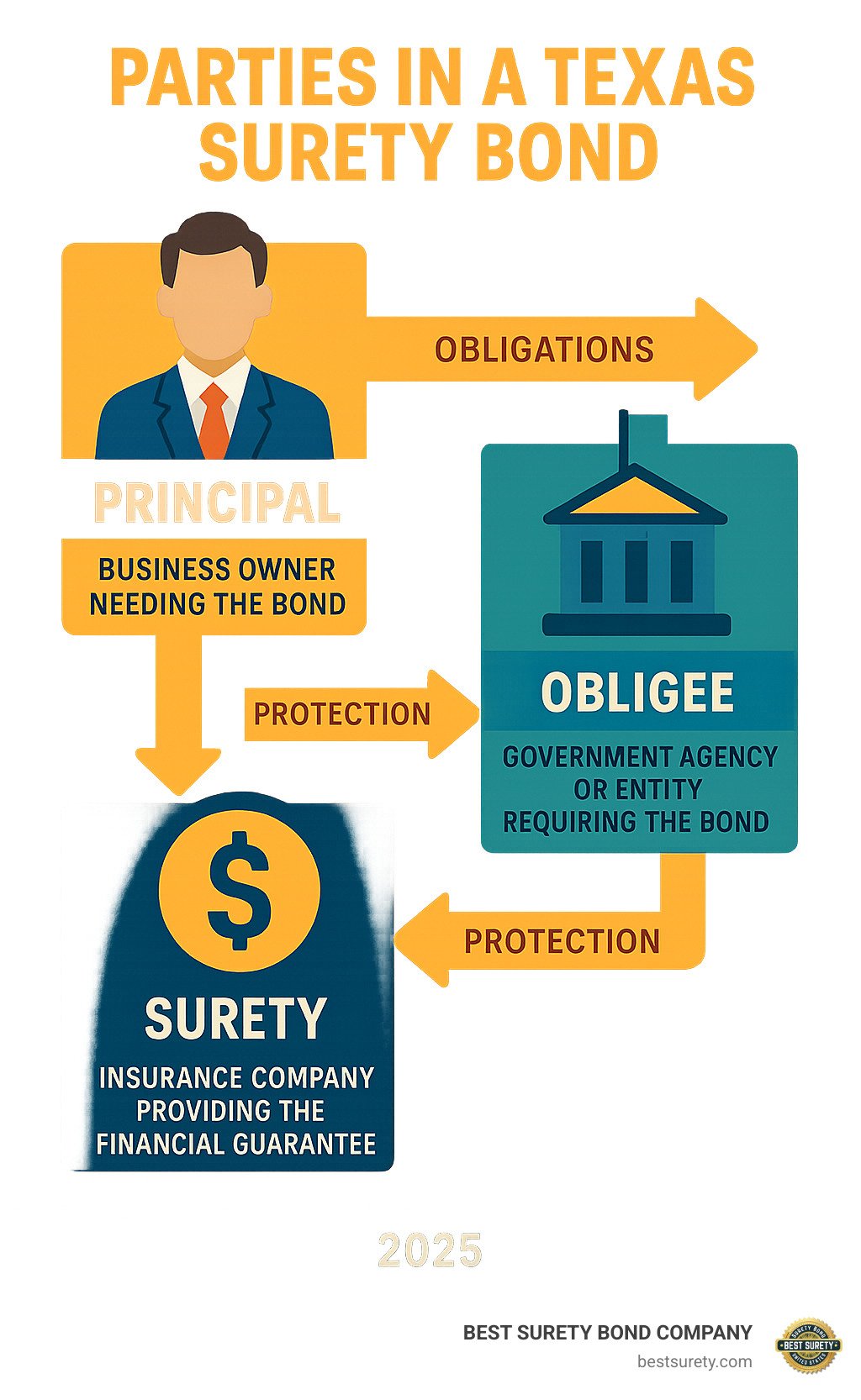
The magic of surety bonds lies in their three-party structure. You (the principal) are the person or business that needs the bond. The obligee is whoever requires the bond – often a Texas state agency, city government, or court. And the surety (that’s where we come in!) is the company that provides the financial backing, guaranteeing your performance.
Here’s what makes this arrangement unique: if someone files a valid claim against your bond, the surety company pays the claimant first, then comes to you for reimbursement. It’s essentially a line of credit that ensures obligations get met, even if you can’t meet them yourself.
The surety vs. insurance difference becomes clear when you consider the beneficiary. Insurance protects you from losses, while surety bonds protect others from your potential non-performance. Both are essential, but they serve completely different purposes in your business toolkit.
Who Requires a Surety Bond?
Getting bonded in Texas isn’t optional for many businesses and situations – it’s the law. Texas state agencies lead the pack in bond requirements, with the Texas Department of Motor Vehicles requiring bonded titles for vehicles without clear ownership documentation, and the Texas Secretary of State mandating bonds for notaries public.
Municipalities and county governments across Texas have their own bonding requirements, particularly for contractors. Since Texas doesn’t issue statewide contractor licenses, cities like Houston, Dallas, and San Antonio each set their own rules. This means contractors often need different bonds depending on where they work.
Federal requirements also come into play, especially for construction projects on government property. The Miller Act requires performance and payment bonds for federal construction work, ensuring projects get completed and workers get paid.
Even private contracts can trigger bond requirements. The Texas Property Code requires payment bonds for certain private construction projects, protecting subcontractors and suppliers from non-payment issues.
When you’re unsure about bonding requirements, the best approach is contacting the entity that’s asking for the bond. They’ll provide specific bond forms and requirements, and we’ll help you steer the process from there.
Common Types of Bonds in Texas
Texas’s diverse economy means a wide variety of bond requirements across industries and situations. The Certificate of Title Bond is probably the most common individual need – required when you own a vehicle but lack clear title documentation due to loss, theft, or improper transfer. These bonds cost 1.5 times the vehicle’s value and remain active for three years.
For businesses, Motor Vehicle Dealer Bonds are essential if you’re buying, selling, or exchanging vehicles commercially. Texas typically requires a $50,000 bond, ensuring dealers operate ethically and comply with state regulations while protecting consumers from fraudulent practices.
Contractor License Bonds vary dramatically across Texas cities and counties. Bond amounts range from $1,000 to $150,000, though many cost as little as $100 annually. These bonds guarantee compliance with local building codes and licensing requirements, making them essential for construction professionals.
Notary Public Bonds are straightforward – Texas law requires all notaries to maintain a $10,000 bond throughout their four-year commission. At around $50 total cost, it’s one of the most affordable professional bonds available.
Business Service Bonds protect clients when your employees work in their homes or businesses. Cleaning services, repair technicians, and similar businesses often need these bonds, with premiums typically starting around $125 for annual coverage.
Alcoholic Beverage Commission Bonds ensure compliance with state liquor laws for licensed establishments, while various court bonds and probate bonds handle legal situations involving estate management or litigation proceedings.
This variety shows why identifying your specific bond need is so important. Whether you’re trying to Get bonded Texas for your first business license or your hundredth project, we’ll help you find exactly what you need at the best possible rate.
How to Get a Bonded Title in Texas: A Step-by-Step Guide
One of the most common reasons people need to Get bonded Texas is for a vehicle they own but can’t properly title. Maybe you bought a car from someone who lost the title, inherited a vehicle without paperwork, or finded the title has errors that prevent legal transfer. Whatever the situation, a bonded title solves this problem by providing legal proof of ownership while protecting any previous owners or lienholders who might have legitimate claims.
The bonded title process might seem intimidating at first, but it’s actually quite straightforward when you know what to expect. Think of it as the state’s way of saying, “We’ll give you a title, but you need to back it up with a financial guarantee just in case someone else has a valid claim to this vehicle.”
Here’s exactly how to steer the Texas DMV process and get your bonded title quickly and efficiently.
Step 1: Determine Your Eligibility and Gather Documents
Before diving into paperwork, you need to make sure you qualify for a bonded title in Texas. The good news is that most people do, but there are specific requirements you must meet.
You’ll need to be a Texas resident or military personnel stationed in Texas, and most importantly, you must have physical possession of the vehicle. The vehicle also needs to be considered “complete” – meaning it has all essential components like a frame, body, and motor for cars, or a frame and motor for motorcycles.
Unfortunately, if your vehicle is considered junked, nonrepairable, stolen, or tied up in legal proceedings, you won’t be eligible for a bonded title. But for most situations involving lost, stolen, or defective titles, you’re good to go.
Now comes the document gathering phase, and this is where being thorough really pays off. You’ll need the Bonded Title Application or Tax Collector Hearing Statement of Fact (VTR-130-SOF), which is your formal request to the state. This form tells your story about how you came to own the vehicle and why you don’t have a clear title.
You’ll also need a Statement of Physical Inspection (VTR-270) that documents the vehicle’s physical characteristics, plus a copy of your current photo ID. But here’s the crucial part: gather every piece of evidence you have that proves you own this vehicle. This might include a bill of sale, canceled check, receipt, or any other documentation showing the purchase or transfer. The stronger your proof of ownership, the smoother your application will go.
If your vehicle was last titled outside Texas or has never been titled here, you’ll also need a VIN Verification (VTR-68-A) from a certified safety inspection station or auto theft investigator.
Step 2: Submit Your Application to the TxDMV
With your documents organized, it’s time to submit everything to the Texas Department of Motor Vehicles. You can mail your application to a TxDMV Regional Service Center, though some locations may accept in-person submissions if you prefer that route.
Don’t forget to include the $15 administrative fee – it’s required for all bonded title applications and gets your file into the review queue. Once the TxDMV receives your application, they’ll examine your documents and determine your vehicle’s value using their established methods.
The review process typically takes a few weeks, and you’ll know it’s complete when you receive your Notice of Determination for a Bonded Title (VTR-130-ND). This document is like your golden ticket – it confirms you’re approved to proceed and, most importantly, tells you exactly how much your surety bond needs to be.
Step 3: Get Your Vehicle Appraised and Purchase Your Bond
Your Notice of Determination will include the vehicle’s appraised value, which the TxDMV calculates using their Standard Presumptive Value (SPV) calculator or the NADA guide. For older vehicles (25+ years) valued under $4,000, the state typically sets the value at $4,000 for bonding purposes.
Here’s where the math gets simple: your bond amount will always equal 1.5 times your vehicle’s value. So if your car is worth $6,000, you’ll need a $9,000 bond. If it’s valued at $10,000, your bond amount will be $15,000.
But here’s the part that surprises most people – you don’t pay the full bond amount. Instead, you pay a small premium, typically 1% to 5% of the bond amount if you have good credit. That $9,000 bond might only cost you $90 to $450. Even with credit challenges, we can usually keep your premium reasonable, often in the 5% to 15% range.
The key timing detail here is that you must purchase your bond within one year of receiving your Notice of Determination. Miss this deadline, and you’ll start the entire process over from scratch. That’s why we make it easy to get your bond quickly – many of our Texas bonded title bonds are available for instant online purchase.
Step 4: Finalize Your Application at the County Tax Office
This final step is where everything comes together, but timing matters. You have just 30 days after purchasing your bond to complete this process at your county tax office.
You’ll need to bring your original surety bond (Form VTR-130-SB), your processed VTR-130-SOF, and the Notice of Determination from the TxDMV. You’ll also complete the Application for Texas Title (Form 130-U) and provide proof of insurance if you’re registering the vehicle at the same time.
Once the county tax office processes everything, you’ll receive your bonded title. The bond stays active for three years, acting as a safety net during this period. If someone comes forward with a legitimate ownership claim, the surety company investigates. If the claim is valid, they’ll pay the claimant up to the bond amount, and you’d be responsible for reimbursing the surety company.
But here’s the good news – after three years without any claims, the bond typically expires and your bonded title effectively becomes a regular, clear title. Most bonded titles never see a claim, making this process a reliable way to establish clear ownership of your vehicle.
The entire process from start to finish usually takes 6-8 weeks, but having an experienced surety bond company guide you through it makes all the difference in avoiding delays and complications.
Understanding the Cost and Process to Get Bonded Texas
When you’re ready to Get bonded Texas, the two questions we hear most often are “How much will this cost me?” and “How quickly can I get my bond?” I completely understand – you’ve got deadlines to meet and budgets to consider. Let me walk you through exactly what to expect so there are no surprises along the way.
The good news is that getting bonded in Texas has become remarkably straightforward and affordable. Whether you’re in Houston dealing with city contractor requirements or anywhere else in Texas needing a quick license bond, we’ve streamlined the entire process to get you bonded fast without breaking the bank.
How Much Does it Cost to Get Bonded in Texas?
Here’s something that catches many people off guard: the premium you pay is not the same as the bond amount. Think of it like car insurance – you might have $100,000 in coverage, but you’re not paying $100,000 for that policy. The same principle applies to surety bonds.
Your premium (what you actually pay) is typically just a small percentage of the total bond amount (the coverage required). So if you need a $10,000 bond, you might only pay $100 to $500 for it, depending on several key factors.
Your credit score plays the biggest role in determining your premium. If you have good credit, you’ll typically pay between 1% to 5% of the bond amount. For example, that $10,000 bond might cost you just $100 to $500 annually. Even with less-than-perfect credit, we work with multiple underwriters to find you competitive rates, though premiums might range from 5% to 10% of the bond amount.
The type of bond you need also affects pricing. A notary bond is considered low-risk and costs a standard $50 for four years in Texas. Business license bonds often start around $100 annually. Contractor bonds vary by city and bond amount but are generally very affordable for smaller amounts.
The bond amount itself influences your premium – larger bonds typically mean higher premiums because there’s more financial risk involved. However, the relationship isn’t always linear. A $25,000 bond doesn’t necessarily cost five times more than a $5,000 bond.
For complex commercial bonds or large contract work, we’ll also look at your business financials and professional experience. But for most standard Texas bonds – the ones needed for licenses, permits, and simple business operations – the process is much simpler.
We pride ourselves on offering some of the most competitive rates in Texas. Many of our bonds start as low as $100, and we work with a network of underwriters to ensure you get the best possible premium. The industry standard for surety bonds typically ranges between 1% and 10% of the bond amount, but we consistently help our clients secure rates on the lower end of that spectrum.
How Long Does it Take to Get Bonded in Texas?
Speed is where we really shine. I know you don’t have weeks to wait around for paperwork – you need to Get bonded Texas and move forward with your business.
For simple bonds like notary public bonds, many license and permit bonds, and standard business service bonds, we offer instant approval and same-day issuance. I’m talking about completing your application, paying your premium, and receiving your bond digitally within minutes. It’s that fast.
Our digital delivery system means no waiting for mail or making trips to pick up documents. Once approved, your bond is delivered electronically, ready to submit to whatever agency requires it.
Standard business bonds – think contractor license bonds for cities like Houston, Dallas, or San Antonio – typically process within 24 hours. We understand the local requirements in Texas counties and can often expedite processing because we know exactly what each jurisdiction needs.
More complex bonds, such as large contract bonds or those requiring extensive underwriting, naturally take longer. These might involve reviewing business financials, work history, and project details. Even so, we work diligently to expedite these applications. For smaller contracts ($100,000 or less), many of our underwriters offer “fast track” applications that can provide approval within just a few days.
The most complex bonds – large construction contracts or specialty commercial bonds – might take two to four weeks for full underwriting. But here’s the thing: we’ll give you a clear timeline upfront, and we stay in communication throughout the process.
Houston processing times and throughout Texas benefit from our local expertise. We understand Texas regulations, work with local underwriters, and have relationships that help speed up approvals. Whether you’re in Houston’s energy sector, Dallas construction, or San Antonio’s growing business community, our Texas focus means faster service for you.
The bottom line? Most people are surprised by how quickly and affordably they can get bonded in Texas. We’ve built our entire process around making it as smooth as possible, so you can focus on running your business instead of worrying about bond requirements.
Frequently Asked Questions about Texas Surety Bonds
What is the difference between a bonded title and a regular vehicle title?
When you Get bonded Texas for a vehicle title, you’re getting something quite different from a standard title. A bonded title comes with a surety bond attached that acts as a financial safety net, protecting anyone who might have a legitimate claim to your vehicle. Think of it as a three-year insurance policy that says, “If someone can prove they’re the real owner, they’ll be compensated.”
The bond stays active for three years in Texas. During this time, if a previous owner, lienholder, or anyone else comes forward with a valid ownership claim, the surety bond will pay them up to the bond amount. But here’s the good news: if no one makes a claim during those three years, your bonded title essentially transforms into a regular, clear title.
A regular vehicle title, on the other hand, provides clear, undisputed ownership right from the start. There’s no waiting period, no bond attached, and no question about who owns the vehicle. It’s the gold standard of vehicle ownership documents.
Can I get a Texas surety bond with bad credit?
Absolutely! Having less-than-perfect credit doesn’t disqualify you from getting bonded in Texas. We work with clients across the entire credit spectrum every day, and we’ve built relationships with multiple underwriters specifically to help people in various credit situations.
Here’s the reality: your credit score affects your premium, not your eligibility. While someone with excellent credit might pay 1% to 5% of the bond amount, those with challenging credit typically see premiums ranging from 5% to 15%. It’s higher, yes, but it’s still very manageable for most people.
Some bonds are considered so low-risk that they don’t even require a credit check. Many of our license and permit bonds fall into this category, making them accessible to virtually everyone who needs them.
Our team specializes in finding affordable options for all credit situations. We’ll work with you to find the most competitive rate possible, regardless of your credit history. After all, everyone deserves the chance to get their business licensed or their vehicle titled properly.
What happens if someone files a claim against my bond?
This is probably the question that keeps people up at night, but understanding the process can put your mind at ease. When someone files a claim against your bond, it triggers a thorough investigation by the surety company.
First, we investigate everything. Our claims team will examine the validity of the claim, review the bond terms, and determine whether you actually failed to meet your obligations. Not every claim that gets filed is legitimate, and we’re your first line of defense against frivolous or invalid claims.
If the claim is valid, the surety company will pay the claimant up to the bond amount. This immediate payment protects the obligee (like the state agency or the person making the claim) and fulfills the guarantee we made on your behalf.
Here’s the crucial part: you’re then required to reimburse the surety company for the full amount paid out, plus any legal fees or investigation costs. This is called indemnification, and it’s part of the agreement you sign when you get bonded. Think of it this way – the surety bond provides immediate financial backing, but you’re ultimately responsible for making things right.
The best approach is always to address any issues directly and promptly before they escalate to a bond claim. Most problems can be resolved through communication and good business practices, keeping everyone happy and your bond claim-free.
Conclusion: Get Your Texas Surety Bond Fast and Easy
Getting bonded in Texas doesn’t have to be complicated or time-consuming. Whether you’re trying to secure a bonded title for your vehicle, obtain a contractor license bond for your growing business in Houston, or need any other type of surety bond, the process can be surprisingly straightforward when you have the right partner.
Throughout this guide, we’ve walked you through everything you need to know about surety bonds in Texas. From understanding the three-party relationship between you, the obligee, and the surety company, to navigating the specific steps for getting a bonded title through the TxDMV, you now have the knowledge to move forward with confidence.
The key to success when you need to Get bonded Texas is working with a company that understands both the speed you need and the affordability you deserve. We’ve helped thousands of Texans secure their bonds quickly, often with same-day approval and digital delivery. Our fast approval process means you can get back to focusing on what matters most – running your business or getting your vehicle properly titled.
What sets us apart is our commitment to making surety bonds accessible to everyone. Whether you have perfect credit or have faced some financial challenges, we work with a wide network of underwriters to find you the best possible rates. Many of our bonds start at just $100, and with premiums typically ranging from just 1% to 10% of the bond amount, getting bonded is more affordable than most people expect.
From the busy streets of Houston to the growing communities across all Texas counties, we’re here to serve you with the expertise and personal attention you deserve. Our licensed agents understand Texas regulations inside and out, and we’re committed to providing not just fast service, but the right guidance to ensure you get exactly the bond you need.
Don’t let bond requirements slow down your progress. Whether you’re a contractor ready to bid on your next project, a business owner applying for a license, or someone who simply needs to title their vehicle, we make the process simple and stress-free.
Get started with your Texas surety bond today and experience the difference that expert guidance and fast, affordable service can make!
