

What is a Construction Bond and Why is it Essential for Your Texas Project?
Construction bonds are three-party financial agreements that guarantee a contractor will fulfill their contractual obligations. For any major construction project in Texas, they are a critical safety net.
Quick Answer:
- What: Surety bonds that protect project owners from financial loss if a contractor defaults.
- Who: Involves the contractor (principal), project owner (obligee), and the surety company.
- Why: Required by law on most Texas public projects over $100,000.
- Types: Bid, performance, and payment bonds are the most common.
- Cost: Typically 0.5% to 3% of the total contract value.
When you’re building a new school in Houston or a highway near Dallas, you need a guarantee that the work gets done right and everyone gets paid. According to industry research, an unbonded contractor is ten times more likely to fail than its bonded counterpart. This is why Texas mandates these bonds on most public construction projects.
A bond is a three-way promise: the contractor commits to completing the work, the surety company promises to step in if they don’t, and the project owner is protected from financial loss. More than just a requirement, having a bond builds trust and credibility in a competitive market.
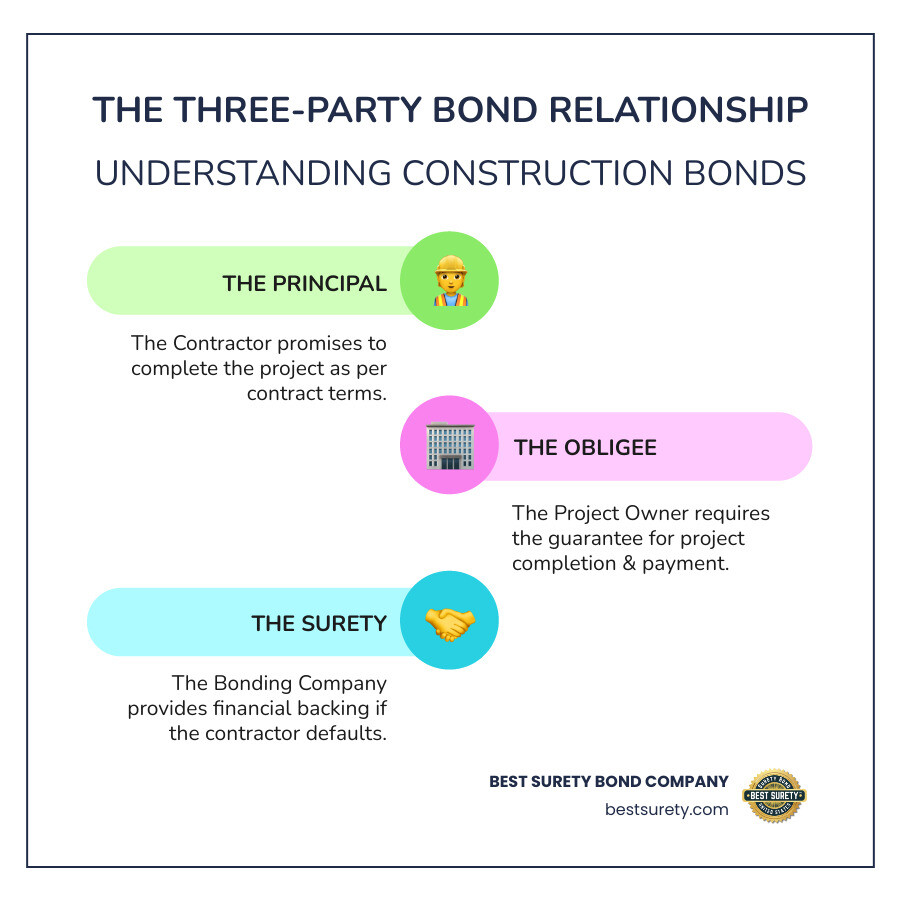
Construction bonds vocabulary:
The Purpose of a Construction Bond
A construction bond is a financial guarantee that protects project owners from the fallout of contractor failure. Backed by a surety company, it ensures the project is completed to spec and all bills are paid. Key functions include:
- Contractor Performance: Guarantees the contractor will adhere to the contract’s terms and quality standards.
- Project Completion: If a contractor defaults, the surety steps in to find a new contractor or provide funds to finish the job, preventing a work stoppage.
- Financial Security: Protects the project owner from financial loss due to delays, poor work, or abandonment.
- Subcontractor and Supplier Payment: Ensures laborers and suppliers get paid, preventing costly mechanics’ liens against the property.
- Risk Management for Contractors: Obtaining a bond proves a contractor has been pre-qualified by a surety, signaling financial stability and opening the door to larger projects. For more on this, see these risk management for contractors strategies.
Who are the Parties Involved?
Every construction bond involves a three-party commitment:
-
The Principal (Contractor): The contractor who buys the bond and is obligated to perform the work as specified in the contract. The principal is ultimately liable to the surety for any claims paid out under an indemnity agreement.
-
The Obligee (Project Owner): The entity requiring the bond, such as a government agency or private developer. The obligee is the beneficiary of the bond’s protection and files a claim if the principal defaults.
-
The Surety (Bonding Company): The company that issues the bond and guarantees the principal’s performance. The surety underwrites the contractor’s financial health and experience. If a valid claim is made, the surety fulfills the obligation and then seeks reimbursement from the principal.
The Key Players and Process: How Construction Bonds Work in Texas

Getting a construction bond in Texas is a straightforward process that helps you win more work, whether it’s a highway project in Dallas or a school in Houston. The surety company acts as your financial advocate, telling project owners they are willing to back your work.
The Step-by-Step Bonding Process
The path to a construction bond begins with an application, followed by an underwriting review based on the Three C’s—the foundation for your approval and rate.
-
Capital: This is your financial strength. Underwriters review your balance sheets, cash flow, and working capital to ensure you can handle the project’s financial demands. Strong financials lead to better rates.
-
Capacity: This assesses your ability to perform the work. We look at your track record, equipment, and experience with similar projects. A history of on-time, on-budget completion is key.
-
Character: This is your business reputation. Your credit score, payment history, and industry reputation all demonstrate your reliability. A strong character can accelerate your application.
The process is simple: submit your application with financial statements and project details. Our underwriters review your file, often providing a decision within 24 hours for qualified contractors. Upon approval, you pay the premium and the bond is issued.
Requirements for Obtaining Construction Bonds
Being prepared is the key to a fast and easy bonding process. While requirements vary by project, you will generally need:
- Financial Statements: Current and professionally prepared balance sheets, income statements, and cash flow statements. CPA-prepared documents are often required for larger bonds.
- Work History: A portfolio of completed projects, including their value and outcomes. This serves as your resume to the surety.
- Project Details: The scope, timeline, and contract for the specific job you need to bond.
- Company Organization Documents: Your business structure (LLC, corporation, etc.), ownership details, and time in business.
- Credit Score: Both personal and business credit scores are heavily weighted, impacting rates and approval speed. Good credit means faster approvals and lower costs.
We guide you through the specific documentation needed for your situation, ensuring a smooth process. For a detailed checklist, see our guide on More info about construction bond requirements.
A Contractor’s Guide to the Types of Construction Bonds in Texas

Understanding the different types of construction bonds is essential for Texas contractors. These bonds are your toolkit for protecting projects and building client trust. Most fall under Contract Bonds, which cover a project from the bidding phase to completion. As specialists in Surety Bonds for Contractors, we know the right bond combination is key to winning major projects in Houston, Dallas, and across the state.
Bid Bonds
A bid bond is your promise to enter into a contract at your bid price if you win. It shows the project owner you are a serious bidder and protects them if you back out, covering the cost difference to the next lowest bidder. A key advantage is that bid bonds are typically free, with the premium rolled into the final performance and payment bonds. This allows you to bid on multiple projects without upfront costs. Learn more at our More info about bid bonds page.
Performance Bonds
Once you win the contract, a performance bond guarantees project completion according to the contract’s terms, quality standards, and timeline. It protects the owner from financial loss due to contractor default, delays, or substandard work. If a valid claim is made, the surety will arrange for project completion or compensate the owner, giving them the confidence to award you large contracts. Explore the details in our More info about performance bonds section.
Payment Bonds
A payment bond guarantees that all subcontractors, suppliers, and laborers on your project will be paid. This protects everyone in the supply chain and, crucially for the owner, prevents mechanics’ liens from being filed against their property. In Texas, with its complex lien laws, this protection is invaluable for keeping projects on track and free of legal disputes. Find out more on our More info about payment bonds page.
Key Differences: Performance vs. Payment Bonds
Though often issued together, these bonds protect different parties. Performance bonds protect the project owner, while payment bonds protect those who supply labor and materials.
| Feature | Performance Bond | Payment Bond |
|---|---|---|
| Who is Protected | The Project Owner (Obligee) | Subcontractors, Suppliers, Laborers |
| What is Guaranteed | Project completion per contract terms | Payment for labor and materials |
| When a Claim is Made | Contractor defaults on work or quality | Contractor fails to pay for labor/materials |
Together, they provide comprehensive protection, making large-scale construction possible.
Other Common Construction Bonds Offered by BEST SURETY BOND COMPANY
We also offer specialized bonds for unique Texas projects:
- Maintenance Bonds: Guarantee your work against defects for a set period (typically 1-2 years) after project completion.
- Subdivision Bonds: Required by municipalities, these guarantee that a developer will complete public improvements like roads, sewers, and utilities.
- Supply Bonds: Guarantee that suppliers will deliver materials and equipment as specified in the contract.
- Lien Bonds: Used to “bond off” a mechanics’ lien, transferring the claim from the property to the bond so the project can proceed while the dispute is resolved.
Whether you need a standard bond or a specialized one like a CCDC Maintenance Bond, we have the Texas expertise to support your project.
Navigating Requirements, Costs, and Claims in Texas
For any Texas contractor, from Houston to Austin, success with construction bonds comes down to three things: knowing when you need them, what they cost, and how to handle a claim.
Bonding Requirements for Public vs. Private Projects in Texas
Bonding rules in Texas vary by project type:
-
Public Projects: The Federal Miller Act mandates performance and payment bonds for federal projects over $100,000. Texas has its own “Little Miller Act” requiring bonds for state and municipal projects, such as a new fire station in Dallas or a highway in San Antonio. These laws protect taxpayer funds.
-
Private Projects: While there is no legal requirement for bonds on private construction, most large-scale private owners demand them. They want the same financial protection as public entities. Being bondable signals your stability and opens doors to more lucrative private contracts.
For more on how bonding laws work, this Guide to Bonding Requirements Under Construction Reform offers valuable insights.
How are Construction Bonds Priced in Texas?
Construction bond premiums typically cost 0.5% to 3% of the contract value. On a $1 million project, this could be $5,000 to $30,000. Your specific rate is determined by a risk assessment based on:
- Your Financials & Experience: The “Three C’s” (Capital, Capacity, Character) are key. Strong financials, a proven track record, and good credit result in lower rates, often in the 0.5% to 1% range.
- Project Size & Complexity: Larger or more complex projects may have higher rates due to increased risk.
- Credit Score: A strong credit score can significantly lower your premium and increase your bonding capacity.
Bid bonds are typically free. You only pay the premium for performance and payment bonds after you win the job. We work to secure the best rates for Texas contractors. For a detailed breakdown, see our page on More info about construction bond costs.
The Bond Claim Process and Its Implications
Understanding the claim process is critical. A claim begins when an obligee (project owner) or claimant (subcontractor) notifies the surety of a contractor’s default, such as failure to complete work or pay bills.
- Investigation: The surety launches a thorough investigation to validate the claim, reviewing contracts and interviewing all parties. This protects contractors from frivolous claims.
- Resolution: If the claim is valid, the surety acts to resolve the issue. This may involve hiring another contractor to finish the job, providing financial assistance, or paying the obligee for damages.
- Indemnity: This is the most important part for the contractor. Under the indemnity agreement, you are required to reimburse the surety for all costs associated with the claim, including legal fees. Unlike insurance, a bond protects the owner, but the contractor remains financially liable.
A claim can severely damage your ability to get bonded in the future, limiting your access to public and large private projects in Texas. The best strategy is open communication with your surety to resolve issues before they become a formal claim.
Frequently Asked Questions about Construction Bonds in Texas
Here are answers to the most common questions we hear from contractors in Houston, Dallas, and across Texas.
How quickly can I get a construction bond in Texas?
Very quickly. We specialize in fast approvals and offer same-day issuance for qualified contractors. Our streamlined online application allows you to get an instant quote and begin the process immediately. With your required documents ready (financials, project details), we can often issue bonds in hours. Our Houston-based team understands Texas construction timelines and is built for speed.
What is the difference between a surety bond and insurance?
This is a common point of confusion. While both involve premiums, their purpose and structure are fundamentally different.
- Agreement Type: Insurance is a two-party agreement (you and the insurer). A bond is a three-party agreement (you, the project owner, and the surety).
- Who is Protected: Insurance protects you (the insured). A bond protects the project owner (the obligee).
- Claims: With insurance, the insurer pays for your covered loss. With a bond, if the surety pays a claim due to your default, you must reimburse the surety under an indemnity agreement.
- Loss Expectation: Insurers expect and price for losses. Sureties operate on a zero-loss basis by pre-qualifying contractors.
Are bid bonds really free?
Yes, bid bonds are typically issued with no upfront cost. This is standard industry practice in Texas. You are not charged a premium to submit a bid. The cost is rolled into the premium for the performance and payment bonds, which you only pay for if you win the contract. This allows you to bid on multiple projects without incurring upfront expenses.
Get Your Texas Construction Bond Today
Construction bonds are your gateway to bigger projects, stronger client trust, and sustainable growth in the competitive Texas market. By securing a bond, you demonstrate to project owners in Houston, Dallas, and beyond that you are a credible and reliable contractor.
Bonding provides the peace of mind every project owner wants—assurance that the job will be done on time, on budget, and that all workers will be paid. This contractor credibility is why bonded contractors win more public and private projects.
At BEST SURETY BOND COMPANY, we make bonding simple. Our entire process is built for fast approvals and low rates, backed by the personal service Texas contractors deserve. Our Houston-based team has deep Texas expertise, navigating the requirements of municipalities and developers across the state.
When you need a bond, you need it fast. Our streamlined process delivers the construction bonds you need without delays, often with same-day approval. We have the fastest turnaround times in the industry.
Don’t let a lack of bonding hold you back. The Texas construction market is booming. Let us provide the bonding you need to capture the best opportunities and take your business to the next level.
