Understanding Dallas Probate Bond Requirements
When someone passes away in Dallas County, obtaining a Dallas probate bond is often required before you can legally manage their estate. This specialized surety bond protects beneficiaries and creditors from potential mismanagement of estate assets by the appointed executor or administrator.
Quick Dallas Probate Bond Facts:
- Required by: Dallas County Probate Courts for most estate administrations
- Purpose: Protects estate beneficiaries from executor misconduct or negligence
- Cost: Typically 0.5% to 3% of the bond amount annually (e.g., $100-$300 for a $10,000 bond)
- Processing time: Can be approved same day with proper documentation
- Bond amount: Set by the court based on estate value
- Duration: Remains active until estate is closed and court releases the bond
The Dallas probate process can be overwhelming. Understanding bond requirements early helps avoid delays in settling the estate. As one Dallas probate attorney noted, “The bond is essentially insurance that the person handling the estate will do their job properly and honestly.”
I’m Haiko de Poel. Through my work with financial and legal tech companies, I’ve helped streamline complex processes like Dallas probate bond applications for thousands of clients. My experience gives me deep insight into how surety bonds protect families during difficult estate proceedings.
What is a Dallas Probate Bond and Why is it Necessary?
When a loved one passes away in Dallas County, the probate court often requires a Dallas probate bond before you can manage their estate. This isn’t just red tape; it’s a crucial protection that ensures the deceased’s final wishes are honored and their beneficiaries are safeguarded.
A Dallas probate bond is a financial safety net. As an executor or administrator, you handle money, property, and assets belonging to others. The bond guarantees that if something goes wrong—through honest mistakes or misconduct—there’s a way to make things right.
The Dallas County Probate Courts require these bonds particularly during dependent administration cases, where the court maintains close oversight. Under the Texas Estates Code, the court must protect heirs and beneficiaries, and requiring a bond is one of its most effective tools.
This protection is necessary. For example, if an administrator fails to pay debts, mishandles distributions, or misuses funds, the bond ensures beneficiaries can recover their losses. It also covers situations like newly finded assets or poor financial decisions that damage the estate’s value.
Even if a will tries to waive the bond requirement, Dallas courts typically still require one during dependent administration. The court’s primary concern is protection, not convenience.
Surety Bond vs. Insurance Explained
Many people assume a Dallas probate bond works like insurance, but there’s a crucial difference that directly affects you as the bonded party.
| Feature | Surety Bond | Insurance Policy |
|---|---|---|
| Purpose | Guarantees you’ll fulfill your duties as executor/administrator | Protects you from financial losses due to covered risks |
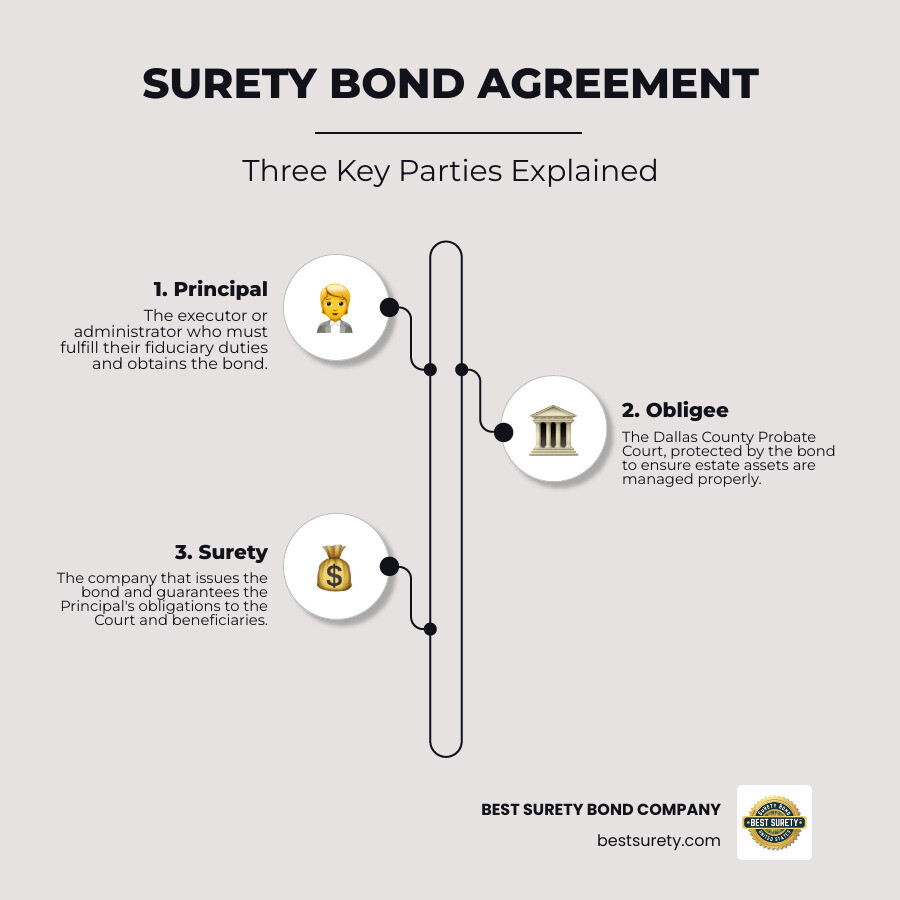
| Parties Involved | Three: You (Principal), Dallas County Court (Obligee), Bond Company (Surety) | Two: You (Policyholder) and Insurance Company |
| Who Pays Claims | Bond company pays initially, then seeks full reimbursement from you | Insurance company pays and doesn’t seek reimbursement |
| Risk Expectation | Claims aren’t expected – you’re responsible for proper performance | Claims are expected and built into pricing |
| Your Financial Responsibility | You must repay any claims paid by the bond company | You’re not responsible for repaying covered claims |
The key difference? A surety bond is essentially a line of credit, not insurance. If a valid claim is filed against your bond because you mishandled estate assets, the surety company will pay the Dallas County court or affected parties. But then they’ll seek full reimbursement from you, plus interest and fees.
This structure benefits an honest executor. Knowing they must collect from you if there’s a problem, the bond company is incentivized to help you succeed, often providing guidance to help you avoid mistakes.
Consequences of Not Having a Required Bond
Attempting to handle a Dallas estate without a required Dallas probate bond creates immediate and serious problems.
The court simply won’t appoint you as executor or administrator without the proper bond. This means you can’t access bank accounts, sell property, pay bills, or distribute assets—you’re locked out of managing the estate.
If your bond lapses or is cancelled while you’re serving, the court can remove you. This forces the family to start over with a new administrator, causing significant delays and legal costs.
Estate settlement delays are inevitable without proper bonding. Creditors aren’t paid, beneficiaries can’t receive inheritances, and property may lose value. These delays often create family tensions and additional legal costs.
The court may also impose legal penalties for non-compliance, including fines. More importantly, you could face personal liability for any damages caused by the delay.
Estate assets remain frozen until you’re properly bonded. This means families can’t access needed funds, and bills pile up unpaid, accruing interest and penalties.
At BEST SURETY BOND COMPANY, we understand these situations are time-sensitive. That’s why we’ve streamlined our application process for fast, same-day approvals so you can fulfill your fiduciary responsibilities without delay.
Navigating the Dallas Probate Bond Process: Requirements and Costs
Getting a Dallas probate bond shouldn’t add stress to a difficult time. At BEST SURETY BOND COMPANY, we’ve streamlined the process for Dallas families and their attorneys.
The good news? Our application process is designed for speed and simplicity. You can get an online quote in minutes, and with the right documentation, we often provide same-day approval. We know probate matters can’t wait, so our systems are built to move at the pace you need.
The process is simple: complete our online application with basic personal and estate details, and we’ll handle the underwriting. Our team guides you through each step to determine your bond premium.

Requirements for a Dallas Probate Bond
To apply for a Dallas probate bond, we’ll need some information to ensure a smooth process with the Dallas County Probate Court. We’ll walk you through exactly what’s needed.
Good credit is the most important factor. While we work with clients in various credit situations, a solid credit history—free from recent bankruptcies or foreclosures—usually qualifies for our best rates and fastest approvals. Your financial stability shows us (and the court) that you’re reliable.
Attorney representation is essential for larger estates, particularly for bonds over $25,000 to $50,000. Most surety companies, including us, require you to work with a qualified probate attorney. Legal counsel helps with bond approval and significantly reduces your risk during estate administration.
We’ll also need detailed estate information to structure your bond. This includes the estimated value of all assets (property, bank accounts, investments), known debts, and beneficiary information. The Dallas County Probate Court uses these details to set the required bond coverage.
A copy of your court order is essential. This document provides the precise bond amount, confirms your appointment, and gives the case number and timeline. We cannot issue a bond without it, so obtaining it early helps avoid delays.
Finally, you’ll complete our bond application with your personal and estate details. Our Texas-based team reviews every application personally, so if you have questions, you’ll talk to real people who understand Dallas probate requirements.
How Much Does a Dallas Probate Bond Cost?
The cost of your Dallas probate bond is an annual premium—a small percentage of the total bond amount set by the Dallas County Probate Court. It’s an annual fee that keeps your bond active until the estate is closed.
Several factors influence your premium. The bond amount is the biggest factor, determined by the court based on the estate’s value. Your credit score and financial stability also play a significant role. Applicants with excellent credit typically get our most competitive pricing, while those with credit challenges may face higher premiums but can often still qualify.
The complexity and size of the estate also matters. Larger estates with complicated asset structures may have slightly higher rates due to the increased responsibility.
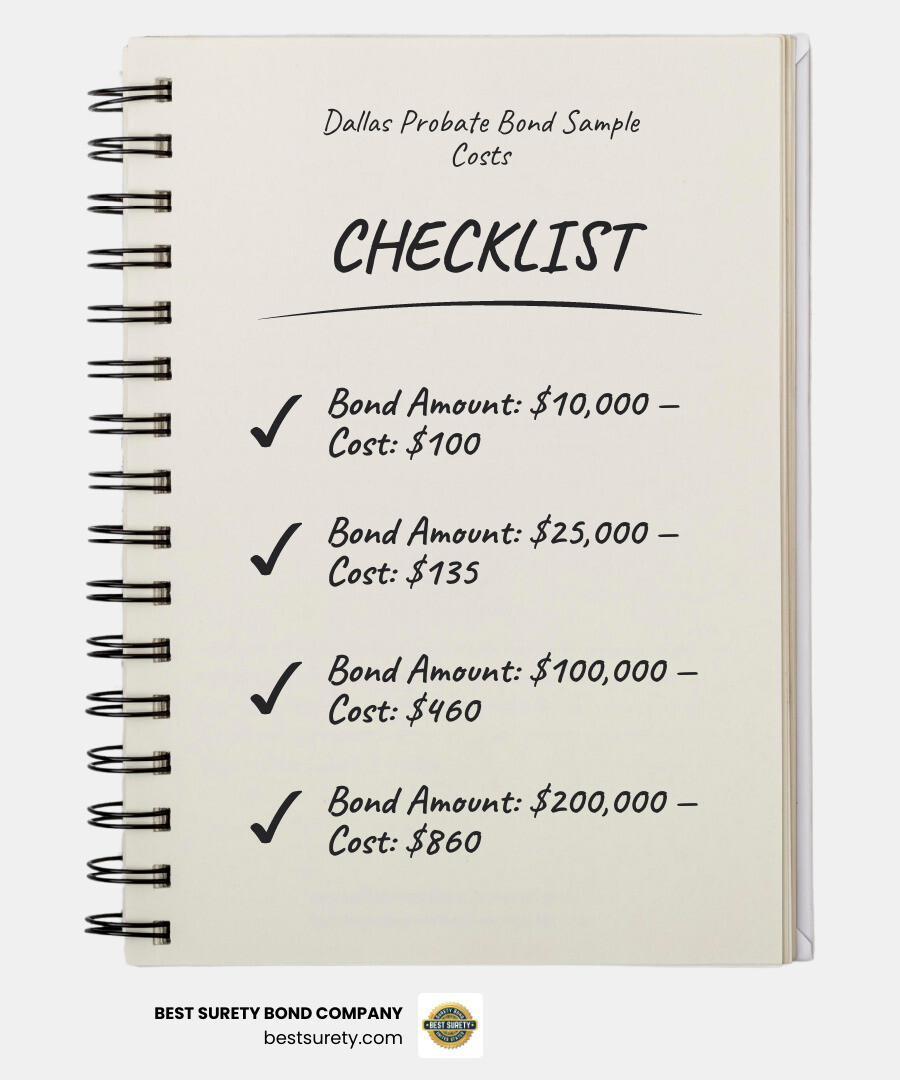
Here’s what qualified applicants typically pay: A $10,000 bond costs around $100 annually, while a $25,000 bond runs about $135 per year. For a $50,000 bond, expect to pay approximately $260, and a $100,000 bond typically costs $460 annually. Larger estates requiring a $200,000 bond usually see premiums around $860, while a $500,000 bond generally costs about $1,610 per year.
These are annual renewal fees, paid each year until the court releases the bond. This structure encourages efficient estate administration, as closing the estate sooner means you stop paying premiums.
At BEST SURETY BOND COMPANY, we pride ourselves on offering competitive rates in Texas while maintaining the fast, personal service Dallas families deserve.
Types of Probate Bonds and Who Issues Them in Dallas County
Understanding the specific type of Dallas probate bond you need is crucial for a smooth application. The term “probate bond” covers several court-ordered bonds for different roles in Dallas County estate administration. These are issued by surety companies licensed in Texas that meet state financial and regulatory standards.

Common Types of Probate Bonds
The Dallas County Probate Courts require different bonds depending on your role and the estate’s circumstances. Here are the most common types:
An Executor Bond is needed when a will names you as the executor. The surety company will typically review the will to understand your responsibilities and any special provisions affecting bond requirements.
If someone dies without a will (“intestate”) or the named executor cannot serve, the court appoints an administrator. An Administrator Bond is then required to ensure assets are distributed according to Texas inheritance laws.
Guardian Bonds serve a different but vital purpose. When the court appoints you to manage the financial affairs of a minor or an incapacitated adult, this bond protects their assets from mismanagement.
If you’re managing assets in a trust, you’ll likely need a Trustee Bond. This ensures you follow the specific terms of the trust document.
Finally, an Administrator with Will Annexed bond applies when a will exists but the named executor cannot serve. The court appoints someone else to carry out the will’s instructions, combining elements of both executor and administrator roles.
Each type carries the same promise: that you’ll faithfully perform your duties and protect the interests of beneficiaries and creditors.
Who Issues and Where to Find Information on a Dallas Probate Bond
Dallas probate bonds come from surety companies—specialized financial institutions that vouch for your performance. They must be licensed to operate in Texas and maintain strong financial ratings to ensure they can pay claims.
Most surety companies work through licensed agents who understand local requirements. At BEST SURETY BOND COMPANY, we’ve helped Dallas-area families and attorneys with probate bonds for years. Our experienced team works with a network of top-rated surety companies, allowing us to find you the best possible rate for your Dallas probate bond.
What sets us apart is our local expertise and fast service. We understand Dallas County Probate Court requirements and can often deliver your bond in as little as two hours. That speed is crucial when dealing with court deadlines.
For official information, the Official Dallas County Probate Court Information website is your best resource. It provides court forms, filing requirements, and contact information.
When choosing a surety provider, look for companies with strong financial strength ratings from A.M. Best—ratings of A or A+ indicate financial stability. You’ll also want a provider known for fast approvals and responsive service, since probate matters are often time-sensitive.
Our Texas-based team combines human expertise with digital convenience, making the bond process as straightforward as possible.
After You’re Bonded: Claims, Validity, and Legal Roles
Once your Dallas probate bond is issued and filed with the court, you’ve cleared a major hurdle. However, understanding what happens next is just as important as getting bonded.
Your bond remains active throughout the probate process, requiring annual renewal until the estate is settled. The bond is only discharged when the court officially releases you from your duties, usually after your final accounting is approved and all assets are distributed.
Most executors and administrators never face a bond claim. But disputes can arise during estate administration.

What Happens if a Claim is Filed Against the Bond?
While claims are rare, it’s important to understand the process if one is filed against your Dallas probate bond. The process is fair and thorough, protecting both the estate and you.
The claim investigation begins when a beneficiary or creditor alleges you’ve breached your fiduciary duty or mismanaged assets. This could involve anything from failing to distribute assets to making poor financial decisions.
The surety company steps in to conduct a comprehensive investigation. They review evidence, interview parties, and work with the Dallas County Probate Court to determine the claim’s merit. They take this responsibility seriously to get the facts right.
If the claim is valid, the surety pays the court up to the full bond amount to cover the losses. However, you’re still on the hook. Unlike insurance, a surety bond doesn’t absorb your losses. You must reimburse the surety company for everything they pay out, plus any associated costs.
This reinforces why the bond system works. Knowing you’re ultimately responsible encourages careful, honest management of estate assets. It’s also why working with an experienced probate attorney is so valuable—they help you avoid mistakes that could lead to claims.
The Role of an Attorney in the Bond Process
A skilled probate attorney is more than just helpful—for many Dallas probate bonds, especially larger ones, it’s required by the surety company. This requirement benefits everyone involved.
Your attorney provides essential legal guidance, helping you understand bond requirements, the likely amount, and your specific responsibilities. Texas probate law is nuanced, and legal counsel is critical.
The application process is much smoother with an attorney. They know what documentation the surety needs and how to avoid pitfalls that delay approval, which is critical when time is a factor.
Court filings and ongoing compliance are where attorneys excel. They handle paperwork, meet deadlines, and help you steer complex reporting requirements, dramatically reducing your risk of making errors that could trigger a bond claim.
Estate settlement is more manageable with legal expertise. Your attorney helps you inventory assets, pay debts, handle taxes, and distribute inheritances according to Texas law. This guidance is your best protection against errors.
If you need legal representation, the Find a Texas Lawyer resource from the State Bar of Texas can help you locate qualified probate attorneys in the Dallas area. Combined with our efficient bonding services, the right legal team creates a smooth path through probate.
The peace of mind from proper legal representation is invaluable. It’s an investment that protects both you and the estate.
Frequently Asked Questions about Dallas Probate Bonds
Dealing with probate while grieving is overwhelming, and you likely have questions about the Dallas probate bond process. As a long-serving provider in the Dallas-Fort Worth area, we’ve answered these questions for thousands of clients. Here are the most common ones:
Can a probate bond be waived in Dallas County?
Sometimes, but it depends on the type of administration. If a will waives the bond requirement and the court approves an independent administration (with minimal court oversight), you might not need a bond.
However, in a dependent administration, the Dallas County Probate Court almost always requires a Dallas probate bond to protect the estate and its creditors, even if the will waives it. The court’s primary duty is to safeguard the estate, and the bond is essential protection during supervised administration.
We’ve seen many families surprised by this, so we always recommend discussing your situation with a probate attorney early on.
How long does it take to get a probate bond in Dallas?
The process can be remarkably fast with the right provider. With your paperwork in order and a straightforward application, we can often approve and issue your Dallas probate bond the same day, sometimes in just a few hours.
We understand court deadlines don’t wait. Our streamlined online application and relationships with top-rated surety companies allow us to deliver many bonds in 2 hours or less at no extra cost. We’ve built our reputation on speed because timing is critical in probate.
The key to fast approval is having everything ready: your court order, completed application, estate details, and any required attorney representation.
Can I get a Dallas probate bond with bad credit?
While good credit makes getting a bond easier and more affordable, it’s not always a deal-breaker. Poor credit presents challenges, as surety companies assess risk based heavily on credit history.
Applicants with credit issues typically face higher premiums, and some may need to provide collateral. However, we work with multiple surety companies, some with programs for people with less-than-perfect credit. Having an experienced probate attorney can also improve your approval chances, as it shows the surety you’re committed to proper legal guidance.
We’ve successfully helped many clients with credit challenges secure their required Dallas probate bonds. The key is being upfront so we can explore all available options. Don’t let credit concerns stop you from applying—let us see what we can do.
Get Your Dallas Probate Bond with Confidence
Securing a required Dallas probate bond doesn’t have to be overwhelming. We understand you’re dealing with the loss of a loved one and don’t need the added stress of complex paperwork and long approval times.
That’s why we’ve built our approach around making this step as smooth as possible. When you work with BEST SURETY BOND COMPANY, you get peace of mind. We combine the convenience of online quotes and same-day approvals with the personal touch and local expertise from years of serving Texas families.
Our team has helped thousands of executors and administrators meet court requirements quickly and affordably. We know delays add to your family’s burden, so we prioritize fast approvals, often delivering bonds in hours. Our clients are often surprised by how straightforward the process is with the right partner.
Whether you have a small estate or complex assets, we’re committed to finding you the lowest possible rates while meeting all Dallas County court requirements. Our local expertise means we understand Texas probate law, and our relationships with top-rated sureties give us the flexibility to find the perfect solution for you.
The relief our clients feel when their Dallas probate bond is secured is what drives us. We’re here to protect the estate’s assets, satisfy court requirements, and give you one less thing to worry about.
Ready to take the next step and get your probate process moving forward?