
Why Premium on Bonds Payable Matters in Corporate Finance

Premium on bonds payable occurs when a company issues bonds for more than their face value because the bond’s stated interest rate is higher than the current market rate.
Quick Answer: Premium on Bonds Payable Essentials
- What it is: The amount by which bonds are sold above their face value
- When it happens: When stated interest rate > market interest rate
- Accounting treatment: Recorded as an adjunct liability account
- Impact: Reduces the company’s effective borrowing cost over time
- Amortization: Premium decreases over the bond’s life, lowering interest expense
Think of it this way: if you’re selling a $1,000 bond with an 8% interest rate when similar bonds only pay 6%, investors might pay $1,100 for your bond. That extra $100 is your premium on bonds payable.
For companies, this premium signals strong market confidence and reduces the true cost of borrowing. The premium is amortized over the bond’s life, creating a lower effective interest expense on the income statement.
Whether you’re a Texas contractor needing to understand financial statements for bonding, or a business owner reviewing corporate finance, grasping this concept helps you understand how companies optimize financing costs.
I’m Haiko de Poel. In my two decades leading financial services companies, I’ve seen how understanding premium on bonds payable helps business owners make smarter financing decisions, especially when evaluating a company’s financial health for partnerships or investments.
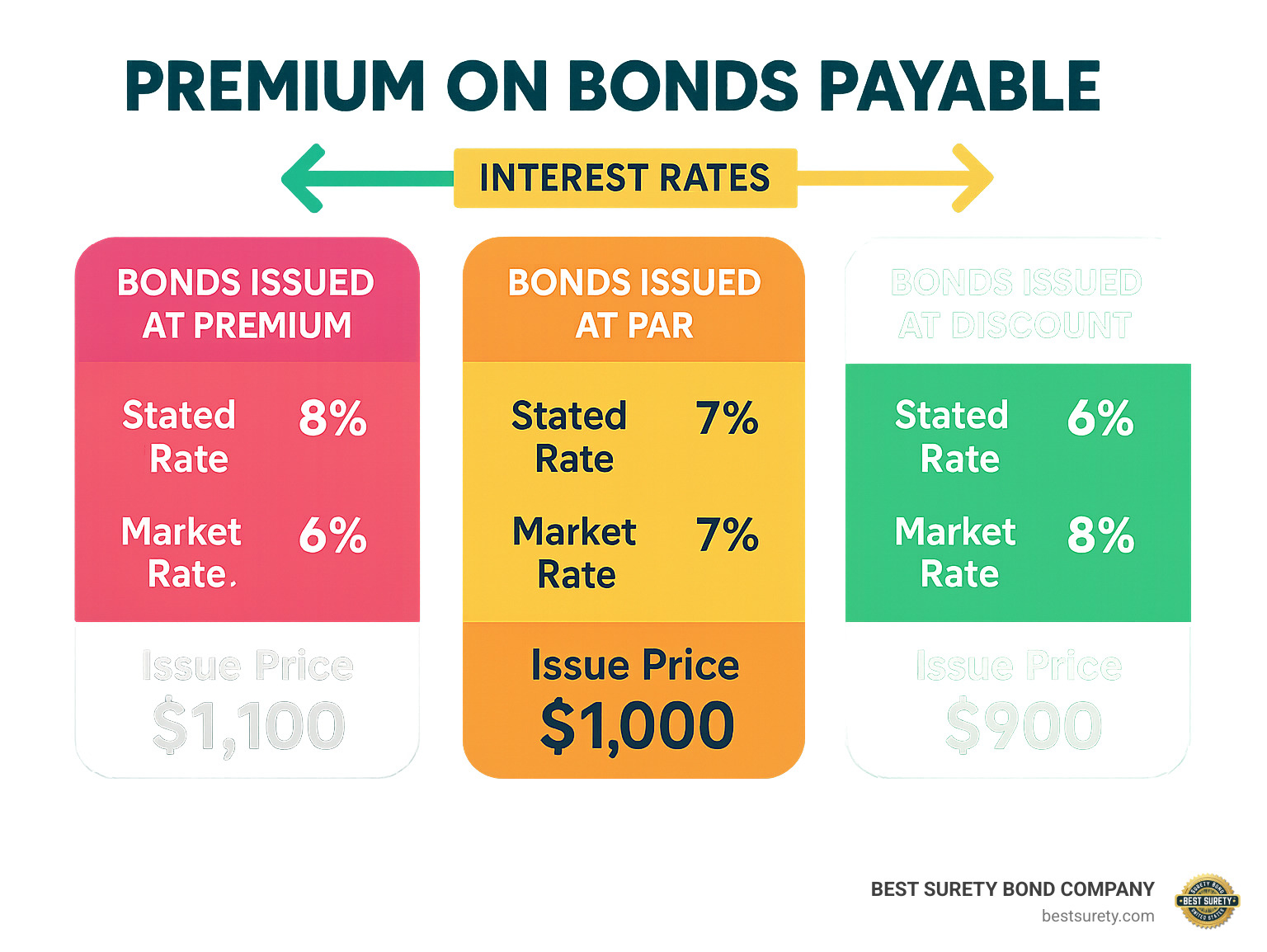
Know your premium on bonds payable terms:
The “Why” and “How” of Bond Premiums
Imagine shopping for investments and finding two similar bonds. One offers 8% interest while the market only pays 6%. Most investors would pay extra for that higher return—and that’s how a premium on bonds payable is created.
When a company issues a bond, it’s asking for a loan. The key is the relationship between the bond’s stated interest rate and the current market rate. If the bond’s rate is higher, investors compete to buy it, driving the price above face value.
This investor demand is the driving force behind bond premiums. When a bond’s stated rate exceeds the market rate, it becomes a highly sought-after investment.
Why Do Companies Issue Bonds at a Premium?
Why would a company offer higher interest rates than necessary? It’s often unintentional, a result of timing and strategy that works in the company’s favor.
Favorable market conditions play the biggest role. For example, a company might set its bond’s stated rate at 8% when market rates are high. If market rates drop to 6% before issuance, the bond becomes very attractive, and investors will pay a premium for it.
Company reputation also creates premiums. A financially strong company with excellent credit is seen as a safe bet, allowing it to command a premium from investors seeking security.
A major advantage for the issuing company is lowering effective borrowing costs. The upfront premium cash reduces the true interest expense over the bond’s life, acting like a discount on borrowing despite the higher stated rate.
Premium bonds also offer flexibility in financing. The extra cash provides immediate working capital for expansion or new investments. For Texas businesses, this flexibility can mean better bonding capacity and stronger balance sheets.
How to Calculate a Premium on Bonds Payable
Calculating the premium on bonds payable involves present value math. The core question is: “What would an investor pay today for the bond’s future cash flows?”
The issue price represents the total cash the company receives when selling the bond. The face value is what they promise to repay at maturity. When the issue price exceeds the face value, you’ve got your premium.
For a practical example, consider a $1,000 bond with an 8% annual interest rate when the market rate is 6%. Investors calculate the present value of the future $80 annual interest payments and the $1,000 principal repayment.
Using the 6% market rate, the bond’s issue price might be $1,085.30. The premium on bonds payable is $85.30—the extra amount investors pay for the higher interest.
For a detailed look at these calculations, you can explore An example of bond pricing to see how the numbers work in practice.
| Feature | Premium on Bonds Payable | Discount on Bonds Payable |
|---|---|---|
| Issue Price vs. Face Value | Issue Price > Face Value | Issue Price < Face Value |
| Stated Rate vs. Market Rate | Stated Rate > Market Rate | Stated Rate < Market Rate |
| Investor’s Willingness | Investors pay extra for higher yield | Investors pay less to compensate for lower yield |
| Accounting Classification | Adjunct account (adds to bond liability) | Contra account (reduces bond liability) |
| Impact on Interest Expense | Reduces interest expense over life of bond | Increases interest expense over life of bond |
| Amortization | Decreases the carrying value of the bond over time | Increases the carrying value of the bond over time |
Understanding these calculations is valuable for business owners evaluating financing options or assessing partners, especially when navigating bonding requirements for Texas contractors.
Accounting for a Premium on Bonds Payable
Accounting for bonds issued at a premium requires careful tracking of every dollar, from the initial sale until the final payment.
Under Generally Accepted Accounting Principles (GAAP), the premium on bonds payable is an “adjunct liability account.” This means it’s a credit balance added to the bond’s face value, showing its true carrying value on the balance sheet.
This matters because the premium is real cash received by the company. For example, if investors pay $105,000 for a $100,000 bond, the $5,000 premium must be recorded correctly to reflect the company’s true financial position.
Recording the Premium on Bonds Payable in Journal Entries
The initial journal entry for issuing bonds at a premium captures three key parts of the transaction.
Using our earlier example where a company issues $100,000 in bonds but receives $101,000 in cash, here’s how it looks:

This entry shows the full picture: Cash is debited for the $101,000 received. Bonds Payable is credited for the $100,000 face value (the amount due at maturity). The Premium on Bonds Payable account is credited for the extra $1,000.
This setup is crucial for amortizing the premium over the bond’s life. Each period, a portion of the premium reduces interest expense, lowering the effective borrowing cost.
For companies in Texas looking to understand these concepts for their own financial reporting or bonding requirements, this foundation helps explain how corporate financing works. You can explore more detailed examples in A spreadsheet showing entries for bonds.
How Premiums Appear on Financial Statements
The premium on bonds payable actively impacts the three major financial statements.
On the Balance Sheet, the premium is shown with the bonds payable in the long-term liabilities section, presenting a complete picture:

This shows the true carrying value of the debt. For instance, with an $800 unamortized premium, the total bond liability is shown as $100,800. This transparency clarifies the company’s actual obligations.
The Income Statement feels the premium’s impact through reduced interest expense. As the premium gets amortized, it directly lowers the interest expense below the cash interest paid, reflecting the true cost of borrowing.
On the Cash Flow Statement, the initial cash received from the premium bond issuance is a financing inflow. Ongoing interest payments are an operating outflow, but the premium’s effect is seen in the lower interest expense that impacts net income.
For more details on where premiums and discounts appear on financial statements, check out this helpful resource on premium or discount on bonds payable presentation on the balance sheet.
Understanding these accounting treatments becomes especially valuable for Texas businesses working with contractors, suppliers, or partners who issue bonds. It provides insight into their financial strength and borrowing efficiency.
The Financial Impact: Amortization and Cost of Borrowing
The premium on bonds payable creates financial benefits over time through a process called amortization. Instead of sitting on the balance sheet, the premium is gradually “used up.”
Amortization spreads the premium’s impact over the bond’s life. It reduces interest expense each period, creating a more accurate picture of the company’s true borrowing cost.
Companies use two main amortization methods. The straight-line method divides the premium equally over each interest period—it’s simple but less precise. The effective interest method is more complex but superior, maintaining a constant effective interest rate.
Both methods aim to reduce the premium balance to zero by maturity, lowering the reported interest expense. This effectively reduces the true cost of borrowing below the stated rate—a significant business advantage.
What Happens to the Premium Over the Bond’s Life?
The premium on bonds payable is like a melting ice cube. Initially, the full premium adds to the bond’s carrying value. With each interest period, a portion is amortized, or “melts away.”
When issued, the bond’s carrying value is its face value plus the full premium. As interest is paid, the company amortizes part of the premium, reducing both the premium account and the bond’s carrying value.
At maturity, the premium is fully amortized. The Premium on Bonds Payable account is zero, and the bond’s carrying value equals its face value. The company then repays the face value to bondholders.
This systematic reduction ensures the bond’s value on the balance sheet moves smoothly from its premium amount down to face value over the bond’s life. You can see this process illustrated in An illustration of premium amortization over time.
How Amortization Affects Interest Expense
The real benefit is that amortizing the premium on bonds payable directly reduces the interest expense on the income statement, creating cost savings.
While the cash interest payment to bondholders is fixed, the recorded interest expense is lower. This is because the amortized premium is subtracted from the cash payment to calculate the expense.
For example, if a company pays $6,000 in cash interest and amortizes $300 of premium, the reported interest expense is only $5,700. That $300 difference improves the bottom line.
This results in a lower effective interest rate than the stated rate. The company benefits from the upfront premium, leading to higher net income and a reduced cost of borrowing over the bond’s life.
For Texas businesses evaluating corporate financial health or considering partnership opportunities, understanding this concept helps assess how well companies manage their financing costs. A detailed guide to bond amortization is available here for those wanting to dive deeper into the mechanics.
A Different Kind of Premium: Corporate Bonds vs. Surety Bonds
The term “premium” can be confusing. We’ve discussed premium on bonds payable in corporate finance, but Texas business owners also encounter another type of “premium” related to surety bonds, which protect business operations.
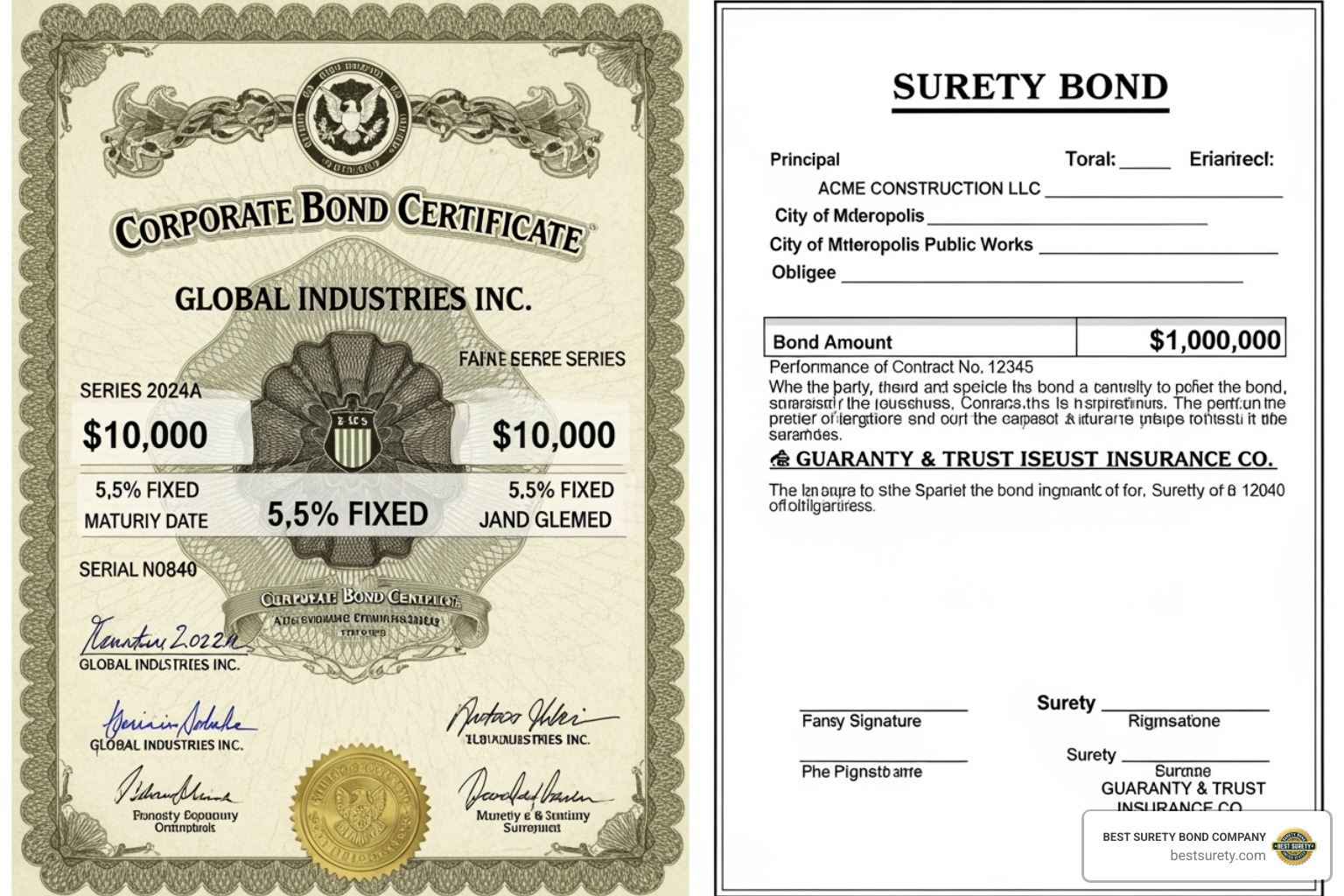
A corporate bond is a form of debt financing. The premium on bonds payable is an accounting adjustment reflecting market conditions and the cost of borrowing money.
A surety bond is different; it’s a guarantee. For instance, a Houston contractor uses one to guarantee project completion. It’s a three-way agreement between the principal (your business), the obligee (who requires the guarantee), and the surety (who provides the financial backing).
This distinction is crucial for Texas businesses. Whether in San Antonio or Austin, surety bonds are often mandatory for project bids and business licenses, not optional financing.
Understanding the “Premium” on a Surety Bond
The “premium” for a surety bond is entirely different from a bond payable premium. It’s not an accounting adjustment; it’s simply the cost of getting that financial guarantee.
Surety bond cost is determined by an underwriting process that assesses your business’s financial strength, experience, and specific risk. Unlike corporate bond premiums tied to interest rates, surety premiums are based on a risk assessment of your business.
Your premium depends on the bond amount, guarantee type, credit history, financial health, and industry track record. An established contractor with strong financials will pay less than a new startup.
Crucially, a surety bond premium is not a liability on your balance sheet. You’re buying a service—the surety’s guarantee. There’s no amortization, interest expense adjustment, or carrying value.
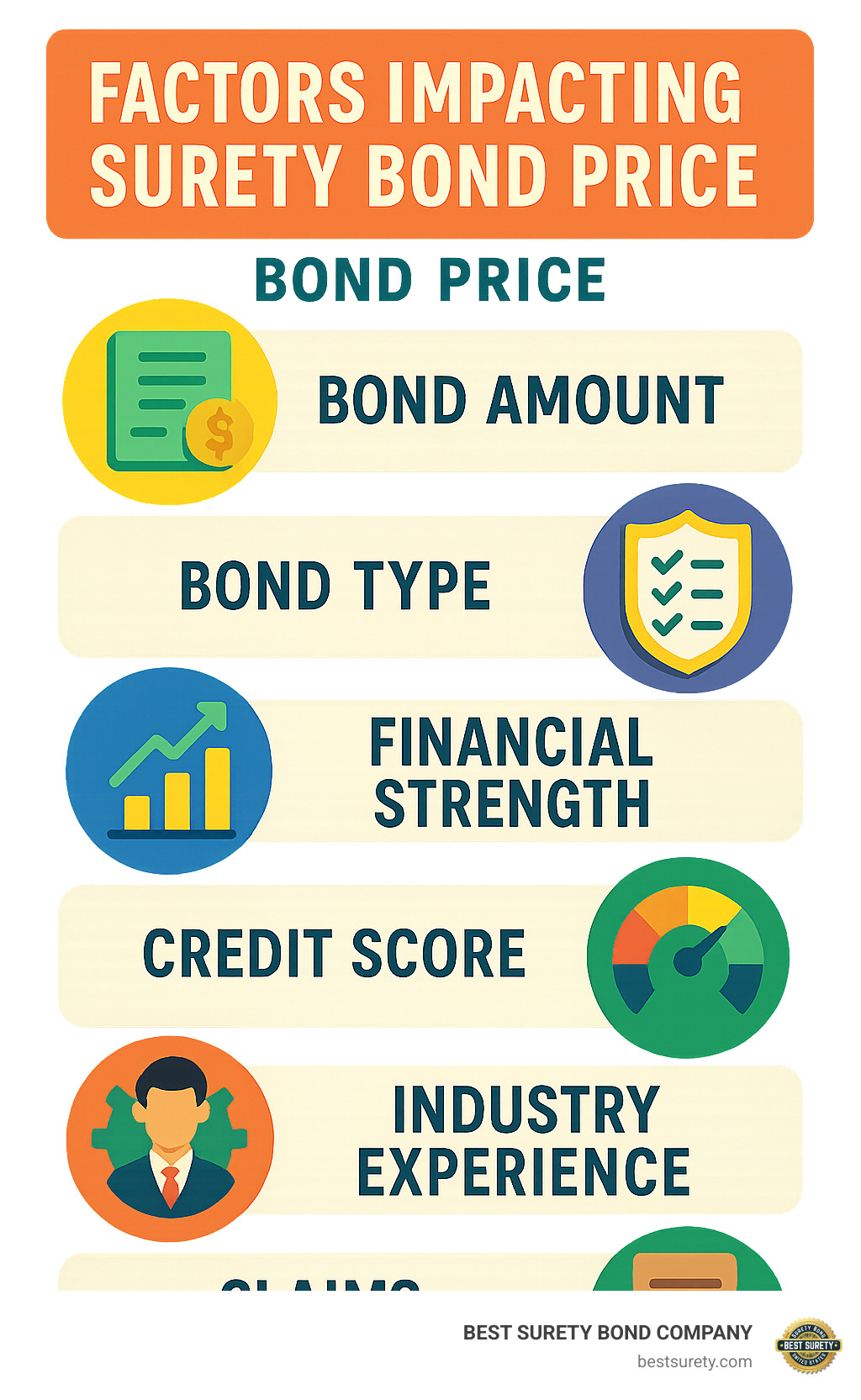
For Texas businesses, understanding these costs upfront helps with project bidding and licensing budgets. A performance bond for a major Houston infrastructure project might cost 1-3% of the contract value annually, while a simple license bond for a small business might cost just a few hundred dollars per year.
At BEST SURETY BOND COMPANY, we specialize in making this process straightforward for Texas businesses. We offer fast approvals and competitive rates across all bond types – from license and permit bonds to contract bonds and court bonds. Our team understands that when you need a surety bond, you usually need it quickly, which is why we provide online quotes and often same-day issuance to keep your business moving forward.
Frequently Asked Questions about Bond Premiums
Bond accounting can be confusing. As a resource for business owners across Texas, I’m here to answer the most common questions about premium on bonds payable in simple terms.
What is a premium on bonds payable in simple terms?
It’s the extra amount investors pay for a bond above its face value. This happens when the bond offers a higher interest rate than the current market average, making it more attractive. For example, investors might pay $1,100 for a $1,000 bond that pays 8% interest when the market rate is only 6%. The extra $100 is the premium.
Is a premium on bonds payable a good thing for a company?
Yes, it’s generally a good thing. A premium on bonds payable signals strong investor confidence in the company’s financial health. More importantly, the upfront premium reduces their true borrowing cost over the bond’s life, resulting in a lower effective interest rate. This means more cash flow upfront and lower financing costs overall—a win-win for the company.
What is the difference between a bond premium and a bond discount?
The difference comes down to interest rates. A bond premium occurs when the bond’s stated interest rate is higher than the current market rate, so it sells for more than face value. A bond discount is the opposite: the stated rate is lower than the market rate, so it sells for less than face value. Both premiums and discounts are market mechanisms that adjust a bond’s effective yield to align with current market expectations, ensuring a fair return for investors.
Conclusion: From Accounting Concepts to Business Guarantees
Understanding premium on bonds payable reveals how companies can benefit from offering interest rates higher than the market demands. When investors pay a premium, they help companies reduce their true borrowing costs over time.
We’ve seen how amortizing the premium reduces interest expense, creating a win-win. The company gets cheaper financing, and investors receive attractive returns on a trusted bond.
For business owners in Texas and Houston, the word “premium” has a more immediate meaning: the cost of a surety bond, which is vital for day-to-day operations.
While a premium on bonds payable is an accounting tool for corporate finance, the premium you pay for a surety bond is your ticket to doing business. It’s the fee that gets you bonded so you can bid on that construction project in Houston, obtain your contractor’s license, or meet whatever bonding requirements your industry demands.
At BEST SURETY BOND COMPANY, we’ve spent years helping Texas businesses steer these practical financial guarantees. We know that when you’re trying to grow your business, you need bonds that are fast, affordable, and reliable. You don’t have time to wade through complex financial theory – you need results.
Whether you’re a contractor in Dallas needing a performance bond for your next project, or a Houston-based business applying for a license bond, we understand the urgency. Our same-day approvals and competitive rates mean you can focus on what you do best while we handle the bonding process.
The beauty of surety bonds lies in their simplicity compared to corporate bond accounting. You pay a straightforward premium, get your bond, and you’re ready to work. No amortization schedules, no balance sheet adjustments – just the financial guarantee you need to move forward.
Get your fast and affordable surety bond quote today and experience why Texas businesses trust BEST SURETY BOND COMPANY for their bonding needs. Because while understanding premium on bonds payable might impress your accountant, getting the right surety bond will actually grow your business.
