
The Truth About Surety Bond Refunds
Whether you’re entitled to a refund on a surety bond when the court case is over depends on the type of payment you made and the specifics of your case. Here’s what you need to know:
Quick Answer:
- Surety Bond Premium: Generally non-refundable (it’s a service fee)
- Collateral Posted: Usually refundable when the court case ends and the bond is exonerated
- Cash Bail: Refundable minus court fees and fines
- Rare Exceptions: Clerical errors, duplicate bonds, or bonds never filed with the court
Many people assume they’ll get their money back after their court case. However, the premium paid for a surety bond is almost always non-refundable, as it’s a service charge for the guarantee.
Confusion arises from mistaking the premium for a refundable deposit. When you post a surety bond, you’re paying a company to guarantee your court appearance; this fee covers their risk and service.
However, any collateral you put up (cash, property, or other assets) to secure the bond is typically returned once the court releases the bond and you’ve met all your obligations.
I’m Haiko de Poel, and with my experience in financial and legal services, I’ve seen how confusing these refund policies can be. I’ve helped thousands understand situations like being entitled to a refund on a surety bond when the court is over.
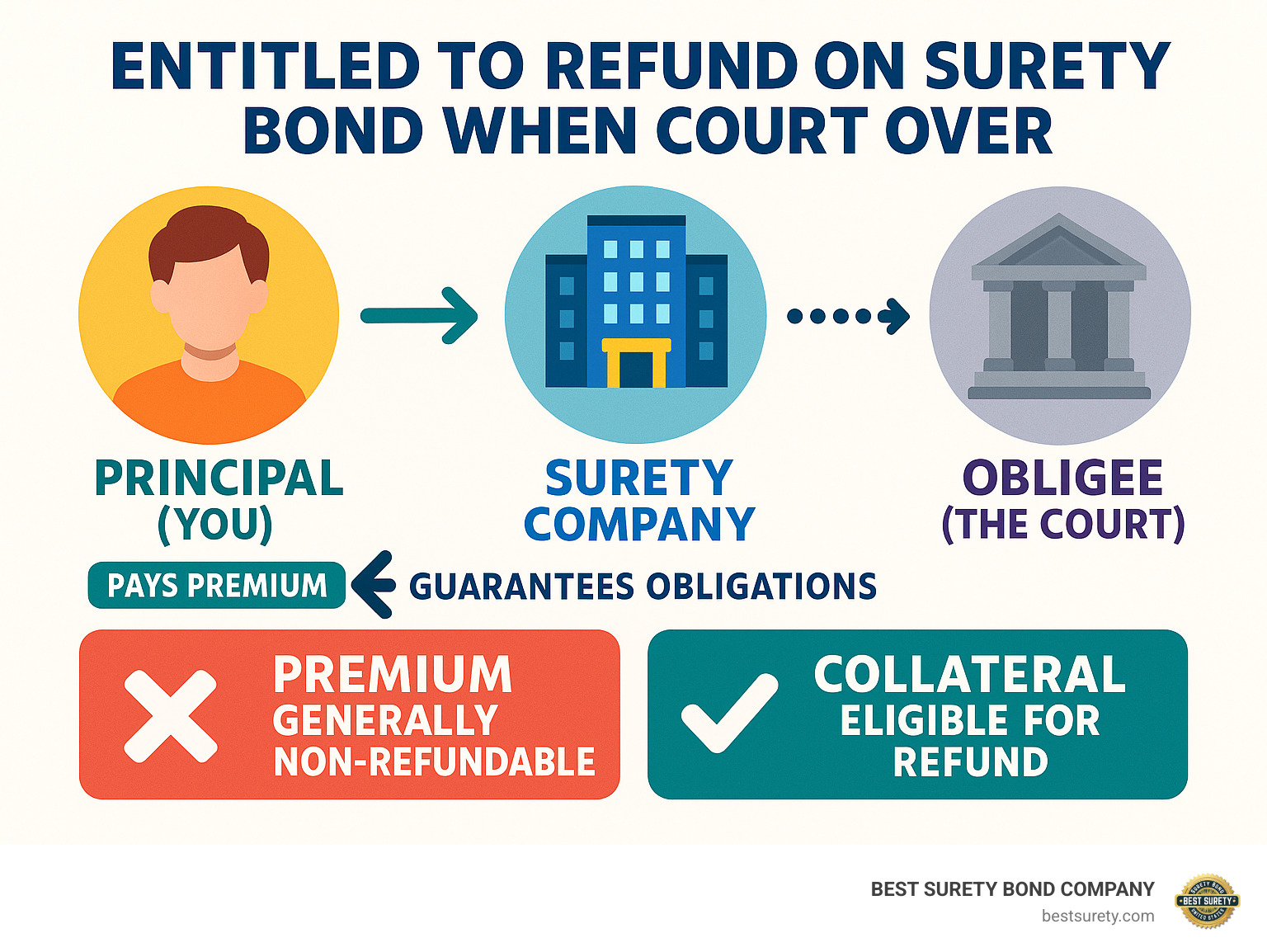
A surety bond involves three parties:
- The Principal: That’s you, the person or entity who needs the bond. You pay the premium.
- The Obligee: This is the entity requiring the bond (e.g., a court, a government agency). They are protected by the bond.
- The Surety: This is the bond company that guarantees the Principal’s obligations to the Obligee. They take on the financial risk.
The premium pays the Surety for vouching for you and assuming financial risk if you fail to meet your obligations. It is not a refundable deposit.
Why Most Court Bond Premiums Are Non-Refundable
The reality is that when you’re seeking a refund on a surety bond after court, the premium itself rarely qualifies. The fee you pay is considered “fully earned” the moment the bond is active.
Like car insurance, you don’t get a premium refund for not having an accident. The surety’s risk begins immediately when they guarantee your obligations to the court, and that service has value regardless of the outcome.
The “earned premium” concept is crucial for court bonds. Whether your case is short or long, the surety has provided a legal guarantee that protects the court, and that service cannot be undone.
Bail bonds are a common example. The typical 10% fee paid to a Texas bail bondsman is for their service of posting the full bail amount. This premium is non-refundable, even if the case is dismissed, because it covers the risk, service, and paperwork.
Appeal bonds function similarly. They guarantee payment if an appeal fails. The premium covers the surety’s risk during the appeals process, and it’s non-refundable regardless of the outcome of the court proceedings.
Probate bonds also have non-refundable premiums. They protect an estate’s beneficiaries, and the premium pays for that protection from the start.
This is how the surety business works—it’s about financial guarantee and risk assumption from the moment the bond is active. If you want to learn more, check out What is a Surety Bond? or dive deeper into Understanding court surety bonds.
The Difference Between a Surety Bond Premium and Cash Bail
The difference between a surety bond premium and cash bail is significant for refunds and often causes confusion.
A surety bond premium is a non-refundable fee paid to a surety company for guaranteeing your court appearance. You’re hiring them to vouch for you. In Texas, the premium is typically 10% of the bail amount. For a $10,000 bail, you would pay a non-refundable $1,000 fee to the bondsman.
Cash bail is when you pay the full bail amount directly to the court. This money is usually refundable (minus fees and fines) after the case concludes, provided all court appearances are met. The court holds your money as insurance that you’ll show up.
| Feature | Cash Bail | Surety Bond Premium |
|---|---|---|
| Payment To | The Court | Bail Bondsman/Surety Company |
| Amount Paid | Full bail amount | Percentage of bail amount (e.g., 10%) |
| Refundability | Generally Refundable (minus fees/fines) | Generally Non-Refundable |
| Purpose | Direct guarantee to the court | Fee for surety’s guarantee to the court |
| Risk | You bear the full financial risk | Surety company bears the financial risk |
| Collateral | Your money is the collateral | May require additional collateral from you |
| Return Time | Typically 10-15 business days after case ends | Not applicable (it’s a fee, not a deposit) |
The key difference is what you’re paying for. With cash bail, you’re using your own money as security. With a surety bond, you’re paying someone else to use their credit on your behalf.
What Happens to Collateral?
The good news is that while the premium is non-refundable, any collateral you provide to secure the bond is typically returned. Understanding the collateral vs. premium distinction is crucial.
A surety company may require collateral—such as cash, property, vehicles, jewelry, or other assets—as extra security to ensure they can recover funds if you fail to meet your obligations.
This collateral is returned after the court case conclusion and you’ve fulfilled all your obligations. The court issues a bond exoneration order, which releases the surety from their guarantee and allows for your collateral return.
For instance, if you used your car as collateral for a bail bond in Houston, it will be returned once you’ve met all court requirements and the case is over. The bond exoneration signals the surety can release your assets.
The timeline for getting collateral back should be in your agreement with the surety company. You can read more about collateral to get the full picture.
Are You Entitled to a Refund on a Surety Bond When Court is Over?
The straight answer is you’re generally not entitled to a premium refund when your court case ends, but you should get your collateral back. The premium is an earned service fee.
The key term to know is bond exoneration.
Bond exoneration is the official court order stating you’ve met all obligations. Without this release of liability, the bond remains active, and you could face ongoing costs.
This is like paying for a security service; you pay for the guarantee, not the outcome. The same principle applies to surety bonds.
The confusion often comes from mixing up different types of bonds and payments. While most premiums aren’t refundable, there are specific situations where you might see money back. Your collateral, however, should be returned once everything is properly wrapped up.
We work with all Types of Surety Bonds and can explain when you might—and won’t—see a refund.
Specific Circumstances for a Refund
While rare, a few exceptions exist where you might be entitled to a refund on a surety bond when the court is over. These typically involve mistakes or unusual circumstances.
- The bond was never filed with the court. If paperwork was lost or never submitted, the bond never went into effect. In this case, the surety took on no risk, and you should receive a full refund.
- A duplicate bond was issued. If you, your lawyer, or a family member accidentally paid for the same bond twice, the duplicate, unnecessary bond should be refunded.
- The bond was canceled before its effective date. In rare cases where charges are dropped or a technicality makes the bond unnecessary before the surety assumes risk, a refund may be possible.
- You overpaid due to a calculation error. If your premium was miscalculated and you paid too much, the overage should be returned to you.
In Texas, some surety companies may offer prorated refunds for multi-year probate bonds if the estate closes early, but this is not guaranteed and depends on the provider.
These situations are uncommon. Most of the time, once the premium is paid and the bond is active, that money has done its job.
Factors That Void Your Refund Eligibility
Conversely, certain factors will void any eligibility for a premium refund.
- A claim was filed against your bond. If you violated the bond’s conditions, causing the surety to pay a claim, you will not get a refund. In fact, you will be responsible for reimbursing the surety for the claim amount. You can learn more about what happens when a claim is investigated.
- The bond was active. Premiums are “fully earned” once the bond is effective because the surety assumed risk from day one. This risk assumption is what your premium paid for.
- You failed to appear in court or violated bond conditions. This results in forfeiture, where the surety pays the full bond amount to the court. You then become liable to the surety for that amount, plus costs, and will not receive a premium refund.
- You didn’t comply with other court requirements. Failing to complete community service, missing drug tests, or violating travel restrictions can all void any possibility of a refund.
The best way to protect yourself financially is to follow all court orders and stay in communication with the court and your surety company.
How to Request a Surety Bond Refund in Texas: A Step-by-Step Guide
While premium refunds are rare, getting your collateral back or processing a cash bail refund in Texas is straightforward. The process requires patience and paperwork but is manageable with the right steps.
Being entitled to a refund on a surety bond when the court is over usually means getting collateral back, not the premium. This guide covers the process for collateral, cash bail, and rare premium refund scenarios.

Step 1: Obtain an Official Court Order
This first step is the most critical. You cannot get money or collateral back without an official court order. This document is your key to the refund process.
You need an official document confirming you’ve fulfilled all court obligations and the bond is no longer needed. This is legally known as bond exoneration or a release of liability.
For cash bail, work with the court clerk’s office. They process your refund after a signed judge’s order confirms case completion. Texas counties have different forms; for example, Bexar County uses an Order to Refund Cash Deposit, while Harris County has its own court procedures.
For surety bonds, you need a certified copy of the exoneration order to prove to the surety company that their obligation to the court has ended.
Before going to the courthouse, have your original bond receipt and other court documents ready to speed up the process.
Step 2: Contact Your Surety Provider
With the court order in hand, contact your surety provider or bail bondsman promptly. There’s no reason to delay getting your collateral back.
Submit a clear, professional written request with a copy of the court exoneration order. Use email to create a paper trail.
Review your original bond agreement for specific requirements, such as a cancellation notice period or required forms. Following their process will prevent delays.
Providing proof that the court has released you is essential. Without the exoneration order, the surety company cannot legally release your collateral.
If you have questions, our [Surety Bond FAQs](https://bestsurety.com/surety-bonds/surety-bond-faqs/) cover common situations our Texas clients face.
Step 3: Await Confirmation and Processing
After submission, the surety company will review your paperwork. This is a necessary legal step to verify the bond’s release before returning collateral.
For collateral return, the process begins once they confirm everything is in order. Cash collateral is returned quickly, while property or vehicles may take longer due to transfer paperwork.
Cash bail refunds from the court typically take 10 to 15 business days after your case ends, but this varies by Texas county. The court may deduct administrative fees or outstanding fines from your refund.
Prorated refunds on premiums are incredibly rare. They might occur with multi-year probate bonds if an estate closes early, but this is at the surety’s discretion and not guaranteed.
Follow up politely if you don’t hear back in a reasonable timeframe. You can also check [State-specific surety regulations](https://www.fiscal.treasury.gov/surety-bonds/laws-regs.html) if you have concerns about processing times.
While premium refunds are unlikely, collateral return is a standard, successful process in Texas courts.
Frequently Asked Questions about Surety Bond Refunds
Understanding if you’re entitled to a refund on a surety bond when the court is over can be confusing. The rules often surprise people. Here are common questions we receive from our Texas clients:
Do you get your money back from a surety bond in Texas?
The premium you pay for a surety bond is almost always non-refundable. This applies across Texas—from Houston to Dallas—for all bond types, including license, contract, and court bonds.
Think of it as a service fee. The surety company assumes financial risk the moment your bond is issued, and that fee was earned when they vouched for you.
However, you will get back any collateral you provided (cash, property, etc.) once the bond is exonerated by the court, provided you met all obligations and no claims were filed.
How long is a court surety bond good for in Texas?
A court surety bond is not on a calendar schedule; it remains active for the entire duration of the court case until a judge officially releases it through “exoneration.”
This happens when your case concludes and you’ve met all court-required conditions, such as attending hearings or paying fines. Once the judge signs the exoneration order, the bond’s purpose is fulfilled.
While the bond’s validity is tied to legal proceedings, premiums are often structured annually, so a lengthy case might require additional premium payments.
What is the difference between a cash bond refund and a surety bond refund?
This distinction often causes confusion, even for legal professionals.
A cash bond is the full bail amount paid directly to the court. It acts as a security deposit and is generally refunded (minus court fees or fines) after the case concludes.
A surety bond involves paying a non-refundable premium (usually 10% in Texas) to a surety company. This is their fee for guaranteeing the full bail amount to the court.
The confusing part is that while the premium is non-refundable, any collateral you provided to the surety is returned after the bond is exonerated.
In short: with cash bonds, you get your principal payment back. With surety bonds, you get your collateral back, but not the premium.
Get Expert Help with Your Texas Court Bond Needs
Navigating Texas court bonds requires local expertise. While you’re generally not entitled to a refund on a surety bond when the court is over, understanding collateral return and exoneration is crucial to protect your finances.
Whether you need a bail bond in Harris County, an appeal bond in Dallas, or a probate bond elsewhere in Texas, the procedures can be overwhelming. A trusted provider makes all the difference.
At BEST SURETY BOND COMPANY, Houston’s trusted surety provider, we help clients steer these situations with confidence. We provide fast approvals, affordable rates, and clear guidance on bond obligations and potential refunds.
Our licensed agents have guided over 10,000 clients across Houston, Dallas, San Antonio, Austin, and all Texas counties through the entire bond process. We know how different Texas courts handle exonerations and collateral returns.
Our commitment is to transparency. We explain that premiums are non-refundable but ensure you know how to get your collateral back. We assist with court orders and paperwork to ensure a prompt return of your collateral.
We’re licensed in all 50 states, so whether your legal matter is local or extends beyond Texas, we have the expertise to help. Our goal is to make the process simple and affordable, offering same-day approvals and the lowest rates.
Don’t steer complex Texas court bonds alone. Our licensed agents are ready to help you understand your obligations from start to finish.
Get Your Texas Surety Bond Today
