

Why Understanding Advance Payment Bond Costs Matters for Your Business
Decoding the Advance Payment Bond Cost: What Will You Pay?
Ready to get a clear picture of what an advance payment bond cost will look like for your project? Understanding these expenses upfront is super important for smart budgeting and keeping your project’s finances healthy. Let’s break down how it all works, so there are no surprises.
At BEST SURETY BOND COMPANY, we believe in clear, straightforward pricing. You won’t find any hidden fees or confusing jargon here. Knowing the typical advance payment bond cost helps you budget smartly and keeps your project on track, ensuring healthy profit margins from the start.
How is the Advance Payment Bond Cost Calculated?
So, how do we figure out your advance payment bond cost? It’s usually a small percentage of the total bond amount you need – this is called the bond premium. This percentage isn’t one-size-fits-all; it depends on a careful look at the risk involved in your specific situation. Our goal is always to get you the lowest rate possible, based on a fair assessment.
While some bonds have a set rate, most are calculated individually. Generally, you can expect the rate calculation for an advance payment bond to fall between 0.4% and 10% of the bond amount (also known as the bond value). For instance, if you need a $50,000 bond and your rate is 2%, your cost would be $1,000. Sometimes, for larger bond amounts, we can even offer a sliding scale rate, meaning the percentage might actually go down a bit!
Our friendly team of underwriters at BEST SURETY BOND COMPANY conducts a thorough underwriting assessment. They look at things like your financial health, what kind of project you’re working on, and your past experience. This helps us understand the risk involved. The better your financial standing and track record, the lower your perceived risk, and that means a lower bond premium for you. It’s all about finding you the best possible rate!
Just to give you a quick idea, a $10,000 bond might cost you around $100 to $140, while a $50,000 bond could be around $500. This often aligns with a general idea that every $10,000 in bond value costs about $100. However, it’s good to know that for higher-risk situations or if you’re just starting out, the cost can sometimes go higher, even up to 5% to 20% of the bond’s value. This wide percentage range truly shows why your unique situation and our risk assessment are so important in determining your final advance payment bond cost.
Average Cost Examples for Common Bond Amounts
To make things even clearer, let’s look at some common cost examples for advance payment bonds. The table below shows what you might expect to pay for different bond amounts, depending on your credit profile. These are estimates, and your final bond premium will be set after our quick and thorough financial underwriting review.
| Bond Amount | Excellent Credit (0.5% – 1%) | Average Credit (1% – 3%) | Bad Credit (3% – 10%+) |
|---|---|---|---|
| $10,000 | $50 – $100 | $100 – $300 | $300 – $1,000+ |
| $25,000 | $125 – $250 | $250 – $750 | $750 – $2,500+ |
| $50,000 | $250 – $500 | $500 – $1,500 | $1,500 – $5,000+ |
| $100,000 | $500 – $1,000 | $1,000 – $3,000 | $3,000 – $10,000+ |
| $500,000 | $2,500 – $5,000 | $5,000 – $15,000 | $15,000 – $50,000+ |
| $1,000,000 | $5,000 – $10,000 | $10,000 – $30,000 | $30,000 – $100,000+ |
As you can see, the difference between a low-risk premium and a high-risk premium can be significant. For a $10,000 bond, you might pay as little as $50 if you have excellent credit, or over $1,000 if your financial history is more challenging. Similarly, a $1,000,000 bond could be $10,000 for a top-tier applicant, but potentially $100,000 or more in higher-risk situations. This really highlights why your financial health and the details of your project play such a big role in determining your overall advance payment bond cost.
Key Factors That Determine Your Bond Premium
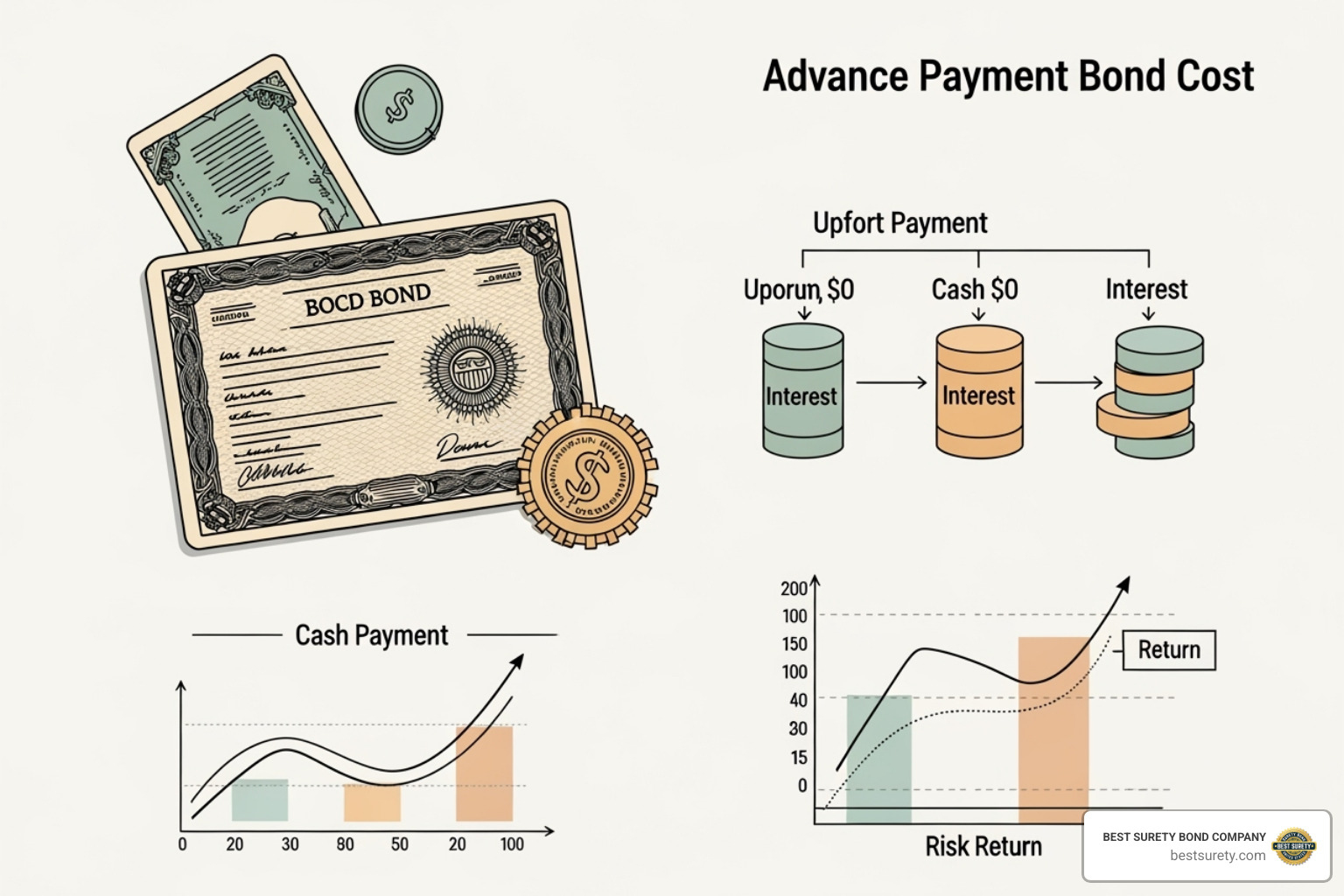
When we calculate your advance payment bond cost, it’s not just a random number. Our team, which you can think of as financial detectives, carefully looks at several key factors. We want to understand the risk involved with your specific bond. This helps us offer you the best possible rate.
Our goal during this underwriting process is to figure out how likely it is that a claim might be made against the bond. We review different parts of your business to get a clear picture of your financial health and reliability. The more stable and reliable you appear, the better your premium will be!
The Role of Financial Strength and Credit Score
Your financial strength is super important when it comes to your advance payment bond cost. This includes looking at both your business finances and your personal finances.
Our underwriters will check things like your working capital, net worth, and your profitability history. Having a strong financial record shows us that you can manage money well. It proves you can meet your obligations, even if unexpected problems pop up.
Your personal credit score is also a huge factor. In fact, for many commercial bonds under $50,000, it’s often the first thing we look at. A good credit score tells us you’re dependable and that you’ve paid your debts on time in the past. This means less risk for us, which leads to a lower percentage rate for your bond. We’ve found that having a good credit score (usually 700 or higher) helps you get the very best rates and qualify more easily. You can learn more about why your credit score matters from consumer finance experts.
But don’t worry if your credit isn’t perfect! We understand that life happens. While your advance payment bond cost might be a bit higher, we do offer bad credit bonding options. These special programs are designed to help contractors with lower credit scores still get the bonds they need. You might pay a higher premium (often in the 3-10% range or more), or we might ask for some collateral. Either way, we’re committed to finding a solution that works for you.
Project and Contract Specifics
Beyond your financial health, the details of the project itself greatly influence your advance payment bond cost.
First, the bond amount itself plays a big role. This amount is usually a percentage of the total project cost. Since your premium is calculated as a percentage of this bond amount, a higher bond amount will naturally lead to a higher overall cost.
We also consider the total contract value, how long the project duration is, and how complex the work will be. Longer projects or those with tricky requirements can sometimes mean higher risks for us. This might result in a slightly higher premium. Also, contracts that include extended warranty periods can affect the cost, as they mean we’re exposed to risk for a longer time.
Finally, we look at the industry risk associated with your type of work. Some industries naturally carry more risk than others. Advance payment bonds are commonly used in many different sectors, including:
- Construction contracts (for example, to buy materials before the work even starts)
- Manufacturing (especially for custom products that need upfront material costs)
- Government contracts
- Travel agencies
- Auto dealerships
- Collection agencies
- Health clubs
- Auctioneers
- Public notaries
- Durable medical equipment providers
Each of these industries has its own unique risk profile that our underwriters carefully consider.
The Contractor’s Experience and Track Record
Your experience and professional history give us valuable insights into how reliable you are and how capable you are of completing projects successfully. When we’re figuring out your advance payment bond cost, we look at several things:
We want to know your years in business. A company that has been around for a while, showing consistent operation, often means more stability. It also shows experience in managing projects and finances over time.
Your project completion history is also important. If you have a proven track record of finishing projects on time and within budget, especially projects similar to the one you’re bonding, it greatly reduces the perceived risk. It tells us you know what you’re doing!
We also check your previous bond claims. Having a history with no past claims against your bonds is a really good sign for us. On the flip side, if there have been claims in the past, it might raise some concerns and could lead to higher premiums or extra requirements.
The management experience of your team is crucial too. When experienced leaders are at the helm, they can handle challenges effectively. This helps ensure the project gets done right.
Lastly, your company reputation matters. A strong name for quality work, ethical practices, and happy clients can also help us see you as a lower risk.
All these factors together help us understand your business’s overall ability and character. This, in turn, directly affects the premium you’ll pay for your advance payment bond.
Strategies to Reduce Your Advance Payment Bond Cost
Nobody wants to pay more than they have to, right? A high advance payment bond cost can definitely eat into your project margins. But here’s the great news: you’re not powerless in this! We understand that every single dollar counts, especially for hard-working contractors and businesses across Texas and nationwide. By being smart and proactive, you can actually influence your bond premium and secure much more favorable terms. Think of it as making a savvy investment in your business’s future and your ability to get bonded for bigger and better projects.
Strengthening Your Financial Profile
This is probably the biggest game-changer when it comes to reducing your advance payment bond cost. Simply put, the stronger your financial standing, the less risk you present to the surety company. And that means a lower premium for you!
So, what does “strengthening your financial profile” really mean? It boils down to a few key areas. First, focus on improving your credit score. Your personal credit score is incredibly important. Make it a priority to pay your bills on time, reduce any outstanding debt, and always keep an eye on your credit report for errors. A solid score signals to us that you’re reliable, which can lead to a lower percentage rate on your bond.
Next, work on building your business capital. This includes increasing your working capital and overall net worth. When you have healthy financial reserves, it shows you can handle unexpected costs and fulfill your obligations, even if a bump in the road appears.
We also highly recommend providing professional financial statements. Submitting CPA-prepared Audit or Review statements, rather than just basic compilations, offers a much higher level of assurance to our underwriters. This extra layer of confidence can absolutely make a difference in your rate. And finally, consistently demonstrating profitability over time is crucial. A track record of making money shows you’re running a well-managed and financially stable business. By focusing on these areas, you’re not just getting a lower bond cost; you’re building a stronger, more resilient business overall.
Shopping for the Best Rates and Terms
Just like you wouldn’t jump at the first price quote for a major project, you shouldn’t settle for the first bond quote you receive either. The surety market is a competitive place, and bond rates can vary quite a bit between different providers.
That’s where working with a surety specialist like BEST SURETY BOND COMPANY comes in. We’re truly a game-changer! We partner with a wide network of top-rated sureties, which means we can shop around on your behalf to find the best possible rates and terms custom just for you. The best part? Our service is typically free to contractors, as we’re compensated by the surety providers. This means you can easily compare quotes to ensure you’re getting the most competitive advance payment bond cost available for your unique business profile.
It’s also helpful to understand the difference between ‘account rating’ and ‘class rating’ sureties. Some sureties use a ‘class rating’ system with more standardized rates, while others use ‘account rating,’ which allows for more flexibility and personalized pricing based on your specific qualifications. A specialist can guide you to the right type of surety for your business. We pride ourselves on finding the right surety partner for your business profile, matching contractors with sureties that best fit their size, experience, and financial situation. This personalized approach often leads to lower premiums and a smoother, more efficient bonding process.
Exploring Support Programs and Alternatives
Sometimes, especially for newer businesses or those facing specific financial problems, meeting standard underwriting criteria can feel like a tall order. But don’t worry, there are support programs and alternatives that can help you secure the bond you need! It’s important to know that these options might come with their own associated costs, but they can be incredibly valuable stepping stones.
One fantastic option is The SBA Surety Bond Guarantee Program. This program, offered by the Small Business Administration, is designed to help small contractors qualify for bonds they might not otherwise be able to obtain. The SBA steps in as a guarantor to the surety, which reduces the surety’s risk. While there’s a small fee (currently 0.6% of the bonded contract amount), it can open doors to larger projects and better terms for your business.
In some situations, especially for larger or higher-risk bonds, a surety might suggest funds control. This involves a neutral third-party company managing project funds to ensure proper disbursement to your subcontractors and suppliers. While it adds a layer of oversight and typically costs between 0.75% and 1.00% of the contract price for their service, it can make it possible to get bonded for projects that would otherwise be out of reach.
Finally, as a last resort or for very high-risk scenarios, collateral options might be discussed. This could involve an Irrevocable Letter of Credit (ILOC) from your bank. While collateral secures the bond for the surety, it does tie up your capital and incurs its own annual cost (generally between 0.5% and 2% of the required amount). We always aim to avoid collateral requirements if we can, but it’s an option to consider when absolutely needed. Understanding when to use these support tools and what their associated costs are is key to making informed decisions about your advance payment bond cost.
Frequently Asked Questions about Advance Payment Bonds
We understand that advance payment bonds can seem complex, especially when you’re focusing on getting your projects off the ground. Don’t worry, we’re here to clear things up! Here are some of the most common questions we hear, answered simply and directly, so you can get back to what you do best.
What’s the difference between the bond amount and the bond cost?
This is a really important question, and it’s where many people get a little confused! Think of it this way:
The bond amount (sometimes called the penal sum) is the big number. It’s the maximum financial protection the surety company provides to your client (the obligee) if something goes wrong and you don’t fulfill your obligations or misuse the advance payment. It’s the “up to” limit that the surety would pay out.
The bond cost (or premium) is the small number you pay to get that protection. It’s like paying for an insurance policy – you pay a small fee upfront for a much larger amount of coverage. This cost is a percentage of the total bond amount, and as we’ve seen, it typically ranges from 0.4% to 10%, depending on your unique profile and project details. You pay this premium, usually annually, for as long as the bond needs to be in place. Just remember, if the surety does pay out on a claim, you, the contractor, are legally responsible for reimbursing them for any money they paid out on your behalf. It’s a guarantee, not an insurance payout for you!
Can I get an advance payment bond with bad credit?
We get it – life happens, and sometimes credit scores take a hit. So, the good news is, yes, it is often possible to get an advance payment bond even with a lower credit score! We understand that a past financial hiccup doesn’t define your ability to deliver a great project.
At BEST SURETY BOND COMPANY, we believe in finding solutions. We work with a network of surety companies that offer specialized programs designed for applicants who might have less-than-perfect credit. While your advance payment bond cost will likely be higher than for someone with excellent credit (expect rates anywhere from 5% to 20% of the bond’s face value), our goal is to help you secure the bond you need to land that project. In some cases, to mitigate the increased risk, the surety might ask for collateral or other forms of security. But rest assured, we’ll explore all avenues to get you bonded.
Who pays for the advance payment bond?
This one’s straightforward: you, the contractor (also known as the principal), are responsible for purchasing and paying for the advance payment bond. You’ll pay the premium directly to the surety company.
However, here’s the savvy contractor’s secret: this advance payment bond cost is considered a legitimate project expense. This means that when you put together your bid for the job, you typically factor the bond premium directly into your overall contract price. So, while you’re the one cutting the check, the cost is ultimately absorbed by the project owner (the obligee) as part of the total project budget. It’s a standard and accepted practice in the industry, ensuring that the necessary financial safeguards are in place for everyone involved from the very beginning.
Get Your Fast, Affordable Advance Payment Bond Today
Securing an advance payment bond is more than just a formality; it’s a strategic move for your business! It’s a critical step in managing your project’s cash flow effectively and building invaluable trust with your clients. Think of it as a stamp of approval that showcases your financial stability and your unwavering commitment to fulfilling your contractual duties. It’s a smart way to ensure your projects start strong, stay on track, and protect both your interests and your client’s investment right from the get-go.
At BEST SURETY BOND COMPANY, we truly understand the unique needs of contractors like you. That’s why we specialize in providing fast, low-cost surety bonds for businesses both in Texas and across the entire nation. Our process isn’t just efficient; it’s genuinely streamlined to ensure you can get bonded quickly and get right to work on what you do best. We pride ourselves on offering some of the lowest rates in the industry, backed by our deep expertise as Texas surety experts with a broad national reach. Whether your next big project is in Houston, Dallas, or anywhere across the USA, we’re here to help you steer the complexities of advance payment bond cost with ease, clarity, and complete transparency.
Ready to secure your project’s financial foundation and gain that crucial peace of mind? We’ve made it easy for you. You can explore more info about our contract bond services and find exactly how we can help you get the bond you need without the usual hassle. Our commitment to fast approvals and dedication to providing truly affordable premiums means you’re just a few clicks away from moving forward confidently.
Don’t let bonding complexities slow you down! Get Bonded Today! We’re committed to making the entire process as smooth and affordable as possible, so you can focus all your energy on what matters most: building success.
