

Why Every Auto Dealer Needs This Critical License Requirement
An auto dealer bond is a legally required surety bond that protects consumers from fraudulent or unethical practices by motor vehicle dealers. Here’s what you need to know:
Key Facts:
- Required in all 50 states for auto dealer licensing
- Protects consumers from fraud, title issues, and unpaid taxes
- Bond amounts typically range from $10,000 to $300,000 depending on state
- Premium costs range from 1% to 9% of the bond amount
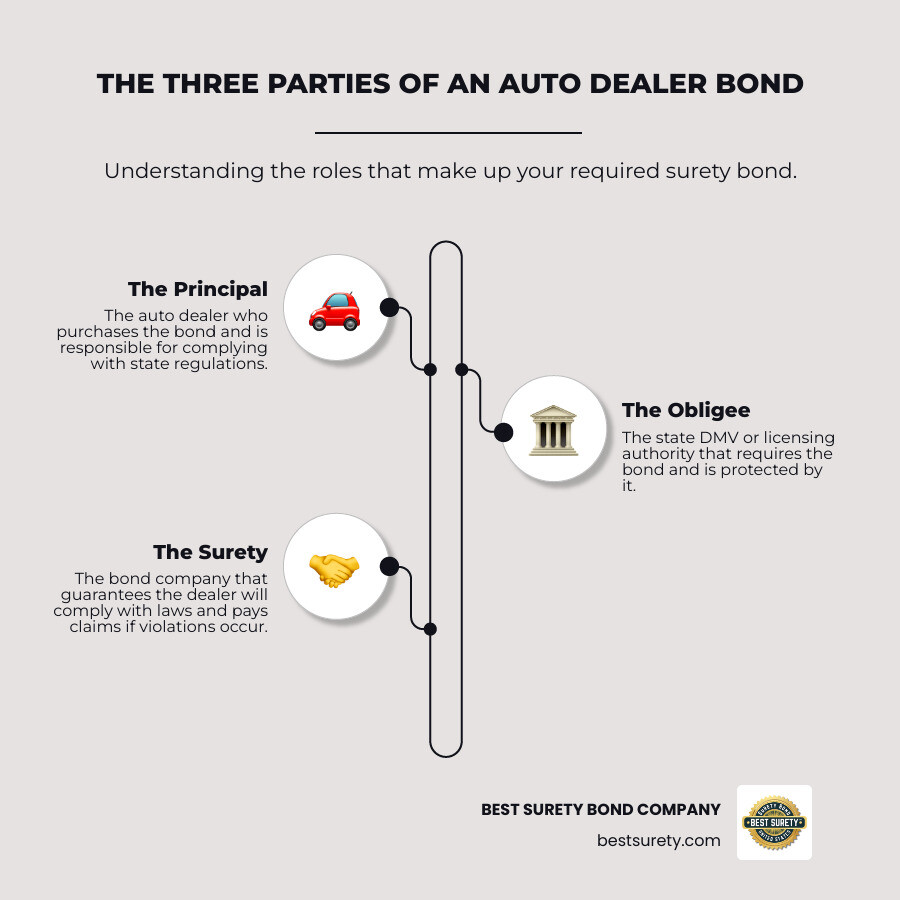
- Three parties involved: the dealer (principal), state DMV (obligee), and bond company (surety)
Common Bond Amounts by State:
- California: $50,000 (general dealers), $10,000 (wholesale/motorcycle)
- Texas: $25,000
- Florida: $25,000
- Illinois: $50,000
Before someone can obtain a motor vehicle dealer license, they must post a surety bond that ensures compliance with industry regulations. This isn’t insurance that protects you – it’s a financial guarantee that protects your customers and the state from potential harm caused by your business practices.
The bond works as a three-party contract where the surety company guarantees you’ll follow state laws. If you violate regulations or harm a customer, they can file a claim against your bond. The surety pays valid claims, but you must reimburse them for any money paid out.
I’m Haiko de Poel, and I’ve helped hundreds of entrepreneurs steer complex licensing requirements across multiple industries, including automotive dealerships seeking auto dealer bonds for state compliance. My experience scaling businesses in fintech, legal services, and franchise development gives me deep insight into the regulatory challenges dealers face when launching their operations.
Explore more about auto dealer bond:
What Is an Auto Dealer Bond and Why Is It Required?
Picture this: you’re buying a car from a dealership, and something goes wrong. Maybe the title never gets transferred properly, or the dealer pockets your trade-in money without paying off your old loan. That’s exactly why every state requires auto dealer bonds – they’re your financial safety net.
An auto dealer bond is a special type of surety bond that works as a three-party agreement. You, the auto dealer, are the Principal who purchases the bond. The Obligee is your state’s DMV or licensing authority that requires the bond. And the Surety is the bond company (like us!) that guarantees you’ll follow all the rules.
Here’s where it gets interesting – this isn’t insurance that protects you. Think of it more like a financial promise you make to your customers and the state. You’re essentially saying, “I guarantee I’ll run my dealership ethically, and if I don’t, there’s money available to make things right.”
The bond protects against some pretty serious stuff: fraud, misrepresentation, title transfer issues, and failure to pay taxes. States like California take this so seriously that California Vehicle Code Section 11710 spells out exactly what dealers must do to stay compliant.
Who is Protected by an Auto Dealer Bond?
The real heroes in this story are consumers and the public. When you buy a car, you shouldn’t have to worry about getting scammed or losing your money to a shady dealer. That’s where the auto dealer bond steps in as your guardian angel.
But it’s not just individual buyers who benefit. Financing agencies are protected when dealers fail to handle loan paperwork correctly. State government agencies know they’ll get their tax money even if a dealer tries to skip out on payments. Even other dealers benefit because bonds help maintain ethical business practices across the entire industry.
The protection covers everything from odometer tampering to failure to deliver valid titles. It’s about building trust in an industry where people make some of their biggest purchases. When customers know there’s financial protection backing every transaction, everyone wins.
What Happens if a Claim is Filed?
Nobody wants to think about claims, but understanding the process is crucial. When someone believes they’ve been financially harmed by your dealership, they can file a claim against your auto dealer bond.
The surety investigation kicks off immediately. Our team digs deep to determine if the claim has merit. We’re not just writing checks – we’re protecting both the claimant and you from frivolous accusations.
If we determine the claim is valid, here’s where things get real: the surety pays damages up to your bond amount. But – and this is important – you’re on the hook for principal reimbursement. That means every dollar we pay out, you owe back to us.
This financial responsibility aspect makes bonds different from insurance. We’re not absorbing your losses; we’re guaranteeing payment to harmed parties while you remain ultimately responsible. It’s a powerful incentive to run your dealership with integrity from day one.
Who Needs a Bond and Are Requirements Universal?
If you’re making money by buying, selling, or exchanging motor vehicles, you’ll almost certainly need an auto dealer bond. This requirement covers a surprisingly wide range of vehicle professionals beyond just the traditional car lot dealer.
New car dealers selling directly from manufacturers need bonds, as do used car dealers operating from physical lots. But the requirement extends further – wholesale dealers who sell primarily to other dealers, motorcycle dealers, RV dealers, and ATV dealers all typically need bonds. Even those involved in commercial vehicle sales like trucks and trailers usually fall under these requirements.
Here’s where it gets interesting: while every single state requires some form of auto dealer bond, the details vary dramatically from state to state. Think of it like speed limits – every state has them, but the actual numbers are all over the map.
| State | Bond Amount | Term | Obligee (Regulatory Body) |
|---|---|---|---|
| Texas | $25,000 | 2 years | Texas DMV |
| California | $50,000 (general) / $10,000 (wholesale/motorcycle) | 1 year | California DMV |
| Florida | $25,000 | 1 year | Florida DHSMV |
The bond amounts range from as low as $10,000 in some states to $300,000 in others. Bond terms might be one year in California but two years in Texas. Some states have different expiration dates that don’t align with your business calendar.
This is why it’s crucial to learn more about your state’s requirements before you start the licensing process. What works in one state might leave you completely non-compliant in another.
The Difference Between a Dealer and a Private Seller
Not everyone who sells a car needs an auto dealer bond – and understanding this distinction can save you time and money. Private party sales are generally exempt from bond requirements when someone is simply selling personal vehicles they’ve owned and used.
The key difference comes down to intent and volume. Professional dealers are in the business of selling for profit, while private sellers are typically just moving their personal property. Most states use the number of vehicles sold per year as the determining factor.
In California, selling more than five vehicles annually typically triggers the dealer requirement. Florida sets the bar at three vehicles not titled in your name when sold for profit. Texas generally requires licensing if you sell more than four vehicles in a 12-month period.
The pattern is clear: if you’re flipping cars as a business, even from your driveway, you’ll likely need to get licensed and bonded.
State-Specific Bond Amount Examples
Understanding bond amounts across different states helps you plan your startup costs and expansion strategy. Here are some real-world examples:
California requires the highest bonds for most dealers at $50,000, though wholesale and motorcycle dealers can get by with $10,000 bonds. Texas keeps it straightforward with a standard $25,000 requirement for most dealer types.
Florida also sets their requirement at $25,000, while Illinois bumps it up to $50,000. Georgia falls in the middle at $35,000 for most auto dealers.
These amounts represent the maximum the surety company will pay on valid claims – not what you’ll pay for the bond itself. Your actual premium will be a small percentage of these amounts, typically ranging from 1% to 9% depending on your credit and business profile.
How Much Does an Auto Dealer Bond Cost?
Here’s the good news: you won’t pay the full bond amount upfront. The cost of your auto dealer bond is called the “premium,” and it’s just a small percentage of the total bond amount your state requires. While Texas might require a $25,000 bond, you’ll typically pay somewhere between 1% and 9% of that amount annually.
Think of it like this: if you have excellent credit and need a $25,000 bond, you might pay as little as $250 per year. That’s less than a dollar a day to meet your legal requirements and protect your customers.
Your premium isn’t pulled out of thin air, though. Several key factors determine exactly what you’ll pay:
Your credit score is usually the biggest factor. We’ve seen applicants with strong credit histories secure premiums as low as 1% of the bond amount. Someone with a $50,000 bond requirement might pay just $500 annually with excellent credit.
Your business financials matter too. Surety companies want to see that your dealership is financially stable and well-managed. The stronger your financial position, the lower your risk profile.
Industry experience can work in your favor. If you’ve been operating as a licensed dealer for years without issues, that track record speaks volumes about your reliability.
Claims history is another consideration. If you’ve had claims filed against previous bonds, expect higher premiums. It’s like having accidents on your driving record – it signals higher risk.

Don’t worry if your credit isn’t perfect. We work with multiple underwriting programs specifically designed to help dealers with challenging credit histories get bonded. Yes, your premium might be higher, but we can usually find a solution that fits your budget.
Getting the Best Rate on Your Premium
Every dollar counts when you’re launching or growing your dealership, so let’s talk about how to keep your auto dealer bond premium as low as possible.
Maintaining good credit is your best investment. Most surety companies pull from Experian, so keep an eye on that score. Even small improvements can translate to significant savings on your annual premium.
Providing complete financial statements helps underwriters see the full picture of your business. When you’re transparent and organized with your paperwork, it builds confidence and often leads to better rates.
Working with an experienced surety agency like ours gives you a major advantage. We’ve built relationships with multiple surety providers over the years, which means we can shop your application around to find the most competitive rate. Not all agencies have this capability.
Shopping for quotes is always smart business. The first quote you receive might not be the best one available. We make this easy by handling the legwork for you.
Multi-year discounts can provide additional savings. Some surety companies offer reduced rates if you purchase a two-year bond instead of renewing annually.
Ready to see what your auto dealer bond will actually cost? You can get a fast, free quote for your bond through our streamlined online process. Most quotes are ready within minutes, and we pride ourselves on offering some of the most competitive rates in Texas and nationwide.
The Step-by-Step Process to Get Your Bond and License
Getting your auto dealer bond and license doesn’t have to feel overwhelming. Think of it as a three-step journey that moves you from aspiring dealer to licensed professional. While each state has its own quirks and requirements, the basic path remains consistent across the country.
The key is tackling each step methodically. You’ll start by setting up your business foundation, then secure your bond, and finally submit everything to your state’s licensing authority. Let’s walk through exactly what this looks like in practice.

Step 1: Meet State Licensing Prerequisites
Before you can even apply for your auto dealer bond, your state wants to see that you’re serious about running a legitimate dealership. This means establishing a proper business foundation that meets all regulatory requirements.
Your business location is typically the biggest hurdle. Most states require a permanent, commercially zoned property with an enclosed building where you can display vehicles. You’ll need proper signage that clearly identifies your dealership, and the space must meet specific square footage requirements. Don’t forget about parking areas for customer and inventory vehicles.
Business registration comes next. You’ll need to register your business entity – whether that’s an LLC, corporation, or partnership – with your state’s Secretary of State office. This gives you the legal standing to operate as a business entity.
Sales tax permits are mandatory since you’ll be collecting and remitting sales tax on vehicle sales. Contact your state’s tax authority to obtain your sales tax number before moving forward.
Background checks are standard across all states, though the specifics vary. Some states like California require live scan fingerprinting, while others may accept traditional fingerprint cards. Plan for this to take a few weeks, as results must come back clean before you can proceed.
Many states also require completion of a dealer education program. These programs cover state-specific laws, consumer protection requirements, and proper business practices. Some states even require you to pass a written exam demonstrating your knowledge of dealer regulations.
Step 2: Apply for Your Auto Dealer Bond
Once your business foundation is solid, applying for your auto dealer bond becomes the easiest part of the entire process. Our streamlined online application typically takes just a few minutes to complete.
You’ll provide basic information like your business name and any “Doing Business As” names you plan to use. We’ll need your dealership’s physical address – this should be the same commercial location you established in step one.
Personal details for all business owners are required, including Social Security Numbers for a soft credit check. Don’t worry – this soft inquiry won’t impact your credit score, but it helps us determine your premium rate and get you approved quickly.
The beauty of working with us is our fast approval process. We pride ourselves on same-day issuance for most applications, so you won’t be stuck waiting weeks for your bond certificate. Once approved, you’ll receive your official bond document, which you’ll need for the final licensing step.
Ready to get started? You can Apply Today! through our simple online application.
Step 3: File Your Bond and Complete the License Application
With your auto dealer bond certificate in hand, you’re ready for the final push to get licensed. This step involves submitting your bond to the state and completing your dealer license application.
Submit your original bond form to your state’s obligee – usually the Department of Motor Vehicles or similar licensing authority. Make sure you’re sending the original document with the surety company’s official seal. Keep copies for your records, because you’ll need them for renewals and any future reference.
License fees vary significantly by state, but budget for several hundred dollars in application costs. California, for example, charges $175 for new dealer applications, plus additional fees for dealer plates and any special endorsements you might need.
Finalizing your application means double-checking every form, providing photos of your business location if required, and ensuring all supporting documentation is included. Missing paperwork is the most common reason for delays in license approval.
For California dealers specifically, the California New Dealer Application Checklist is incredibly helpful for ensuring you haven’t missed any requirements.
Once everything is submitted, most states process dealer license applications within one to three weeks. Some states offer expedited processing for an additional fee if you need to get licensed more quickly.
Managing Your Bond and Staying Compliant
Congratulations on getting your auto dealer bond and license! But here’s the thing – this isn’t a “set it and forget it” situation. Think of your bond as a living part of your business that needs ongoing attention to keep your dealership running smoothly and legally.
The good news? Managing your bond doesn’t have to be complicated. With a little planning and some solid business practices, you’ll stay compliant and avoid the headaches that come with bond claims or lapses in coverage.
How to Renew Your Auto Dealer Bond
Your auto dealer bond isn’t forever – it has an expiration date that varies by state. Most bonds need renewal annually, though some states like Texas offer two-year terms. Florida dealers need to renew by April 30th each year, while California requires annual renewal along with the dealer license.
Stay ahead of the game by marking your calendar well before your expiration date. We’ll send you renewal notices 30-60 days in advance, but it’s smart to have your own reminder system too. Nobody wants to scramble at the last minute!
When renewal time comes, you’ll simply pay the renewal premium. Here’s something important to know – your rate might change based on your current credit score or how your business has performed over the past year. If your credit has improved or your business has grown stronger, you might even see a lower rate.
Continuous coverage is absolutely critical. Even a single day without an active bond can trigger license suspension or revocation. The state doesn’t mess around with this requirement, so make sure there’s no gap between your old bond expiring and your new one taking effect.
What Happens if You Operate Without a Bond?
Let’s be honest – operating without a required auto dealer bond is like driving without a license. You’re breaking the law, and the consequences can be severe enough to shut down your entire operation.
The state will take immediate action if they find you’re operating without proper bonding. Your dealer license can be denied, suspended, or revoked entirely. Some states impose hefty fines and civil penalties that can reach thousands of dollars.
But the real problem goes deeper than just state penalties. Without a valid bond, you cannot legally sell vehicles. Period. This means your entire revenue stream stops until you get compliant again. Even worse, any customers who were harmed during your unbonded period can take direct legal action against you personally, forcing you to pay damages out of your own pocket.
Insurance won’t cover these situations because you were operating illegally. The financial exposure can be devastating, especially for newer dealerships without deep cash reserves.
How to Avoid Claims Against Your Bond
The best bond management strategy? Never have a claim filed against it in the first place. Every successful dealer I’ve worked with follows some basic principles that keep them out of trouble and build customer trust.
Compliance is your foundation. Stay current with all state laws and regulations – they change more often than you might think. Subscribe to updates from your state’s DMV or dealer licensing authority so you’re never caught off guard by new requirements.
Title transfers are claim magnets when done incorrectly. Make sure every title is transferred accurately and promptly to the new owner. Keep detailed records of when titles were submitted and processed. If there’s ever a delay, communicate proactively with your customers about what’s happening.
Tax and fee remittance must be handled like clockwork. Set up systems to ensure all sales taxes and registration fees are paid to the state on time, every time. Late payments are one of the most common triggers for bond claims.
Truth in advertising isn’t just good ethics – it’s legal protection. Never misrepresent vehicle conditions, mileage, or warranty terms. Odometer tampering is a particularly serious violation that can result in both criminal charges and bond claims.
Record keeping might seem tedious, but it’s your best defense if disputes arise. Document every sale, customer interaction, and business transaction. These records can be invaluable in proving you acted properly if someone files a complaint.
Pay sellers promptly when you purchase vehicles from individuals or auctions. Delayed payments create frustrated sellers who may file complaints or bond claims. Honor all warranty agreements you make – your reputation and legal standing depend on it.
By following these practices consistently, you’ll not only avoid costly bond claims but also build the kind of reputation that brings customers back and refers others to your dealership. Your auto dealer bond is ultimately about protecting the public’s trust in your business – and that trust is one of your most valuable assets.
Conclusion
Your journey to becoming a licensed auto dealer starts with understanding that an auto dealer bond isn’t just another regulatory hurdle to jump through—it’s your gateway to building a legitimate, trustworthy business that customers can rely on. This critical investment protects not only the consumers who walk through your doors but also establishes your dealership as a credible player in the automotive industry.
Throughout this guide, we’ve walked through everything from the three-party agreement that forms the foundation of your bond to the state-specific requirements that vary dramatically across the country. Whether you’re facing California’s $50,000 bond requirement or Texas’s $25,000 mandate, the principle remains the same: this bond demonstrates your commitment to ethical business practices and legal compliance.
The cost of your bond—typically ranging from just 1% to 9% of the bond amount—is a small price to pay for the ability to operate legally and the trust it builds with your customers. When you consider that someone with good credit might pay only $500 annually for a $50,000 bond, it becomes clear that this is one of the most cost-effective investments you’ll make in your dealership.
Getting bonded is just the beginning. Staying compliant with state regulations, renewing your bond on time, and following best practices will keep your business running smoothly and help you avoid costly claims. The consequences of operating without a bond—from license revocation to hefty fines—simply aren’t worth the risk.
At BEST SURETY BOND COMPANY, we understand that time is money in the automotive business. That’s why we’ve streamlined our process to offer fast approvals and same-day issuance, often at the most competitive rates in the industry. As Texas experts with national reach, we’ve helped thousands of dealers across all 50 states steer the bonding process with confidence.
Your dealership dreams don’t have to wait. The sooner you get bonded, the sooner you can start building the automotive business you’ve always envisioned. With our expertise guiding you through every step, from application to renewal, you can focus on what matters most—serving your customers and growing your business.
Get bonded today and launch your dealership with confidence!
