

Why Understanding Bonding Rates Can Save Your Business Thousands
Confusion over the bonding rate costs small business owners and contractors thousands of dollars every year. Many mistakenly believe the bond amount is what they’ll pay, but that’s completely wrong.
Quick Answer: What is a bonding rate?
- Bonding rate = The percentage you pay of the total bond amount (typically 0.5% – 10%)
- Bond amount = The coverage limit (what the bond guarantees)
- Premium = What you actually pay (bond amount × bonding rate)
- Example: $50,000 bond × 3% rate = $1,500 premium
Here’s what actually determines your bonding rate:
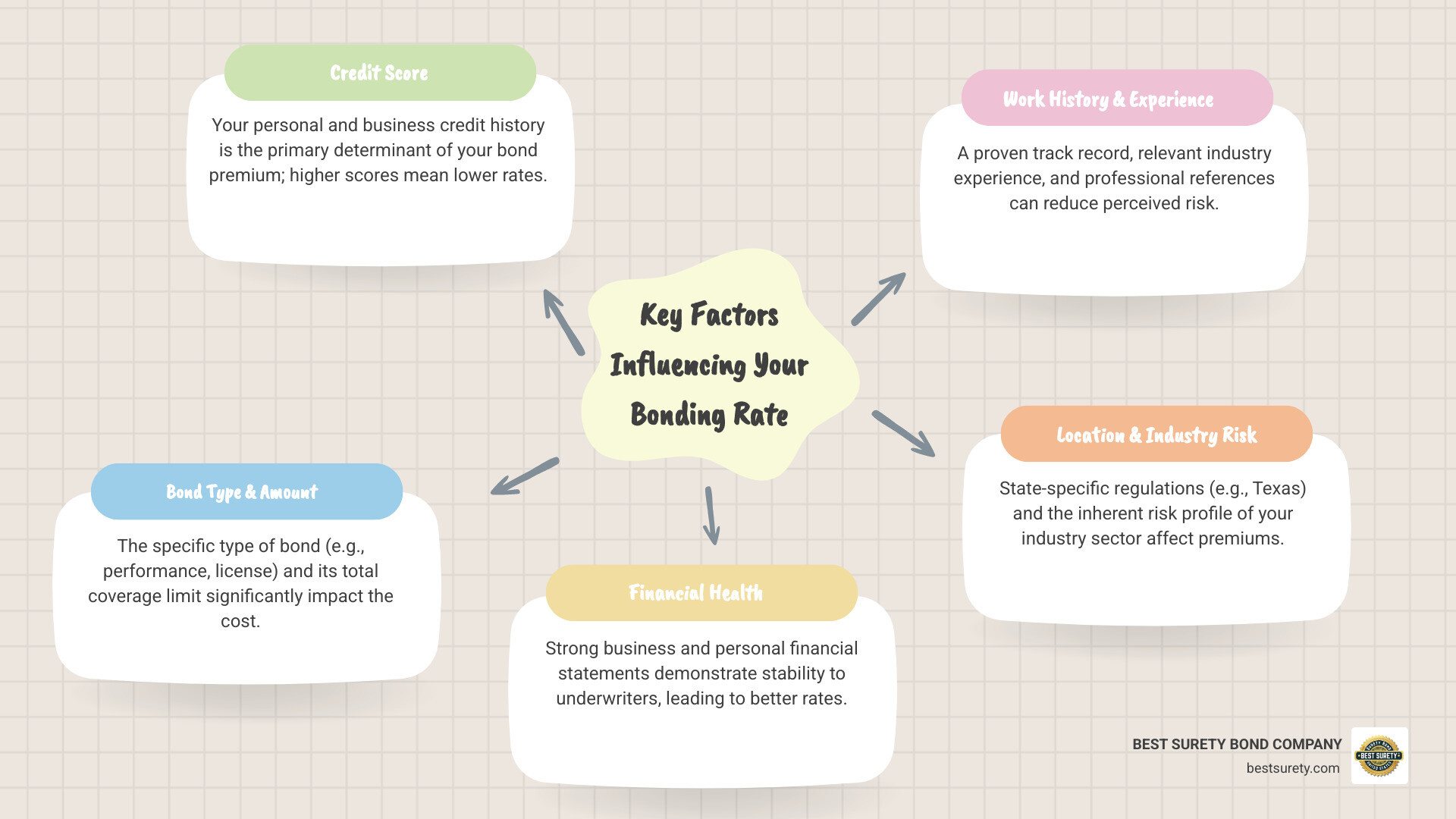
- Credit score (biggest factor)
- Bond type and amount
- Financial credentials
- Work history and experience
- Location and state requirements
- Risk level of your industry
The research shows that highly qualified applicants with strong credit pay as little as $250-$500 for a $50,000 bond, while those with poor credit might pay $2,500-$5,000 for the same coverage. That’s a massive difference that could make or break your project budget.
Whether you’re a contractor in Houston needing a performance bond, a Dallas auto dealer securing a license bond, or any Texas business owner trying to meet regulatory requirements, understanding bonding rates isn’t optional – it’s essential for your bottom line.
I’m Haiko de Poel. With over two decades of experience in finance and insurance, I’ve seen countless entrepreneurs overpay for bonds because they misunderstand how the bonding rate works. A smart bonding strategy can be the key to winning your next big contract.
Quick bonding rate terms:
What Is a Surety Bonding Rate?
A bonding rate is the percentage of the total bond amount you pay as a premium. It’s the price for the financial guarantee a surety bond provides to your clients or a government agency.
Unlike insurance for you, a surety bond is a financial guarantee for your client (the Obligee). It’s a three-party agreement between you (the Principal), the Obligee, and the surety company (the Surety) that backs your promise.
For Houston contractors bidding on city projects or Dallas businesses applying for professional licenses, surety bonds are often non-negotiable requirements. You simply can’t operate without them.
Why Texas businesses need bonds varies by industry and situation. License & Permit bonds ensure you’ll follow state and local regulations – think auto dealers, mortgage brokers, or contractors who need to prove they’ll operate ethically. Contract bonds are different beasts entirely, guaranteeing you’ll complete projects as promised and pay your subcontractors and suppliers.
Without these bonds, many Texas businesses would be locked out of lucrative government contracts or couldn’t even open their doors legally.
Is the Bond Amount the Same as the Bonding Rate?
This confusion trips up business owners every single day, so let’s set the record straight: No, the bond amount and bonding rate are completely different things.
The bond amount is like the coverage limit on an insurance policy – it’s the maximum dollar amount the surety will pay if something goes wrong. Think of it as the “safety net” amount.
The premium is what you actually write the check for – the real cost to get your bond.
The bonding rate is the percentage that connects these two numbers.
Here’s a simple analogy to an insurance policy: If you have a $200,000 home insurance policy, you don’t pay $200,000 for it. You might pay $1,200 per year based on your risk factors. Same concept with bonds.
Example: Let’s say you need a $100,000 performance bond for a construction project in Houston. If your bonding rate is 1%, your premium would be $1,000 – not $100,000. The bond amount represents the maximum protection for your client, while the premium represents your actual cost.
Why Risk Level Is Key to Your Bonding Rate
Every surety bond decision comes down to one fundamental question: How likely is this business owner to keep their promises?
Surety as risk management means we’re essentially betting on your success. When we issue your bond, we’re telling your clients, “We believe this business will deliver.” If you don’t, and we have to pay a claim, you’re legally required to pay us back.
This is why our underwriting process digs deep into your background. We’re not just checking boxes – we’re building a complete picture of your reliability.
High-risk bonds might involve new businesses, complex projects, or industries with higher failure rates. These situations naturally command higher bonding rates because the stakes are liftd.
Low-risk bonds typically go to established businesses with strong credit, solid financials, and proven track records. These applicants earn the lowest rates because they represent minimal risk to the surety company.
Contractor performance bonds perfectly illustrate this principle. A seasoned contractor with 20 years of successful project completions will get a much better bonding rate than someone just starting out – even for identical bond amounts.
Understanding this risk-based approach helps explain why improving your creditworthiness and business fundamentals directly impacts your premium calculation. Every positive change in your risk profile translates to real savings on your bonding costs.
The 6 Key Factors That Determine Your Surety Bonding Rate
Your bonding rate is determined by our underwriting process, which assesses the likelihood you’ll fulfill your obligations. We put our financial backing behind you, so we analyze several factors to gauge your reliability.
Understanding these factors empowers you to strengthen your application and lower your costs. Many are within your control, like improving your credit or organizing financial documents. For Texas business owners, from Houston contractors to Dallas service providers, knowing what we look for can significantly reduce your premium.
The key factors we’ll cover are your credit score, the bond’s type and amount, your financial and work history, your location, and your industry’s risk level. By optimizing these areas, you can secure a much better bonding rate.
1. Your Personal and Business Credit Score
When you apply for a surety bond with us, there’s one factor that carries more weight than almost anything else: your credit score. Think of it as your financial report card – it tells us at a glance how you’ve handled money in the past, and more importantly, how likely you are to honor your commitments.
Here’s the good news: we use a “soft” credit pull during our application process, which means checking your bond eligibility won’t ding your credit score. We’re simply looking to understand your financial picture so we can offer you the best possible bonding rate.
The impact of your credit on your premium can be dramatic. For a standard $50,000 bond, here’s what Texas businesses typically see:
| Credit Score Range | Estimated Premium for a $50,000 Bond |
|---|---|
| Over 675 | $250 – $1,500 (0.5% – 3%) |
| 600 – 675 | $1,500 – $2,500 (3% – 5%) |
| Under 599 | $2,500 – $5,000 (5% – 10%) |
That’s a potential difference of thousands of dollars for the exact same coverage. A Houston contractor with excellent credit might pay just $500 for their bond, while another contractor with poor credit could pay $3,000 or more.
But here’s something important: bad credit doesn’t mean no bond. We work with businesses across Texas every day who’ve faced financial challenges. Maybe you went through a tough period, had medical bills pile up, or your business hit a rough patch during the pandemic. We get it, and we have programs specifically designed to help.
While your bonding rate will be higher with poor credit – typically in that 5-10% range – we work hard to find you the most competitive rate available. Even better, as your credit improves over time, your renewal rates can come down significantly. We’ve seen clients cut their premiums in half after just one year of rebuilding their credit.
The key is being upfront about your situation. Our licensed agents have seen it all, and they’re experts at finding solutions that work for your specific circumstances.
2. The Type and Amount of the Surety Bond
Think of different bond types like different insurance policies – each carries its own level of risk, and that directly affects your bonding rate. A simple Contractor License bond that just ensures you follow basic licensing rules is going to cost you far less than a Performance bond guaranteeing you’ll complete a multi-million dollar Houston construction project on time and on budget.
Here’s why bond type matters so much: some bonds have higher claim rates than others. Court bonds, for instance, involve legal proceedings where outcomes can be unpredictable, so they typically carry higher bonding rates. Contract bonds like Performance bonds require us to guarantee not just that you’ll follow rules, but that you’ll actually deliver on complex projects – that’s a bigger risk for us, which means a higher rate for you.
License & Permit bonds, on the other hand, are usually straightforward. Whether you’re a Dallas auto dealer or a Houston contractor, these bonds primarily ensure you’ll comply with state and local regulations. Since most licensed professionals do follow the rules, claim rates are lower, and so are the bonding rates.
The bond amount itself works as a simple multiplier in your premium calculation. If your bonding rate is 2%, here’s how the math works:
A $10,000 bond costs you $200 annually
A $100,000 bond costs you $2,000 annually
Same rate, but ten times the bond amount means ten times the premium. This is exactly why it’s crucial to know the exact bond amount required for your situation – no more, no less.
At Best Surety Bond Company, we handle everything from basic license bonds to complex performance bonds across Texas and nationwide. Our licensed agents understand the risk profiles of different bond types and can help you secure the most competitive bonding rate for your specific needs.
3. Your Financial Credentials and Work History
When you’re applying for larger bonds or complex contract work, we need to look beyond your credit score to get the full picture of your financial stability. Think of it as getting to know you better before we vouch for your performance – we want to make sure you have the financial foundation to handle whatever project or obligation you’re taking on.
Your balance sheets reveal your business’s financial health. We analyze assets, liabilities, and equity to confirm you have the resources to meet your obligations. A strong balance sheet with manageable debt signals lower risk and helps secure a better bonding rate.
Income tax returns verify your profitability over time. A documented track record of consistent profits demonstrates stability and boosts our confidence in your ability to perform.
Bank statements complete the financial picture by showing your cash flow and liquidity. We need to see that you have enough working capital to manage daily operations while meeting bonded obligations.
For contractors especially, your work history carries significant weight in determining your bonding rate. When you provide a detailed resume highlighting your industry experience, past project successes, and relevant qualifications, you’re essentially building a case for why we should trust you with that bond. Have you completed similar projects before? Do you have the right licenses and certifications? Have you worked with reputable clients?
The more stable and experienced your financial and operational history appears, the more comfortable our underwriters feel – and that comfort translates directly into more favorable rates. It’s really about demonstrating reliability through documentation. We’ve found that applicants who take the time to prepare comprehensive financial documents and work histories not only get approved faster but often secure significantly lower premiums than those who submit incomplete applications.
4. Your Location: Bonding in Texas vs. Other States
Where your business operates plays a bigger role in your bonding rate than most people realize. Each state has its own regulatory landscape, bond requirements, and filing procedures that can significantly impact both your premium and the complexity of getting bonded.
Take auto dealers, for example. If you’re operating in Arizona, you might need a $100,000 surety bond to get licensed. Move your operation to South Dakota, and that requirement drops to just $25,000. Even with the same bonding rate, you’re looking at vastly different premium costs simply because of geography.
The differences go beyond just bond amounts. Some states have streamlined digital filing systems, while others still require paper applications and manual processing. Certain jurisdictions have specific forms, endorsements, or additional requirements that can add time and complexity to your bond application.
Texas presents unique opportunities and challenges for businesses seeking surety bonds. The Lone Star State has its own set of regulations, particularly for contractors working in major metropolitan areas. Houston’s booming construction industry has specific bonding requirements for public works projects, while Dallas businesses often steer different municipal bond regulations depending on the type of work they’re performing.
This is where our Texas-based expertise becomes invaluable. We understand the ins and outs of Texas bond regulations because we live and work here. Whether you’re a contractor bidding on a Houston infrastructure project or a Dallas-based business owner securing your first license bond, we know exactly what documentation you’ll need, which forms to file, and how to steer any local requirements that might trip up out-of-state providers.
But here’s what sets us apart: while we’re proud to be Texas experts, we’re also licensed in all 50 states. This means whether your business expands to California, New York, or anywhere in between, we can provide the same level of service and competitive rates. You get the best of both worlds – local expertise with national capabilities.
Our deep understanding of regional requirements means faster processing, fewer complications, and often better bonding rates because we know exactly how to present your application to meet each state’s specific criteria.
How to Calculate Your Premium and Lower Your Costs
Once you understand the factors that influence your bonding rate, calculating your actual premium becomes surprisingly straightforward. More importantly, knowing this calculation puts you in control of finding ways to reduce your costs and secure the best possible rate for your Texas business.
A Simple Formula for Calculating Your Bond Premium
The math behind your bond premium couldn’t be simpler. Here’s the formula that determines exactly what you’ll pay:
Premium ($) = Bonding Rate (%) × Bond Amount ($)
Let me walk you through a real-world example that many of our Houston contractors encounter. Say you need a $25,000 contractor license bond, and based on your solid credit score and clean financial history, we determine your bonding rate is 1.5%.
Your calculation would look like this:
Premium = 0.015 (1.5%) × $25,000 = $375
That’s it! For a $25,000 bond with a 1.5% bonding rate, you’d pay just $375 annually. The beauty of this formula is its simplicity, but the real value comes from understanding how to influence that bonding rate percentage in your favor.
Of course, determining your exact bonding rate requires our underwriting team to review your specific situation. That’s why we offer free, no-obligation quotes that give you precise numbers rather than estimates. Our online cost calculator can provide instant ballpark figures, but nothing beats a personalized quote from our licensed agents.
Pro Tips for Lowering Your Surety Bond Price
Taking proactive steps before you apply can save you hundreds or even thousands of dollars on your premium. Here’s how to lower your bonding rate:
- Improve your credit score: This is the most effective way to lower your premium. Pay down debts, dispute errors on your credit report, and maintain a consistent payment history.
- Prepare comprehensive financial documents: For larger bonds, organized balance sheets, income statements, and bank statements demonstrate professionalism and financial stability, which translates to better rates.
- Demonstrate relevant industry experience: A detailed resume and project history builds underwriter confidence, especially for contract and performance bonds.
- Work with an experienced agent: Our team at Best Surety Bond Company knows how to present your application to highlight strengths. We shop your bond with multiple surety companies to find the best rate and can identify multi-year discounts.
- Consider a co-signer: For new businesses or those with credit challenges, adding a qualified co-signer with strong financials can significantly improve your rate.
- Explore government programs: For contractors, the U.S. Small Business Administration’s Surety Bond Guarantee Program can help you qualify for bonds you might not get otherwise, opening up new contract opportunities.
One thing that sets us apart is our commitment to transparent pricing with zero hidden fees. We believe in upfront, honest pricing so you know exactly what you’re paying. Our Texas-based team specializes in helping businesses across Houston, Dallas, and all Texas counties secure the lowest possible rates. For detailed information, visit our comprehensive services page.
Understanding and optimizing your bonding rate is key to building a strong bonding relationship that serves your business for years, with the potential for even better renewal rates as your financial profile strengthens.
Frequently Asked Questions about Bonding Rates
The world of bonding rate calculations can feel overwhelming, especially when you’re trying to get your business up and running or secure that next big contract. Let me address the questions I hear most often from business owners across Texas and beyond.
Can I get a surety bond in Texas with bad credit?
Yes, absolutely. While a lower credit score results in a higher bonding rate (typically 3-10% of the bond amount), it does not prevent you from getting bonded. We approve a very high percentage of applicants through our specialized bad credit bonding programs. We work to find you the best possible price. Better yet, your bonding rate isn’t permanent. As you improve your credit, you can qualify for significantly lower rates at renewal, a path many of our Texas clients have successfully taken.
Does it cost anything to apply for a bond?
No. Our application process is completely free with no hidden fees. We provide free, no-obligation quotes so you know your exact bonding rate and premium before committing. For many license bonds, quotes are instant online. For more complex contract bonds, we typically provide a quote within one business day. Applying is the only way to determine your precise cost, and there is no risk in finding out your options.
Are surety bond premiums refundable?
Typically, surety bond premiums are non-refundable once the bond is issued. The premium is considered fully earned the moment we issue the bond because we have assumed the financial risk for the entire term. This policy holds even if your business circumstances change or you no longer need the bond before the term ends. Prorated refunds are rare and only occur in very specific circumstances. We encourage you to work with our licensed agents to ensure you get the correct bond amount and term for your needs, making your investment effective from the start.
Get Your Instant Bonding Rate Quote Today

Now that you understand how your bonding rate is determined, you’re ready to take the next step. Your credit score is typically the biggest factor, followed by the type and amount of bond you need, your financial credentials, and your work history. These elements work together to create your unique risk profile, which directly impacts your premium.
The difference between a good bonding rate and a poor one can literally save or cost your business thousands of dollars. We’ve seen Houston contractors save over $2,000 annually just by improving their credit score before applying. Dallas business owners have secured bonds at half the cost by working with experienced agents who know how to present their applications effectively.
At Best Surety Bond Company, we’ve made it our mission to get you fast approvals and low rates guaranteed. Whether you’re a small business owner needing a license bond or a contractor bidding on a major project requiring performance bonds, our Texas-based experts understand the local requirements while maintaining our national service capabilities.
Our licensed agents are ready to help you steer the process, from understanding state-specific requirements to preparing your financial documents for the strongest possible application. We pride ourselves on same-day approvals for most bond types and instant online quotes that give you real numbers, not estimates.
Don’t let uncertainty about bonding costs hold back your next big opportunity. Get your free quote for a surety bond right now and find why thousands of businesses across Texas and all 50 states trust us for their bonding needs.
Your business success is waiting – and it might cost less than you think.
