

Why Your Collection Agency Needs a Surety Bond
A collection agency bond is a legally required surety bond that guarantees your debt collection business will operate ethically and comply with state regulations. This three-party financial agreement protects consumers and ensures proper handling of collected funds.
Key Collection Agency Bond Requirements:
- Required by law – Most states mandate bonding before licensing
- Bond amounts – Typically range from $2,000 to $50,000 depending on state
- Premium cost – Usually 0.75% to 5% of bond amount (minimum $100)
- Purpose – Protects consumers from fraud, theft, and unethical practices
- Claims – Filed when agencies violate regulations or mishandle funds
Collection agencies are generally required by the states in which they operate to acquire a surety bond before they can do business. These bonds serve as financial protection for both the government agencies that regulate debt collection and the consumers whose debts are being collected.
The bond ensures that if your collection agency fails to follow proper procedures – such as misappropriating funds, discriminating against debtors, or violating the Fair Debt Collection Practices Act – affected parties can file a claim for compensation up to the full bond amount.
Why bonds are essential:
- Legal compliance for business licensing
- Consumer protection against unethical practices
- Industry credibility and trust building
- Financial guarantee for proper fund handling
I’m Haiko de Poel, and through my experience scaling businesses across fintech and legal services, I’ve helped numerous collection agencies steer surety bond requirements to achieve compliant, profitable operations. Understanding collection agency bond requirements is crucial for any debt collection business seeking to operate legally and build lasting client relationships.
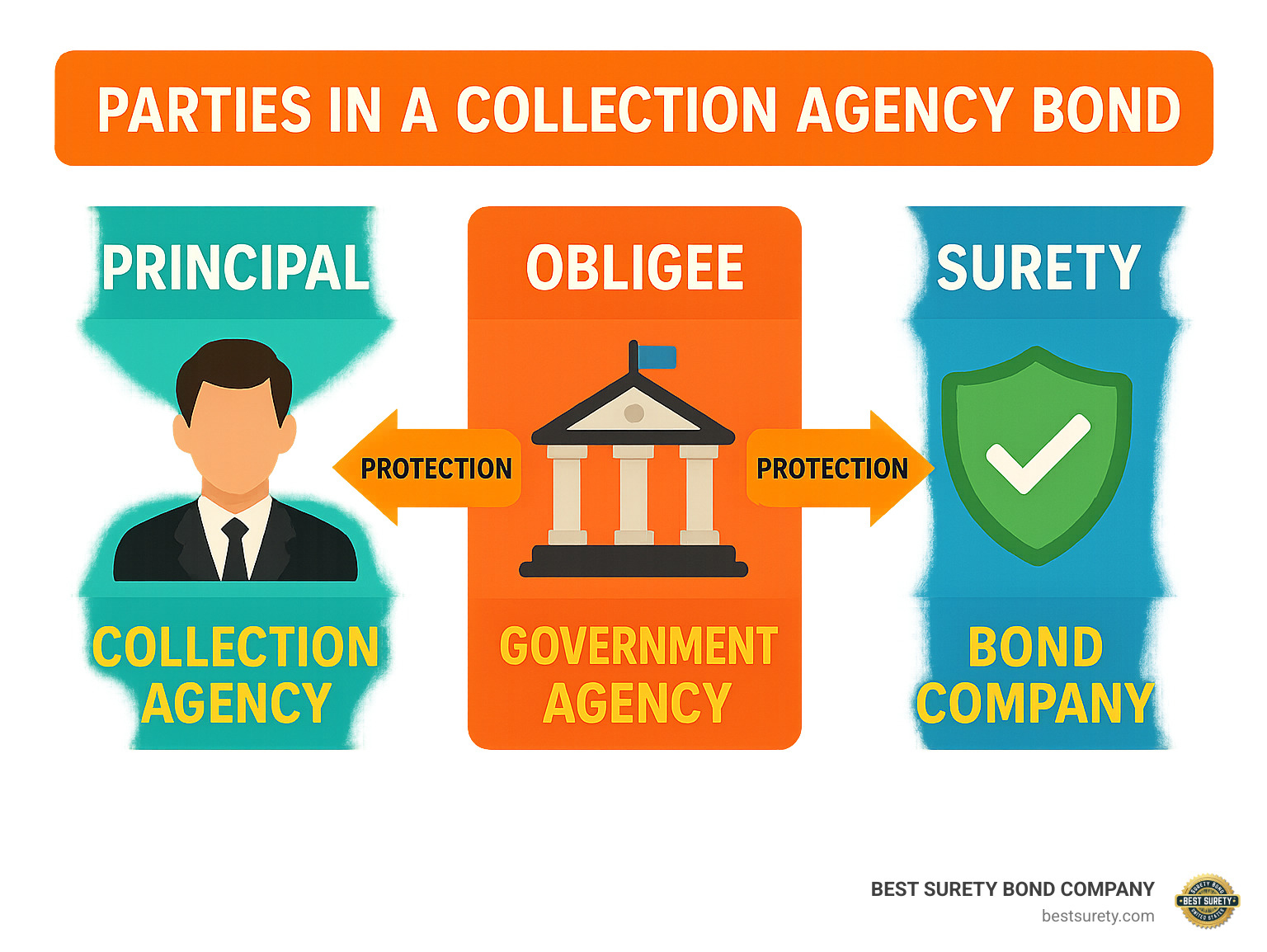
How a Collection Agency Bond Works: A Three-Party Agreement
Understanding how a collection agency bond works is simpler than you might think. Think of it as a safety net that protects everyone involved in the debt collection process – from consumers to government regulators to your business clients.

Every collection agency bond involves three key players, each with a specific role in this financial guarantee arrangement.
The Principal – that’s you, the collection agency owner. When you purchase a bond, you’re making a promise to operate your business according to all applicable laws and regulations. You’re essentially saying, “I’ll play by the rules, and if I don’t, I’ll make it right.”
The Obligee is the government entity requiring your bond – whether it’s Texas’s Department of Licensing and Regulation, another state’s commerce department, or a specific licensing board. They set the bond requirements to protect consumers and ensure industry standards are met. The obligee acts as the watchdog, making sure collection agencies stay compliant.
The Surety is the bond company (like us at Best Surety Bond Company) that issues your bond. We provide the financial guarantee to the government that you’ll follow the rules. If something goes wrong and a valid claim is filed, we’ll step in to pay it – but here’s the key difference from insurance: you’ll need to reimburse us for any amounts we pay out.
This three-party structure creates a powerful incentive for ethical conduct throughout the debt collection industry. It ensures that sensitive consumer information is handled properly, collected funds are remitted correctly, and aggressive or illegal collection tactics are avoided.
Federal law compliance, particularly with The Fair Debt Collections Practices Act (FDCPA), is a cornerstone of what your bond guarantees. The FDCPA protects consumers from harassment, false statements, and unfair collection practices – violations that could trigger bond claims.
The consequences of being unbonded can devastate your collection agency business. Operating without proper bonding exposes you to fines that can reach thousands of dollars, lawsuits from affected consumers or clients, and license suspension that shuts down your operations entirely. In Texas and most other states, attempting to operate a collection agency without the required bond isn’t just risky – it’s illegal.
The beauty of this system is that it creates trust all around. Consumers know there’s financial protection if something goes wrong. Government regulators have assurance that agencies will follow the rules. And collection agencies like yours can operate with credibility, knowing that being properly bonded demonstrates your commitment to professional, ethical business practices.
The Essential Collection Agency Bond: Requirements and Costs
When it comes to collection agency bond requirements, there’s no one-size-fits-all approach. Each state sets its own rules, bond amounts, and regulations based on local consumer protection needs and industry risks. This means if you’re operating across multiple states, you’ll likely need separate bonds for each jurisdiction.
The variation in requirements can be quite striking. In Arizona, the Department of Commerce requires a $10,000 bond, while Idaho’s Department of Finance sets theirs at just $2,000. North Carolina takes a more dynamic approach, requiring between $10,000 to $30,000 based on your agency’s actual collections from the previous year – specifically, one-sixth of your total net collections with a $30,000 cap. Meanwhile, Florida collection agencies often face higher stakes with requirements starting at $50,000 or more.
Here in Texas, where we’re based in Houston and serve agencies across Dallas, Austin, San Antonio, and beyond, the state has its own specific requirements that we know inside and out. Our local expertise helps ensure your agency meets all necessary regulations without any surprises.

Here’s how bond amounts vary across key states:
| State/Province | Bond Amount | Regulating Body |
|---|---|---|
| Arizona | $10,000 | Department of Commerce |
| Idaho | $2,000 | Department of Finance |
| North Carolina | $10,000 – $30,000 | Commissioner of Insurance |
| Florida | $50,000+ | State-specific licensing authority |
| New Brunswick, Canada | $10,000 | Financial and Consumer Services Commission |
Factors Influencing Your Bond Premium
While the state determines your bond amount, what you actually pay in premium depends on several key factors that reflect your agency’s risk profile and the specific bond terms.
Your credit score is typically the biggest factor in determining your premium rate. Collection agencies with strong credit histories and financially stable ownership can expect to pay the lowest rates – usually between 0.75% to 5% of the bond amount. However, if your credit isn’t perfect, don’t worry. We work with agencies across the credit spectrum, though premiums may range higher, sometimes 5% to 15% or more, depending on the perceived risk.
Business financials and industry experience also play important roles. Newer agencies or those with less robust financial statements might face higher premiums initially. A longer track record of stable operations demonstrates reliability to underwriters and often translates to better rates over time.
The bond form wording itself can significantly impact costs. Aggregate limits determine whether the surety’s liability is capped at the bond amount for the entire term or applies to each individual claim. Bonds without aggregate limits typically cost more due to the increased exposure. Cancellation provisions also matter – standard 30-day cancellation periods usually result in lower premiums than bonds with longer notice requirements or no cancellation options.
It’s worth noting that a credit check is required for all collection agency bonds, but we make the process as smooth as possible with fast underwriting and clear communication about what’s needed.
Understanding the Cost of a Collection Agency Bond
The good news is that collection agency bonds are remarkably affordable for the protection they provide. With premium rates typically ranging from 0.75% to 5% of the bond amount, most agencies find the cost very manageable within their operating budgets.
There’s usually a minimum premium of around $100, which is standard across the industry. What’s impressive is the value you receive – for just that $100 minimum, your agency could secure up to $10,000 in coverage. That’s substantial financial protection for less than the cost of a nice dinner.
At BEST SURETY BOND COMPANY, we specialize in providing instant quotes and affordable premiums to collection agencies throughout Texas and nationwide. Whether you’re a startup agency in Houston or an established operation expanding into new states, we understand that speed and cost-effectiveness are crucial to your business success. Our streamlined process means you can get bonded quickly without breaking the bank, allowing you to focus on what you do best – managing collections professionally and ethically.
The Bond Claim Process and How to Avoid It
Nobody wants to face a claim against their collection agency bond, but understanding the process helps you protect your business and maintain compliance. When someone believes your agency has violated regulations or acted improperly, they can file a claim that triggers a formal investigation process.
Who has the power to file a claim? The answer might surprise you – it’s broader than many agency owners realize. Claims can come from consumers who feel they’ve been treated unfairly, clients who believe funds were mishandled, or even state regulators who find compliance violations during routine audits.
Once a claim lands on our desk as your surety company, we immediately begin a thorough investigation. Think of us as neutral investigators – we’re not automatically on anyone’s side. Our job is to determine whether the claim has merit based on facts, documentation, and applicable laws.

During this investigation phase, your cooperation is absolutely essential. We’ll ask for records, correspondence, and detailed explanations of your agency’s actions. We also expect you to work directly with the claimant to resolve the issue if possible – many disputes can be settled without a formal payout.
Here’s where things get serious: if we determine the claim is valid and you can’t resolve it, we’ll pay the claimant up to your bond amount. But remember, a surety bond isn’t insurance for your business. When you obtained your bond, you signed an indemnity agreement promising to reimburse us for any payments we make on your behalf, plus legal fees and investigation costs.
This reimbursement obligation makes avoiding claims your top priority. It’s not just about protecting your reputation – it’s about protecting your bottom line.
Common Reasons for a Claim Against a Collection Agency Bond
Understanding why claims happen is your best defense against them. In our experience working with collection agencies across Texas and nationwide, certain violations appear repeatedly in claim files.
Misuse of funds or theft tops the list of serious violations. This happens when agencies use collected money for operating expenses instead of promptly forwarding it to clients, or worse, when funds simply disappear into personal accounts.
Failure to remit payments to clients is closely related but often stems from poor bookkeeping rather than intentional fraud. When your agency collects $50,000 for a client but only sends $35,000 without proper documentation, you’re asking for trouble.
Fraud or misrepresentation covers a wide range of deceptive practices. This might include inflating debt amounts, claiming authority you don’t have, or making promises about payment arrangements that you can’t keep.
Violations of the FDCPA or state laws represent the largest category of claims. The Fair Debt Collection Practices Act sets strict boundaries around collection activities. Common violations include calling debtors before 8 AM or after 9 PM, contacting family members about the debt, using threatening language, or failing to provide required debt validation notices within five days of initial contact.
Unethical collection practices can trigger claims even when they don’t violate specific laws. Aggressive tactics that cross the line into harassment, discrimination against certain groups of debtors, or adding unauthorized fees all create liability for your agency.
The good news? Most claims are completely preventable through proper training, clear procedures, and consistent compliance monitoring. We’ve seen agencies operate for decades without a single claim by simply following the rules and treating consumers with respect.
At BEST SURETY BOND COMPANY, we’re here to help Houston-area agencies and businesses nationwide understand these requirements and maintain the high standards that protect both your bond and your reputation.
Securing Your Bond: A Simple, Fast Process for Texas Agencies and Beyond
Getting your collection agency bond doesn’t have to be complicated or time-consuming. At BEST SURETY BOND COMPANY, we’ve designed our process to be as straightforward as possible, especially for our clients throughout Texas and nationwide. We know you need to get bonded quickly so you can focus on what matters most – running your business.
The Application Process:
Starting your bond application is easier than you might think. First, you’ll want to determine your state’s specific requirements by contacting the department that regulates collection agencies in your operating states. They’ll confirm the exact bond amount and any special forms needed for your situation.
Once you know what’s required, simply submit your application to us with basic information about your business, ownership details, and financial background. Our underwriting process includes a necessary credit review, but don’t worry – for most collection agency bonds, especially smaller amounts, we can move very quickly through approval.
After approval, you’ll sign an indemnity agreement that protects us if we need to pay a claim on your behalf. Then we issue your bond and you file it with your license application to the state. That’s it – you’re ready to operate legally!
Fast Approval and Same-Day Issuance:
We understand that every day without your bond is a day you can’t do business. That’s exactly why we prioritize fast approvals and offer same-day issuance for your collection agency bond whenever possible. Our streamlined online system and experienced team work together to eliminate unnecessary delays and get you bonded fast.
Being Houston-based with deep Texas roots, we understand the local business environment and can move quickly on Texas applications. But our expertise extends far beyond the Lone Star State. We’re licensed in all 50 states, so whether you’re collecting debts in Dallas, Denver, or Detroit, we’ve got you covered. You can find more info about our nationwide services on our website.
Required Documentation:
To keep things moving smoothly, it helps to have your paperwork ready. You’ll typically need your business license information and financial statements for larger bond amounts or if credit needs additional review. We’ll also need personal financial information from business owners for the required credit check.
Our team of licensed agents is standing by to guide you through each step and make sure you have everything needed for a smooth, fast approval process. We’re here to make getting bonded the easy part of starting or maintaining your collection agency business.
Frequently Asked Questions about Collection Agency Bonds
Understanding collection agency bonds can feel overwhelming, especially when you’re trying to get your business up and running quickly. We’ve helped thousands of collection agencies across Texas and nationwide steer these requirements, so let’s address the questions we hear most often.
What happens if a claim is filed against my bond?
When someone files a claim against your collection agency bond, it’s natural to feel concerned. Here’s exactly what happens: we’ll immediately launch a thorough investigation to determine whether the complaint has merit. During this process, we’ll work closely with you to understand your side of the story and gather all relevant documentation.
If we find the claim is valid, you’ll have the first opportunity to resolve the matter directly with the claimant. This is often the best outcome for everyone involved, as it allows you to maintain control over the situation and potentially preserve business relationships.
However, if you’re unable to reach a resolution and the claim is legitimate, we’ll step in to pay the claimant up to your bond amount. This protects the public and fulfills our obligation to the state. But here’s the crucial part: this isn’t insurance for your agency. You’ll need to reimburse us for the full amount we paid out, plus any legal fees and investigation costs. This is why we always recommend focusing on prevention through strict compliance with all regulations.
Can I get a collection agency bond with bad credit?
Absolutely! Having less-than-perfect credit doesn’t automatically disqualify you from getting a collection agency bond. We understand that business owners face financial challenges, and we’ve developed specialized programs to help agencies with various credit profiles get bonded.
While excellent credit can get you premium rates as low as 0.75% to 1% of your bond amount, we can often approve applicants with credit challenges at rates typically ranging from 5% to 15%. The exact rate depends on several factors beyond just your credit score, including your business experience, financial statements, and the specific bond requirements in your state.
Our Houston-based team has worked with collection agencies across the credit spectrum, and we pride ourselves on finding solutions even when other companies say no. Don’t let credit concerns delay your licensing process – reach out for a free quote and let us explore your options together.
How do bond requirements vary between states like Texas and others?
This is where things get interesting – and sometimes frustrating for agencies operating in multiple states. There’s no federal standard for collection agency bond amounts, so each state sets its own rules based on local regulations and risk assessments.
Here in Texas, we see requirements that reflect our state’s approach to consumer protection and business regulation. But when you compare this to other states, the differences can be dramatic. Arizona requires a $10,000 bond through their Department of Commerce, while Idaho only requires $2,000 through their Department of Finance. Florida often requires $50,000 or more, and North Carolina has a unique sliding scale that can range from $10,000 to $30,000 based on your annual collection volume.
What makes this even more complex is that each state requires its own separate bond. You can’t use your Texas bond to operate in Arizona or Florida. Each jurisdiction wants its own guarantee that you’ll follow their specific laws and regulations.
As a Houston-based company with national reach, we’ve helped agencies steer these varying requirements across all 50 states. Our licensed agents understand the nuances of different state regulations and can help you get properly bonded wherever your business takes you. We’ll make sure you’re compliant in every jurisdiction where you operate, so you can focus on growing your collection agency with confidence.
Conclusion: Get Bonded and Operate with Confidence
Your collection agency bond represents far more than a simple regulatory checkbox – it’s the foundation that transforms your debt collection business into a trusted, compliant operation that both consumers and clients can rely on. This essential financial guarantee demonstrates your commitment to ethical practices while providing the consumer protection that today’s marketplace demands.
When you secure proper bonding, you’re not just meeting state requirements. You’re actively building trust within the industry and ensuring compliance with complex federal and state regulations. This trust becomes invaluable currency in an industry where reputation directly impacts your ability to attract quality clients and maintain long-term business relationships.
The benefits extend beyond mere compliance. A properly bonded collection agency signals professionalism, financial stability, and operational integrity to potential clients. It shows that you’re serious about following the rules and protecting the interests of everyone involved in the debt collection process.
At BEST SURETY BOND COMPANY, we understand the unique challenges facing collection agencies, especially here in Texas where we’ve built our reputation as Houston’s trusted surety provider. Our deep roots in the local market, combined with our nationwide service capabilities, mean we can support your bonding needs whether you’re operating in Harris County or expanding across state lines.
We’ve streamlined the entire bonding process to get you up and running quickly. Our Houston-based experts know the ins and outs of Texas regulations, while our national licensing allows us to serve collection agencies in all 50 states. We pride ourselves on fast approvals, competitive rates, and the kind of personalized service that only comes from working with a company that truly understands your business.
Don’t let bonding requirements become a roadblock to your success. Whether you’re starting a new collection agency or need to renew existing coverage, we’re here to make the process simple, fast, and affordable.
Get Your Free, No-Obligation Quote Today!
