
Why Contractor Bonds and Insurance Are Non-Negotiable for Your Business

Contractor bonds and insurance are not the same thing, but you need both to run a credible, protected business. Here’s the quick breakdown:
Contractor Bonds:
- Protect your client (the project owner).
- Guarantee you’ll complete the work as promised.
- You must repay the surety company if they pay a claim.
- Required for most public projects and many licenses.
Contractor Insurance:
- Protects your business from accidents and lawsuits.
- Covers property damage, injuries, and other liabilities.
- The insurer pays claims—you don’t repay them.
- Required by law in most states (especially workers’ comp).
Bottom line: Bonds guarantee your performance to clients. Insurance protects your assets from unexpected losses. You need both to operate legally, win contracts, and build trust.
As a contractor, you face risks from every angle: unfinished job claims, on-site injuries, or unpaid subcontractors. Without the right protections, any of these could bankrupt your business. That’s where contractor bonds and insurance come in. They work together to shield you and your clients from financial disaster, but they serve distinct purposes.
For example, many Texas public-sector projects require surety bonds, and federal contracts over $100,000 require them under the Miller Act. Getting bonded and insured doesn’t have to be complicated or expensive.
I’m Haiko de Poel, and with over two decades of experience, I’ll guide you through everything you need to know to protect your business, win more projects, and operate with confidence.
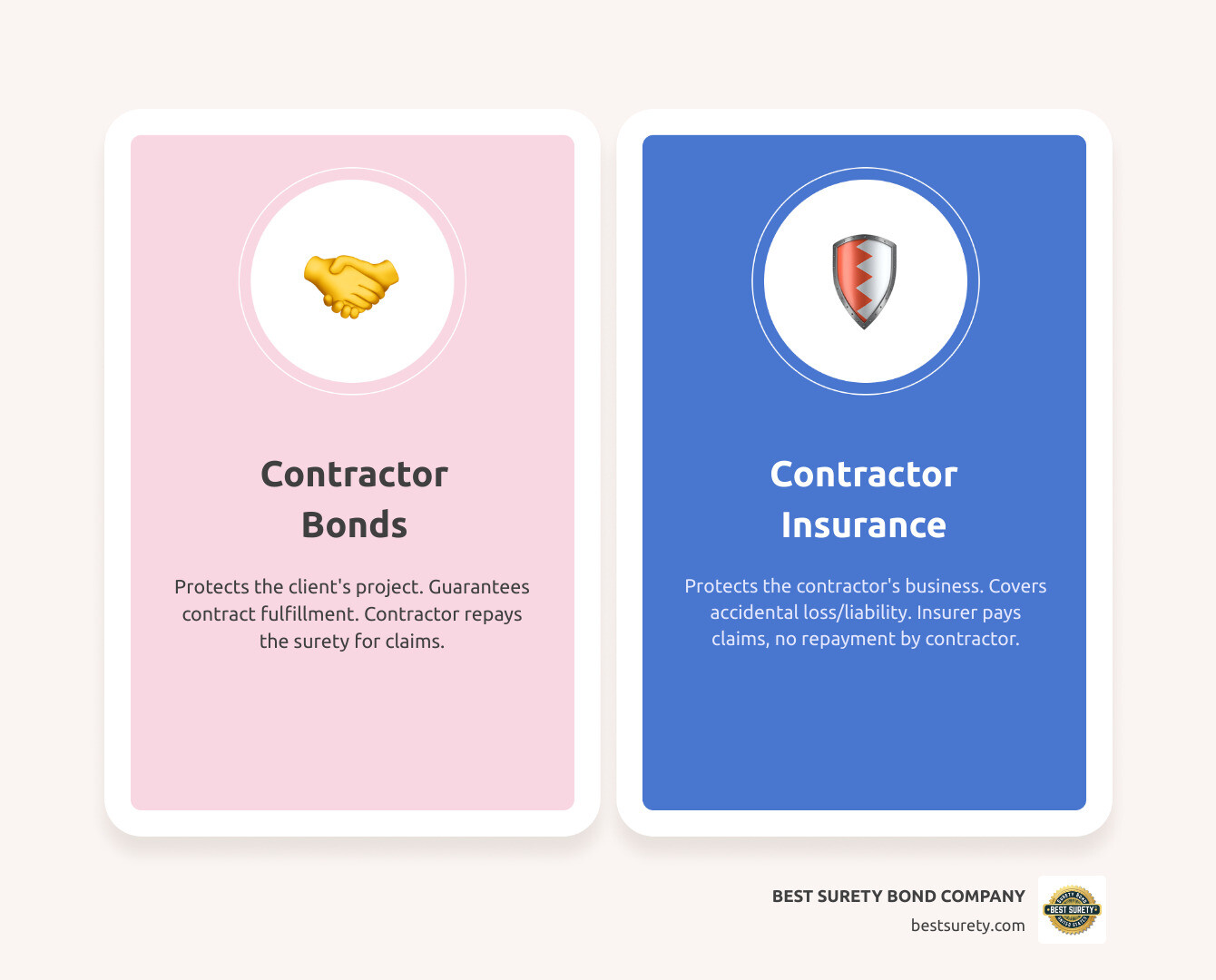
Contractor Bonds vs. Insurance: A Tale of Two Protections
Many contractors find the distinction between contractor bonds and insurance confusing. While they’re often mentioned together, they protect different parties. Think of it this way: a bond is a promise you make to your client, while insurance is a safety net for your business. Understanding this is essential for running a legitimate operation, especially when bidding on public projects in Texas.
| Feature | Contractor Bonds | Contractor Insurance | Key Difference |
|---|---|---|---|
| Who is Protected? | Project Owner/Client | Contractor’s Business | Bonds protect the client; Insurance protects the contractor. |
| Agreement Type | Three-Party: Contractor, Client, Surety Company | Two-Party: Contractor, Insurer | Bonds involve a third-party guarantee; Insurance is a direct contract. |
| Purpose | Guarantees contract fulfillment & regulatory compliance | Covers accidental loss, liability, & property damage | Bonds ensure performance; Insurance covers unforeseen risks. |
| Claim Payout | Contractor repays the surety company | Insurer pays claim from premiums; contractor does not repay | Bonds are like a line of credit; Insurance is risk transfer. |
Who is Protected?
A contractor bond protects your client (the obligee). It’s a financial guarantee that you’ll fulfill your contract. If you fail to complete the work or pay subcontractors, the bond ensures the project owner doesn’t lose their investment. For example, a performance bond allows a Houston project owner to recover losses if you go out of business, while a payment bond ensures your subs and suppliers get paid.
Contractor insurance, on the other hand, protects your business. If a worker is injured or you accidentally damage a client’s property, your insurance policies cover those costs. Without it, you’d pay out-of-pocket, which could easily sink your company.
How Do Claims Work?
The claims process highlights the fundamental difference. If a claim is filed against your bond (e.g., you abandoned a project), the surety company investigates. If the claim is valid, the surety pays the client, but you must repay the surety every penny. A bond is not insurance; it’s a form of credit.
Insurance claims are different. If a client is injured at your job site, they file a claim against your general liability policy. Your insurer investigates and, if covered, pays the medical and legal costs up to your policy limit. You pay a deductible, but you don’t reimburse the insurer for the claim payout. This is risk transfer.
Smart contractors carry both. Bonds show clients you’re trustworthy, while insurance protects your business from the everyday risks of construction.
Decoding Contractor Bonds: Your Guarantee of Performance
Think of a contractor bond as a three-way promise between you (the contractor), the project owner, and a surety company. It guarantees the work gets done right and everyone gets paid.
Unlike insurance, which protects your business, a bond protects your client from you failing to deliver. It’s a financial guarantee that you’ll complete the work, pay your team, and follow all laws. For many contractors, especially those bidding on public projects in Texas, bonds are the price of admission to more profitable work. They are a powerful tool for building credibility.
At BEST SURETY BOND COMPANY, we help Texas contractors get the bonds they need quickly. Learn more in our guide to contract bonds.
What are the Main Types of Contractor Bonds?
Different project stages require different bonds.
- Bid Bonds: Guarantee that if you win a bid, you will sign the contract and provide the required performance and payment bonds. Many public sector bids are invalid without one.
- Performance Bonds: Guarantee you will complete the project according to the contract’s terms. If you fail, the project owner can file a claim to recover losses and hire a replacement.
- Payment Bonds: Guarantee that your subcontractors, laborers, and suppliers will be paid. This is crucial on public projects where mechanics liens are not an option.
- Maintenance Bonds: Cover defects in workmanship or materials for a specified period (usually one year) after project completion.
- License and Permit Bonds: Often required by states and cities (like Houston or Dallas) to operate legally. They ensure you’ll follow local regulations and treat customers fairly.
These types of contractor bonds create a system of accountability that protects everyone.
How Are Contractor Bond Costs Determined?
The premium for a contractor bond is a small percentage of the bond’s total value, typically 0.5% to 3% for contractors with good credit and financials. A $100,000 performance bond might cost between $500 and $3,000.
Key factors influencing your rate include:
- Credit Score: The single most important factor. A strong score means lower premiums.
- Financial Stability: Surety companies review your business financials and cash reserves.
- Experience: A proven track record of successful projects reduces your perceived risk.
- Bond Type and Size: Larger or more complex bonds cost more.
Even with less-than-perfect credit, you can still get bonded, though rates may be higher (5% to 15%). We work with contractors across the credit spectrum to find competitive rates.
What Happens When a Bond Claim is Filed?
When a claim is filed against your contractor bond, it means someone (like the project owner or a subcontractor) alleges you failed to meet your obligations. The claim goes to the surety company, which launches an investigation to verify its validity. This protects you from frivolous claims.
If the claim is valid, the surety will resolve it—for instance, by paying an unpaid supplier or hiring another contractor to finish the job. However, this is where bonds differ from insurance: you must repay the surety company for the full amount they paid out, plus any legal and administrative costs. A bond claim can damage your ability to get bonded in the future, so it’s critical to fulfill your contracts and pay your team on time.
Understanding Contractor Insurance: Your Business Safety Net
While contractor bonds protect your clients, contractor insurance is your business’s personal bodyguard. It’s a collection of policies designed to shield your company from the financial fallout of accidents, lawsuits, and property damage.
Bonds are about keeping promises, but insurance is about surviving when things go wrong. In construction, it’s not a matter of if but when. We partner with top-rated insurers to provide comprehensive coverage for contractors in Texas and nationwide.
What are the Common Types of Contractor Insurance?
Certain policies are essential for nearly every contracting business.
- General Liability Insurance: Your first line of defense. It covers third-party claims of bodily injury, property damage, and advertising injury. If a visitor trips on your job site or you damage a client’s property, this policy pays for medical bills, repairs, and legal fees.
- Workers’ Compensation Insurance: A legal requirement in most states, including Texas, if you have employees. It covers medical expenses and lost wages for employees with work-related injuries and protects your business from related lawsuits.
- Builder’s Risk Insurance: Covers the structure under construction, as well as on-site materials, from perils like fire, theft, and severe weather. If a storm damages your Houston job site, this policy covers the repair costs.
- Commercial Auto Insurance: Vital if your business uses vehicles. It covers liability and physical damage if you or an employee is in an accident while driving for work.
- Inland Marine Insurance: Protects your tools and equipment while in transit or at a job site from theft, damage, or loss. If tools are stolen from your truck, this policy helps cover the replacement cost.
How are contractor insurance and bond premiums calculated?
Unlike bond premiums, which are heavily tied to credit, contractor insurance premiums are based on statistical risk. Key factors include:
- Location: Operating in a dense urban area like Houston may carry higher risks (theft, traffic) than a rural town, affecting rates.
- Coverage Limits: Higher limits mean more protection and higher premiums.
- Number of Employees: More employees increase the statistical likelihood of a workers’ comp claim.
- Company Revenue: Higher revenue often correlates with larger projects and greater liability exposure.
- Services Provided: High-risk work like roofing or demolition commands higher premiums than lower-risk trades like painting.
What Happens When an Insurance Claim is Filed?
The insurance claims process acts as a financial buffer for your business. First, you notify your provider of the incident. The insurer then investigates to determine if the claim is valid and covered by your policy.
If the claim is approved, the insurer pays for damages, medical bills, or legal costs up to your policy’s limit, minus your deductible. Crucially, and unlike with contractor bonds and insurance, you do not repay the insurance company for the claim amount. The insurer absorbs the cost. However, a history of claims can lead to higher premiums at renewal, so practicing good risk management is always the best strategy.
Getting Bonded in Texas: A Quick and Simple Guide
For contractors in Texas, getting contractor bonds shouldn’t be a hurdle. Whether you’re in Houston, Dallas, San Antonio, or Austin, we’ve streamlined the process to get you bonded fast—often on the same day.
As a Texas-based company licensed in all 50 states, we understand local requirements and can support your business wherever it grows. Our mission is to make bonding fast, affordable, and hassle-free so you can focus on building.
The Fast-Track Process to Obtaining Your Contractor Bond
We designed our process to be the fastest in the industry:
- Apply Online in Minutes: Our simple digital application is contractor-friendly and can be completed from any device.
- Fast Underwriting Review: Our expert underwriters provide approvals in hours, not days. Same-day issuance is often possible.
- Get Your Low-Cost Quote: We shop your application with multiple surety companies to guarantee the best rates.
- Pay & Receive Your Bond Instantly: Pay securely online and receive your official bond document by email immediately.
Ready to start? Get Your Free Quote Now and see why thousands of contractors trust us.
Are contractor bonds and insurance legally required in Texas?
Yes, both contractor bonds and insurance are often legally required in Texas, depending on your work.
- Federal Requirements: The Miller Act mandates performance and payment bonds for federally-funded construction projects over $100,000, which applies nationwide.
- Texas State and Local Requirements: Many public works projects in Texas require bonds to protect public funds. The specific thresholds vary, but expect to need them for government-funded schools, roads, or infrastructure.
- Licensing Requirements: Various Texas state boards require license bonds to operate legally in certain trades, guaranteeing you’ll follow industry regulations.
- City-Specific Ordinances: Cities like Houston, Dallas, and San Antonio have their own bonding rules for permits, right-of-way work, or projects affecting public property. Always check with the local permitting office.
On the insurance side, workers’ compensation is mandatory in Texas if you have employees. While not always state-mandated, general liability insurance is almost universally required by clients to sign a contract. For more details on Texas surety rules, visit the Texas Department of Insurance. We’re here to help you steer these requirements.
Why Smart Contractors Need Both Bonds and Insurance
Thriving contractors understand that contractor bonds and insurance aren’t redundant—they’re two sides of a complete protection strategy. Your bond tells clients, “I guarantee my work,” while your insurance says, “My business can handle accidents.” One without the other leaves you exposed.
Being bonded and insured builds immediate trust. When clients in competitive markets like Houston see you’ve made a financial commitment to protect them and yourself, it can be the deciding factor in winning a bid. It signals you’re a professional, not a fly-by-night operation.
Practically, you cannot access the most profitable projects without both. Federal projects (Miller Act), state and municipal work, and most large commercial clients require both bonds and proof of insurance. These protections are your ticket to bigger opportunities and steady growth.
Being “bonded and insured” is the gold standard of credibility. It’s a competitive advantage that tells the market you’re responsible, reliable, and built to last. It’s not just paperwork; it’s a smart business strategy that protects your assets, builds trust, and open ups your company’s potential.
Frequently Asked Questions about contractor bonds and insurance
Here are quick answers to the most common questions we hear from contractors.
What’s the main difference between being bonded and insured?
Being bonded means you have a surety bond that protects your client by guaranteeing you’ll fulfill your contract. If the surety pays a claim, you must reimburse them. It’s a form of credit.
Being insured means you have policies (like general liability) that protect your business from financial loss due to accidents or lawsuits. The insurer pays the claim, and you do not have to repay them.
In short, contractor bonds and insurance are complementary: bonds guarantee your performance to others, while insurance protects your own assets.
Can I get a contractor bond in Texas with bad credit?
Yes. While a strong credit score secures the lowest rates (0.5% to 3% of the bond amount), we specialize in helping contractors with credit challenges. For higher-risk applicants, premiums may range from 5% to 15%, but we work with surety partners who have programs designed for these situations. We can almost always find a solution to get you the contractor bonds you need.
How much does a typical contractor performance bond cost?
The cost is a percentage of the total contract value. For a contractor with good credit and financials, a performance bond typically costs between 0.5% and 2% of the contract amount. For example, a $250,000 performance bond would likely have a premium between $1,250 and $5,000. Your credit, experience, and project specifics all influence the final rate. We shop your application to find you the most competitive rate available.
Ready to find out your exact rate? Get your free quote now and see how affordable it can be.
Conclusion: Secure Your Business and Win More Projects
In contracting, contractor bonds and insurance are the foundation of a business built to last. One guarantees your promises, and the other protects your assets. Together, they position you as a professional that clients trust and seek out, opening doors to larger public projects and more discerning commercial clients.
This comprehensive protection provides more than just compliance; it offers peace of mind. You can bid on major projects confidently, knowing an unexpected accident won’t bankrupt your business. You can focus on what you do best—delivering quality work.
At BEST SURETY BOND COMPANY, our mission is to make getting bonded fast, simple, and affordable for contractors in Texas and across the nation. We offer same-day approvals and competitive rates to help you get the protection you need without delay.
Ready to take your business to the next level? Explore our full range of surety bonds and get your instant quote today. Your next big project is waiting—let’s make sure you’re equipped to win it.
