
Understanding Contractor Surety Bond Cost: Your Essential Investment Guide

Contractor surety bond cost typically ranges from 0.5% to 4% of the bond amount for qualified applicants, with most contractors paying between 1% and 3% annually. Here’s what you need to know:
Quick Cost Overview:
- License Bonds: $100-$500 annually for most contractors
- Performance Bonds: 1-3% of contract value (one-time fee)
- Payment Bonds: 1-5% of contract amount
- Bid Bonds: Often covered by annual administration fee ($1,500-$2,500)
Key Cost Factors:
- Credit Score – Higher scores = lower rates
- Bond Type – License bonds cost less than performance bonds
- Bond Amount – Larger bonds may qualify for tiered pricing
- Financial Strength – Strong financials reduce premiums
- Industry Experience – Proven track record lowers risk
In the construction industry, the difference between winning and losing a contract can come down to a fraction of a percent – and sometimes that difference is the cost of your contract surety bonds. Whether you’re bidding on a major public works project in Houston or securing your contractor license in Texas, understanding bond costs helps you budget accurately and stay competitive.
As Haiko de Poel, I’ve helped countless contractors steer contractor surety bond cost challenges across multiple industries, from construction to franchise development. My experience scaling ventures in fintech and insurance gives me unique insight into how bond costs impact your bottom line and business growth strategy.
What is a Contractor Surety Bond?
Think of a contractor surety bond as a three-way promise that keeps construction projects running smoothly. It’s not insurance – that’s a common misconception. Instead, it’s a credit guarantee where three parties work together: you (the contractor or principal), your client (the project owner or obligee), and the surety company (the guarantor).
Here’s how it works: when you get bonded, you’re essentially having a financially strong company vouch for your ability to complete the work. If something goes wrong and you can’t fulfill your contractor obligations, the surety steps in to make things right – but here’s the key difference from insurance – you’re still on the hook to reimburse the surety for any money they pay out.
The Federal Miller Act requires bonds on all federal construction projects over $100,000, and Texas bonding requirements mirror this protection across state and local levels. Whether you’re working on public works projects like building schools in Houston or handling private projects like commercial developments, bonds provide that crucial financial safety net for project owners.
Why do clients love bonded contractors? Because it proves you have the financial backing and professional credibility to see the job through. In Texas’s competitive construction market, being bonded often means the difference between getting the contract and watching it go to someone else.
For a deeper dive into how these bonds work across different construction scenarios, check out our comprehensive guide on construction surety bonds.
Common Types of Contractor Bonds
Every stage of a construction project has its own bonding needs, and understanding these can help you budget your contractor surety bond cost more effectively.
Bid Bonds come first in the process. When you submit a proposal, this bond guarantees you’ll actually sign the contract if you win. It protects project owners from contractors who might get cold feet or try to renegotiate after winning the bid.
Performance Bonds kick in once you’ve got the job. This is your promise that you’ll complete the work according to the contract specifications, on time and within budget. If you can’t finish for any reason, the surety ensures someone else will.
Payment Bonds often pair with performance bonds, guaranteeing that your subcontractors, suppliers, and workers get paid. This prevents liens from being slapped on the property and keeps everyone in the supply chain happy.
Contractor License & Permit Bonds are your ticket to legally operating in many Texas cities and counties. These bonds ensure you’ll follow local building codes and regulations. For example, many contractors need these bonds just to pull permits or maintain their contractor’s license.
The beauty of working with a Texas-based surety company is that we understand the specific bonding landscape across different municipalities. You can learn more about these essential requirements on our license & permit bonds page.
How is the Contractor Surety Bond Cost Calculated?
Understanding contractor surety bond cost starts with grasping one simple concept: you’re not paying for the full bond amount upfront. Instead, you pay a “premium” – a percentage of the total bond amount that typically ranges from 0.5% to 4% for most qualified contractors in Texas and nationwide.
Think of it like this: if you need a $25,000 contractor license bond and qualify for our best rates at 1.5%, your annual cost would be just $375. However, if your risk profile places you at a 5% rate, that same bond would cost $1,250. The difference? It all comes down to how the surety company assesses your risk.
The rate calculation formula couldn’t be simpler: Bond Amount × Premium Rate = Your Cost. But here’s where it gets interesting – that premium rate isn’t pulled from thin air. It’s carefully calculated based on your unique business profile, credit history, and financial strength.
In the Houston market and across Texas, we’ve seen rates vary significantly based on these factors. Most contractors with solid financials and good credit fall within the 1% to 3% range, making bonding an affordable investment in their business growth. For specialized contract bonds like performance and payment bonds, rates typically stay between 0.2% and 4% of the contract value.

Key Factors That Influence Your Premium
When you apply for a bond with us, we conduct what’s called an underwriting process – essentially a comprehensive risk assessment that determines your premium rate. This isn’t about making your life difficult; it’s about finding you the lowest possible rate based on your unique situation.
The foundation of surety underwriting rests on what we call “The Three C’s” – and understanding these can help you prepare for better rates:
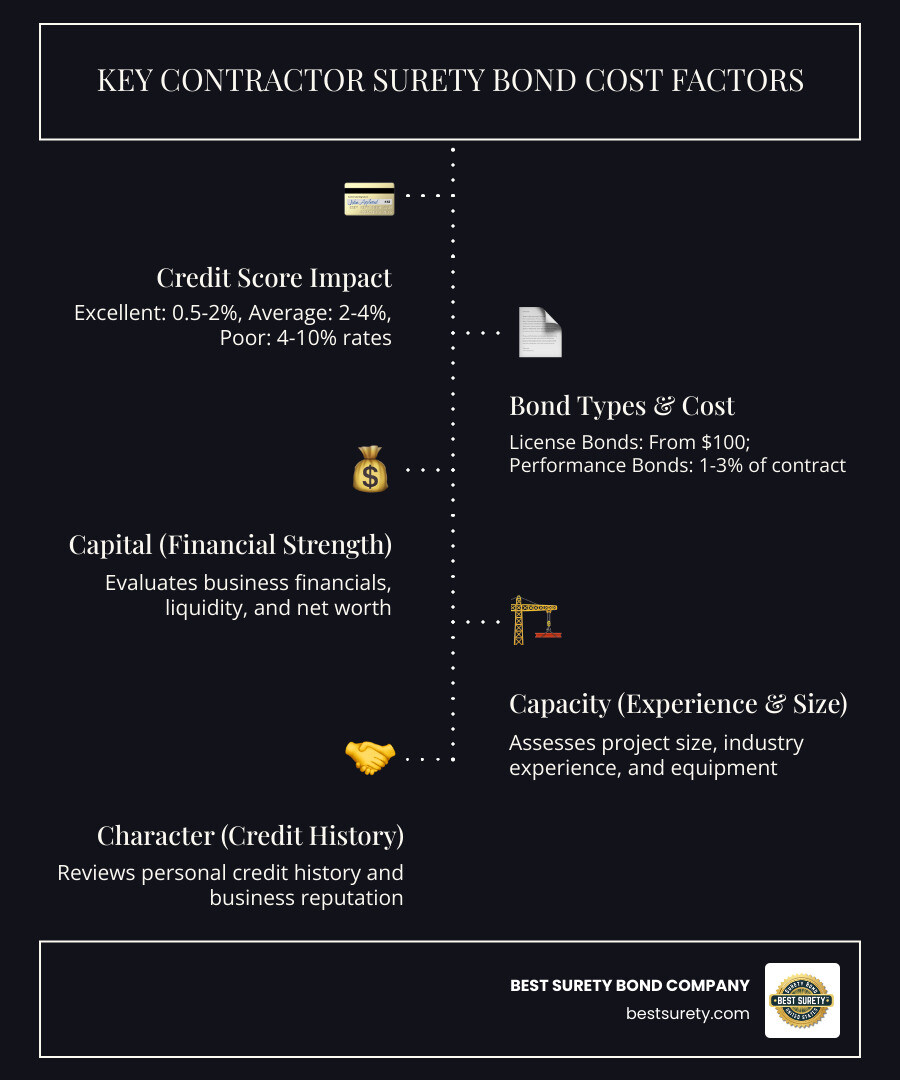
Capital represents your financial strength and stability. Our underwriters review your business financial statements, typically covering the last three years, prepared by a qualified accountant. They’re looking for strong working capital and equity. Here’s a practical guideline: contractors generally need working capital equal to about 1/10th of their total work program. Strong assets and positive cash flow signal lower risk, which translates directly to lower contractor surety bond cost for you.
Capacity measures your ability to handle the work you’re bonding. This includes your industry experience, past project history, and track record with similar project sizes. If your largest completed project was $100,000, many sureties will comfortably bond you for projects up to $200,000 or $300,000, supporting your business growth while managing risk appropriately.
Character encompasses your personal credit score and business reputation. Your credit score plays a huge role here – contractors with excellent credit (700+) often qualify for our best rates in the 0.5% to 2% range, while those with credit challenges might see rates of 4% to 10%. We also consider references from past projects, completion records, and your overall business integrity.
Beyond the Three C’s, several other factors influence your premium. The bond type matters significantly – a simple license bond carries different risk than a complex performance bond. Project size and terms also play a role, with larger, longer-duration projects or those with special contract requirements potentially affecting your rate. The specific bond amount influences cost too, though larger bonds sometimes qualify for tiered pricing that can reduce your rate per thousand.
Understanding Your Contractor Surety Bond Cost with Examples
Let’s make this real with some concrete examples. These are estimates based on typical market conditions – your actual rate depends on our thorough underwriting process designed to get you the most competitive pricing available.

| Bond Amount | Excellent Credit (0.5-1.5%) | Average Credit (2-4%) | Poor Credit (5-10%) |
|---|---|---|---|
| $10,000 | $50 – $150 | $200 – $400 | $500 – $1,000 |
| $25,000 | $125 – $375 | $500 – $1,000 | $1,250 – $2,500 |
| $100,000 | $500 – $1,500 | $2,000 – $4,000 | $5,000 – $10,000 |
For a $25,000 Texas contractor license bond, most qualified contractors pay between $125 and $375 annually. If you have excellent credit and solid business financials, you’ll likely land at the lower end of this range. Many of these smaller license bonds qualify for instant approval, meaning you can get bonded the same day you apply.
For a $100,000 performance bond on a construction project, expect to pay between $1,000 and $3,000 as a one-time fee for the project duration. Contractors with strong financial statements, excellent credit, and proven project experience typically see rates in the 1% to 3% range.
You might also see bond rates expressed as “rate per thousand” or “$/M.” This simply means the cost per $1,000 of bond coverage. For example, a rate of $15/M on a $100,000 bond equals $1,500 total premium – just another way of expressing 1.5%. This format is common in the industry and helps compare rates across different bond amounts easily.
Comparing Costs: Different Bond Types and Scenarios
Understanding the cost variations between different bond types is like learning the difference between renting and buying a house – each serves a different purpose and has a unique pricing structure. As a Texas contractor, knowing these differences helps you budget accurately and avoid surprises when that next big project comes along.
The timing of when you need different bonds also affects your contractor surety bond cost. Some bonds are annual commitments, while others are project-specific investments. Let’s break down how this works in the real world.
Bid Bonds vs. Performance & Payment Bonds
Here’s where many contractors get confused about pricing – bid bonds and performance bonds work completely differently from a cost perspective.
Bid bonds don’t follow the typical percentage-of-bond-amount rule. Instead, most surety companies, including us at BEST SURETY BOND COMPANY, cover your bid bonds through an annual administration fee. This fee typically runs between $1,500 and $2,500 per year, and it’s like an all-you-can-eat buffet for bidding. Whether you submit five bids or fifty, that annual fee covers all your bid bonds and pre-qualification letters for the entire year.
This structure makes perfect sense when you think about it. Bid bonds protect project owners from contractors who win bids but then walk away. Since most contractors don’t actually default on winning bids, the risk is relatively low, making a flat annual fee more practical than individual bond premiums.
Performance and payment bonds tell a different story entirely. These are typically issued together for a single premium and calculated as a percentage of your total contract value, including taxes. For most qualified Texas contractors, you’re looking at rates between 1% and 5% of the contract amount.
Here’s a real example: A $1,000,000 contract in Houston requiring both 50% performance and 50% labor & material bonds with a 12-month maintenance period might cost around $11,300 in premiums. For larger contracts, many sureties offer tiered pricing, where the percentage rate decreases as the bond amount increases – making those bigger projects more affordable per dollar of coverage.
Navigating Your Contractor Surety Bond Cost with Bad Credit
Let’s be honest – not every contractor has perfect credit, and that’s okay. Life happens, businesses face challenges, and past financial difficulties shouldn’t permanently block your path to future success.
If your credit score isn’t where you’d like it to be, expect contractor surety bond cost rates in the higher range, typically between 5% and 10% of the bond amount. Yes, it’s more expensive, but it’s not impossible.
At BEST SURETY BOND COMPANY, we’ve built our reputation on saying “yes” when others say “no.” We have dedicated bad credit programs specifically designed for contractors who’ve faced financial challenges. Our licensed agents understand that your credit score is just one part of your story, and we work hard to find competitive rates even for higher-risk situations.
We can also guide you through options like the SBA Surety Bond Guarantee Program, which acts as a federal guarantor to help small contractors qualify for bonds they might not otherwise obtain. Working with a specialized agent who understands these programs can make the difference between getting bonded and missing out on projects. For more information about options for smaller businesses, check out our small business bonds page.
The Impact of Contract Changes on Bond Costs
Construction projects are living, breathing entities that evolve as work progresses. Change orders are a fact of life, and they can definitely impact your bond costs.
When a change order increases your total contract value, your bond amount may need to increase as well. This triggers what we call “Additional Premium” (AP) – basically, you’re paying for the extra coverage on the increased contract value. The good news? You’re usually only paying the incremental cost, not starting over with a whole new premium.
On the flip side, if change orders reduce your contract scope or value, you might be eligible for “Return Premium” (RP). This means getting money back when your bond exposure decreases – though administrative fees may apply.
Contract modifications involving significant changes to scope, duration, or terms may require bond amendments. These typically involve administrative fees and sometimes a fresh look at your premium rates, especially if the changes significantly alter the project’s risk profile.
The key is communication. Keep your surety partner informed about contract changes as they happen. This ensures your bond stays valid and helps you manage costs efficiently. Nobody likes surprises, especially when they show up as unexpected premium adjustments.
How to Get the Best Surety Bond Rates in Texas and Beyond
Getting the best contractor surety bond cost isn’t just about finding the cheapest quote – it’s about building a partnership that supports your business growth. At BEST SURETY BOND COMPANY, we’ve helped thousands of contractors across Texas and nationwide secure fast approvals at competitive rates because we understand that every dollar saved on bonding costs goes directly to your bottom line.
The key to lowering your premiums starts long before you apply for a bond. Smart contractors treat their bond costs as an investment in their reputation and future opportunities. When you can confidently bid on projects knowing you have reliable bonding capacity, you’re positioning yourself to win more work and grow your business.

Best Practices for Lowering Your Premium
Think of your contractor surety bond cost as a reflection of your business health. The stronger your financial foundation, the lower your premiums will be. Here’s what makes the biggest difference:
Maintain strong credit – this is your most powerful tool for securing low rates. Contractors with excellent credit scores often qualify for rates between 0.5% and 4%, while those with poor credit might pay 5% to 10%. If your credit needs work, focus on improving it before your next renewal. Even small improvements can translate to significant savings on larger bonds.
Provide professional financial statements prepared by a CPA rather than simple compilations. When underwriters see reviewed or audited statements, they gain confidence in your financial stability. This professional presentation often results in better rates, especially for contract bonds over $100,000.
Build a solid project history by documenting your successful completions. Keep detailed records of projects finished on time and within budget. Positive references from past clients and a proven track record in your specialty area demonstrate your capacity to handle similar work in the future.
Work with a dedicated surety agent who understands your industry and has relationships with multiple surety companies. At BEST SURETY BOND COMPANY, our licensed agents know how to present your business in the best light to underwriters. We’ve successfully bonded contractors with challenging credit situations and complex project requirements because we take the time to understand your unique circumstances.
The Underwriting Process and Finding a Surety Partner
The underwriting process is where surety companies decide whether to back your projects and at what cost. Think of it as a detailed business physical exam. Underwriters examine your three C’s – Capital, Capacity, and Character – to assess the risk of guaranteeing your performance.
This comprehensive risk assessment protects both you and the surety company. When you provide complete, accurate information upfront, you streamline the process and often secure better rates. Trying to hide problems or submitting incomplete applications typically backfires with higher premiums or outright declines.
Choosing the right surety partner matters more than many contractors realize. Look for companies with strong financial ratings from A.M. Best, which evaluates insurers’ financial strength. Companies earning A+ or A++ ratings have the stability to support your bonding needs for years to come.
Industry organizations like The Surety and Fidelity Association set standards and best practices that reputable surety companies follow. At BEST SURETY BOND COMPANY, we’re licensed in all 50 states and maintain the highest professional standards. Our Texas-based expertise combined with national reach means we understand local market conditions while having access to competitive programs nationwide.
The best surety partnerships develop over time. As you complete successful projects and strengthen your financial position, your rates typically improve. We work with contractors through their growth phases, adjusting bonding capacity and securing better terms as businesses mature.
Frequently Asked Questions about Contractor Surety Bond Costs
As a Texas-based surety bond company with national reach, we hear these questions daily from contractors across Houston, Dallas, and beyond. Let me address the most common concerns about contractor surety bond cost that can help you make informed decisions for your business.
What is a typical premium for a Texas contractor license bond?
The annual cost for a Texas contractor license bond varies based on your specific situation, but most qualified contractors pay between 1% and 4% of the bond amount. For the smaller license bonds required by Texas cities and counties, you’re typically looking at $100 to $500 annually – a small investment for the ability to legally operate your contracting business.
Let’s break this down with a real example: if you need a $25,000 Texas contractor license bond, you could pay anywhere from $250 to $1,000 per year depending on your credit score and financial strength. Contractors with excellent credit often secure rates closer to that lower end, while those with credit challenges might pay toward the higher range.
Our Houston-based team understands the specific bonding requirements across all Texas municipalities, from small rural counties to major metropolitan areas. This local expertise helps us steer the requirements efficiently and secure you the most competitive rates available in the Lone Star State.
How long does it take to get a contractor bond quote?
Speed matters when you’re trying to secure a project or renew your license, and that’s where BEST SURETY BOND COMPANY truly shines. For most license bonds, we offer instant online quotes and can often provide same-day approval. Many of our Texas contractors have their bonds in hand within hours of applying.
Contract bonds like performance bonds require a more detailed review since we’re examining your financial statements, project history, and overall capacity. Even with this thorough underwriting process, our licensed agents work diligently to provide fast approvals – typically within 24 to 48 hours for straightforward applications.
The key difference lies in complexity: a $10,000 contractor license bond might be approved instantly online, while a $500,000 performance bond for a major Houston infrastructure project will need our underwriters to carefully review your financials and project details.
Is the bond premium a one-time or recurring cost?
This is where understanding bond types becomes crucial for your budgeting. The payment structure depends entirely on what kind of bond you’re securing for your contracting business.
Performance and Payment bonds for specific construction projects work as one-time fees. You pay the premium upfront, and it covers the entire duration of that project. Once you complete the work and fulfill all warranty obligations, the bond expires with no additional payments required.
License and Permit bonds operate on an annual renewal basis. These bonds are tied to maintaining your contractor’s license, so they must be renewed each year to keep your business legally compliant. Think of it like renewing your driver’s license – it’s an ongoing requirement for operating legally in Texas.
At BEST SURETY BOND COMPANY, we make renewal simple with advance notices and streamlined processes. Many of our long-term clients appreciate that their annual license bond renewals become routine, often with improved rates as their business grows and their credit strengthens over time.
Get Your Fast, Affordable Contractor Bond Today
Understanding contractor surety bond cost isn’t just about managing an expense – it’s about making a smart investment in your business’s future. When you secure the right bonds at competitive rates, you’re not just checking a regulatory box. You’re building the foundation for bidding on larger projects, establishing trust with clients, and positioning your company for sustainable growth.
The confidence that comes from having affordable, reliable bonding can transform how you approach opportunities. Instead of hesitating when that perfect project comes along, you can move quickly, knowing your bond costs are predictable and manageable.
At BEST SURETY BOND COMPANY, we’ve built our reputation on making the bonding process as smooth as possible for contractors across Texas and beyond. Our Houston-based team understands the unique challenges facing contractors in our state, from navigating local licensing requirements to meeting tight project deadlines. We combine this local expertise with national authority, being licensed in all 50 states to serve contractors wherever their work takes them.
What sets us apart is our commitment to both speed and affordability. We offer instant online quotes for many bond types, same-day approvals when you need them fast, and consistently low rates that help protect your bottom line. Our licensed agents don’t just process applications – they become your advocates, working to present your business in the best possible light to secure the most competitive premiums available.
Whether you’re a seasoned contractor looking to expand your bonding capacity or a newer business owner securing your first license bond, we’re here to guide you through every step. We’ve helped thousands of contractors across Texas and the nation get bonded quickly and affordably, and we’re ready to do the same for you.
Don’t let contractor surety bond cost concerns hold back your business growth. The right bonding partner makes all the difference between viewing bonds as a burden or embracing them as a competitive advantage. Ready to experience the BEST SURETY difference? Get Bonded Today and find why we’re Houston’s trusted surety provider with the national reach to support your ambitions.
