
Why Understanding Credit Insurance vs Surety Matters for Your Business

Credit insurance vs surety is a common point of confusion for business owners seeking financial protection. While both are risk management tools, they protect different parties and cover fundamentally different risks.
Quick Answer: Credit Insurance vs Surety
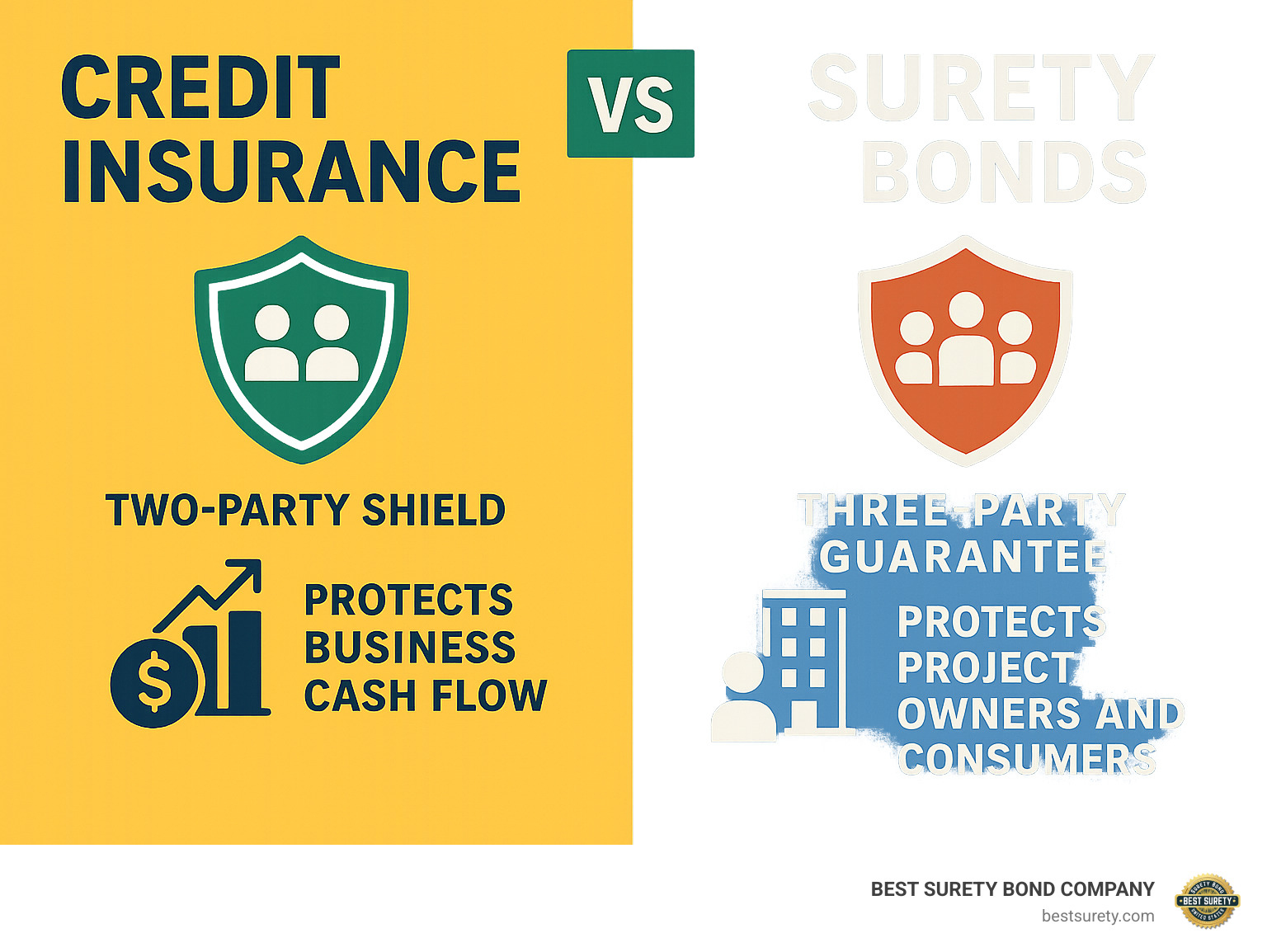
- Credit Insurance: Two-party agreement protecting your business from customer non-payment.
- Surety Bonds: Three-party agreement protecting others from your business failing to meet obligations.
- Risk Covered: Credit insurance covers accounts receivable losses; surety bonds guarantee performance.
- Cost: Credit insurance is typically <1% of sales volume; surety bonds are typically 0.5-2% of the bond amount.
- Who Benefits: Credit insurance pays you; surety bonds pay the harmed party (then you reimburse the surety).
This confusion costs businesses time and money. For example, a Houston contractor might think they need credit insurance for non-paying customers when they actually need a performance bond to secure a project. Or a manufacturer might assume a surety bond protects their receivables, missing out on trade credit insurance that could safeguard their cash flow.
The stakes are high. The global trade credit insurance market is projected to hit $18.14 billion by 2027, while surety bonds protect billions in construction projects annually. Getting this choice wrong can leave your business exposed to the exact risks you’re trying to avoid.
I’m Haiko de Poel, and with over two decades in fintech, insurance, and risk management, I’ve seen countless companies struggle with the credit insurance vs surety decision. My experience has shown me that understanding these financial tools isn’t just academic—it’s essential for protecting your business and winning more work.
What is Trade Credit Insurance?
Trade credit insurance is a financial safety net for when customers can’t—or won’t—pay their bills. Think of it as insurance for your invoices. When you sell on credit terms, you’re lending money to customers. If a major client goes bankrupt or stops paying, trade credit insurance steps in to protect your cash flow.
This specialized insurance covers your accounts receivable, reimbursing you when customers default due to bankruptcy, insolvency, or even political upheaval. Unlike surety bonds, which guarantee your performance to others, credit insurance protects your own business from financial loss.

One of the most valuable features is the “whole turnover policy.” This approach covers your entire customer portfolio, providing a comprehensive shield over all your accounts receivable rather than insuring each invoice separately.
How Credit Insurance Protects Your Cash Flow
Credit insurance transforms the risk of extending credit into predictable protection. If a customer fails to pay due to insolvency, bankruptcy, or protracted default, your policy kicks in. You’ll typically receive 75% to 100% of the unpaid amount, up to your coverage limits. This means a major client default won’t cause a catastrophic blow to your business.
The protection covers both domestic trade within the United States and export transactions. This gives you the confidence to offer more generous credit terms, attract larger customers, and expand into new markets without the fear of catastrophic losses. For Texas businesses, this protection can be the key to seizing major growth opportunities.
Who Typically Uses Credit Insurance?
Credit insurance is most valuable for businesses that regularly extend credit. This includes:
- Exporters dealing with international customers and the added political or economic risks.
- Manufacturers and wholesalers handling high-volume sales on 30, 60, or 90-day payment terms.
- Companies with high-volume sales where even small percentages of bad debt add up quickly.
- Growing businesses that extend credit to win more customers and want to protect their new receivables.
Many policies also include credit assessment services, helping you make smarter decisions about which customers to extend credit to and how much risk to take on.
What is a Surety Bond?
Here’s where the credit insurance vs surety distinction becomes crystal clear. While credit insurance protects your business from your customers, a surety bond protects a third party from your business failing to meet an obligation.

A surety bond is a financial guarantee involving three parties:
- The Principal: Your business, which needs the bond and promises to fulfill an obligation.
- The Obligee: The party requiring the bond (e.g., a project owner or government agency).
- The Surety: The bonding company (us) that financially backs your promise to the obligee.
Crucially, a surety bond is not traditional insurance for you. If we pay a claim because you failed to perform, you are legally required to reimburse us under an indemnity agreement. It functions like a line of credit that must be repaid if used. This system builds trust and accountability, which is vital to commerce, as shown by research on The Economic Value of Surety Bonding.
Common Types of Surety Bonds for Texas Businesses
Texas businesses, especially in Houston’s booming construction sector, frequently need several types of bonds:
- Contract Bonds: These include bid, performance, payment, and maintenance bonds that guarantee various stages of a construction project. We specialize in helping contractors steer these requirements: Contract Bonds.
- License and Permit Bonds: Required for many Texas professions like auto dealers and contractors, these bonds guarantee compliance with state and local laws, protecting the public. We’ve streamlined the process: License & Permit Bonds.
- Commercial Bonds: This broad category covers specialized needs like customs bonds or tax bonds, protecting against financial loss from specific business activities. See our services: Commercial Bonds.
- Court Bonds: Used in legal proceedings, these bonds (e.g., appeal, probate) ensure individuals fulfill court-ordered obligations.
For Houston contractors and other Texas businesses, these bonds are often a legal requirement to operate.
How to Get a Surety Bond Fast
We know delayed bonding means delayed business, so our process is built for speed.
- Apply Online Instantly: Start your application anytime through our streamlined system: Apply for a bond online.
- Fast Underwriting: Our team provides approvals quickly, often within minutes for small business bonds, helping you meet tight deadlines.
- Low Rates: We offer competitive pricing without sacrificing service, making bonding affordable.
- Instant Quotes: Get immediate cost clarity for many standard bonds. Our licensed agents are ready to help you find the best rates in Texas.
From instant approvals to same-day issuance, we deliver speed and quality.
Credit Insurance vs Surety: A Head-to-Head Comparison
To understand credit insurance vs surety, think of an umbrella versus a promise. Both offer protection, but they shield different parties from different risks. Credit insurance is your personal safety net for when customers don’t pay. A surety bond is your promise to a third party that you will perform as agreed.

With credit insurance, you transfer the risk of non-payment to an insurer. With a surety bond, you get a surety to back your promise, but you remain financially liable.
Fundamental Difference: Who is Protected?
The core of the credit insurance vs surety debate is who gets paid when something goes wrong.
- Credit Insurance is a two-party agreement that protects you. When a customer defaults on an invoice, the insurance company pays you. It’s your financial shield.
- Surety Bonds are a three-party agreement that protects the obligee (e.g., a project owner). If you (the Principal) fail to perform, the surety pays the obligee, and then you must reimburse the surety.
Think of it this way: credit insurance is like health insurance for your cash flow. A surety bond is like a co-signed loan; you’re still on the hook to pay it back. For Texas businesses, this is a critical distinction: use credit insurance to protect receivables and surety bonds to guarantee performance.
Claims Process: Credit Insurance vs Surety
The claims processes are fundamentally different:
- Credit Insurance Claim: The process is direct. Your customer defaults, you file a claim, and the insurer pays you 75% to 100% of the debt. The goal is to restore your cash flow quickly.
- Surety Bond Claim: This is more complex. The obligee alleges you failed to meet your obligations. The surety investigates thoroughly. If the claim is valid, the surety makes the obligee whole (e.g., hires a new contractor) and then collects the full cost, plus fees, from you.
Financial Impact: Cost, Collateral, and Credit Capacity
The financial implications are a key part of the credit insurance vs surety decision.
- Credit Insurance costs less than 1% of your insured sales volume. It requires no collateral and can improve your creditworthiness by securing your receivables.
- Surety Bonds cost 0.5% to 2% of the bond amount annually. For qualified Texas contractors, rates can be as low as 0.5%. A key benefit is that bonds don’t tie up your working capital or credit lines like a letter of credit would.
While credit insurance can improve borrowing terms, surety bonds preserve your liquidity, giving you the flexibility to take on larger projects. For businesses in competitive markets like Houston’s construction industry, this capital efficiency is a major advantage.
When to Choose a Surety Bond for Your Project
When does the credit insurance vs surety choice tip in favor of a bond? The answer is simple: when someone else needs a guarantee that you’ll perform as promised. Whether you’re a Houston contractor bidding on a city project or a Dallas business seeking a license, a surety bond is often required.
You’ll need a surety bond for:
- Contractual Requirements: Government projects, especially those under the federal Miller Act, mandate performance and payment bonds to protect taxpayer funds. Bidding on a project in Austin or San Antonio? Bonds are your ticket in.
- Construction Industry Standards: Performance bonds guarantee project completion, while payment bonds ensure subcontractors get paid. You can’t compete for major projects without them.
- Texas Contractor Requirements: Our state has specific mandates for various trades. For example, contractors handling construction debris need a special bond to operate legally. We can help you steer these rules: Get Your Texas Contractor Bond.
- Licensing Regulations: Many professions, from auto dealers to freight brokers, need license bonds to operate. These protect consumers by ensuring you follow state and local laws.
Why a Surety Bond is Often Required
Project owners and government agencies require bonds to ensure public protection and project completion. A bond guarantees compliance with contract terms. If you default, the surety steps in to finish the job or compensate the owner.
Bonds also demonstrate financial responsibility. The underwriting process vets your business, signaling to clients that you are a credible and trustworthy partner. In a competitive bid, being bonded gives you a significant edge.
Making the Right Choice: Credit Insurance vs Surety
The credit insurance vs surety decision comes down to one question: whose financial risk are you covering?
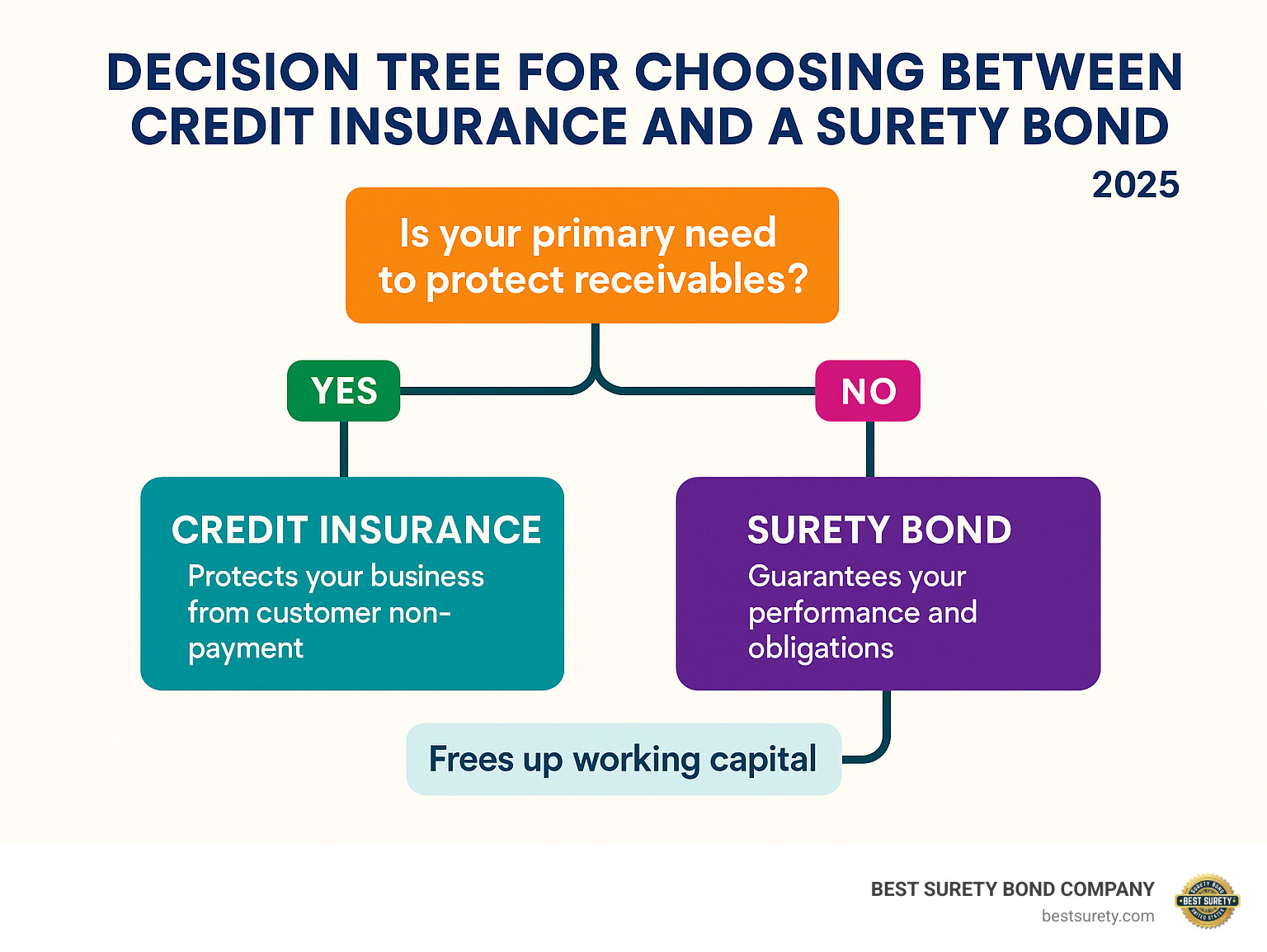
- Choose credit insurance to protect your own cash flow from customer non-payment. It’s for businesses extending credit terms, like manufacturers or exporters.
- Choose a surety bond to guarantee your performance to others. It’s for contractors needing performance bonds or businesses needing license bonds.
For many Texas businesses, surety bonds are a necessity. The good news is that getting bonded with us is fast, affordable, and straightforward, so you can focus on winning more work.
Frequently Asked Questions
Here are the most common questions we hear about credit insurance vs surety from businesses across Texas.
What is the primary difference between credit insurance and a surety bond?
The key difference is who gets protected.
- Credit insurance is a two-party agreement that protects your business from customers who fail to pay. It covers your accounts receivable.
- A surety bond is a three-party agreement that protects a third party (the obligee) from your business failing to perform. If the surety pays a claim, you must reimburse them.
In short: Credit insurance protects your wallet. A surety bond protects someone else’s interests.
Can a surety bond protect my business from a client not paying me?
No. This is a common misconception. A surety bond will not protect you from a non-paying client.
While a “payment bond” sounds like it ensures you get paid, it actually protects the subcontractors and suppliers on a project, guaranteeing they are paid by the general contractor. If you are a general contractor worried about a project owner not paying you, you need credit insurance, not a surety bond. Learn more here: Understanding Payment Bonds.
Surety bonds guarantee your performance to others; credit insurance protects your receivables from others.
How much does a surety bond cost in Houston, Texas?
The cost, or premium, for a surety bond is typically 1% to 3% of the bond amount annually for qualified Texas businesses. The exact rate depends on:
- Your credit score: Strong credit leads to lower rates.
- Bond type and amount: A small license bond costs less than a large performance bond.
- Business financials and experience: Especially important for larger contract bonds.
Many small license bonds have a flat minimum premium, often around $100-$200. We offer some of the most competitive rates in Texas. To find out your exact cost, skip the guesswork and get an instant quote online now.
Conclusion: Securing Your Business with the Right Financial Tool
Choosing correctly between credit insurance vs surety is vital for protecting your business and enabling growth. As we’ve covered, these tools serve entirely different needs.
- Credit insurance is your safety net, protecting your cash flow when customers don’t pay. It’s for businesses that extend credit and need to secure their accounts receivable.
- Surety bonds are your key to winning bigger contracts and meeting regulatory requirements. They guarantee your performance to third parties, like project owners in Houston or state licensing agencies.
Understanding this distinction is crucial. A contractor needing to protect against non-paying clients needs credit insurance, while a business bidding on a government project needs a surety bond.
At BEST SURETY BOND COMPANY, we specialize in helping Texas businesses get the surety bonds they need with confidence. Our fast approvals and competitive rates remove the usual delays and complications, making the process simple and affordable.
Don’t let confusion hold your business back. If you need a performance bond for your next project or a license bond to operate, we’re here to help with the fastest service and lowest rates in Texas.
Explore Our Surety Bond Services and see how the right financial tool can open up new opportunities. Get bonded today and start winning the contracts you deserve!
