

Why Getting Your Customs Bond Online is Essential for Modern Importers
Getting a customs bond online has become the fastest, most efficient way for businesses to secure import compliance. Here’s what you need to know:
Quick Answer for Customs Bond Online:
- Required for: Commercial imports over $2,500 into the U.S.
- Two types: Single Entry (one shipment) or Continuous (multiple shipments)
- Cost: As low as $349 annually for a $50,000 continuous bond
- Processing time: 30 seconds with eBond vs. 3-5 days with paper
- Online benefits: Instant quotes, same-day approval, electronic filing
Whether you’re importing goods into Houston’s busy Port of Houston or any of the 300+ U.S. ports of entry, a customs bond guarantees you’ll pay all duties, taxes, and fees to U.S. Customs and Border Protection (CBP). Without this bond, your shipments can be denied entry or seized.
The good news? The days of paper applications and weeks-long waits are over. CBP’s eBond system processes bonds in as little as 30 seconds – a massive improvement from the previous 3-5 business day turnaround. For Texas importers and businesses nationwide, this means faster cargo release and smoother supply chains.
As Haiko de Poel, I’ve helped scale numerous businesses across finance, legal services, and operational sectors, including companies navigating complex regulatory requirements like customs bond online processes. My experience in fintech and growth architecture has shown me how digital solutions can transform traditionally slow bureaucratic processes into streamlined operations.
What is a Customs Bond and Why is it Required?
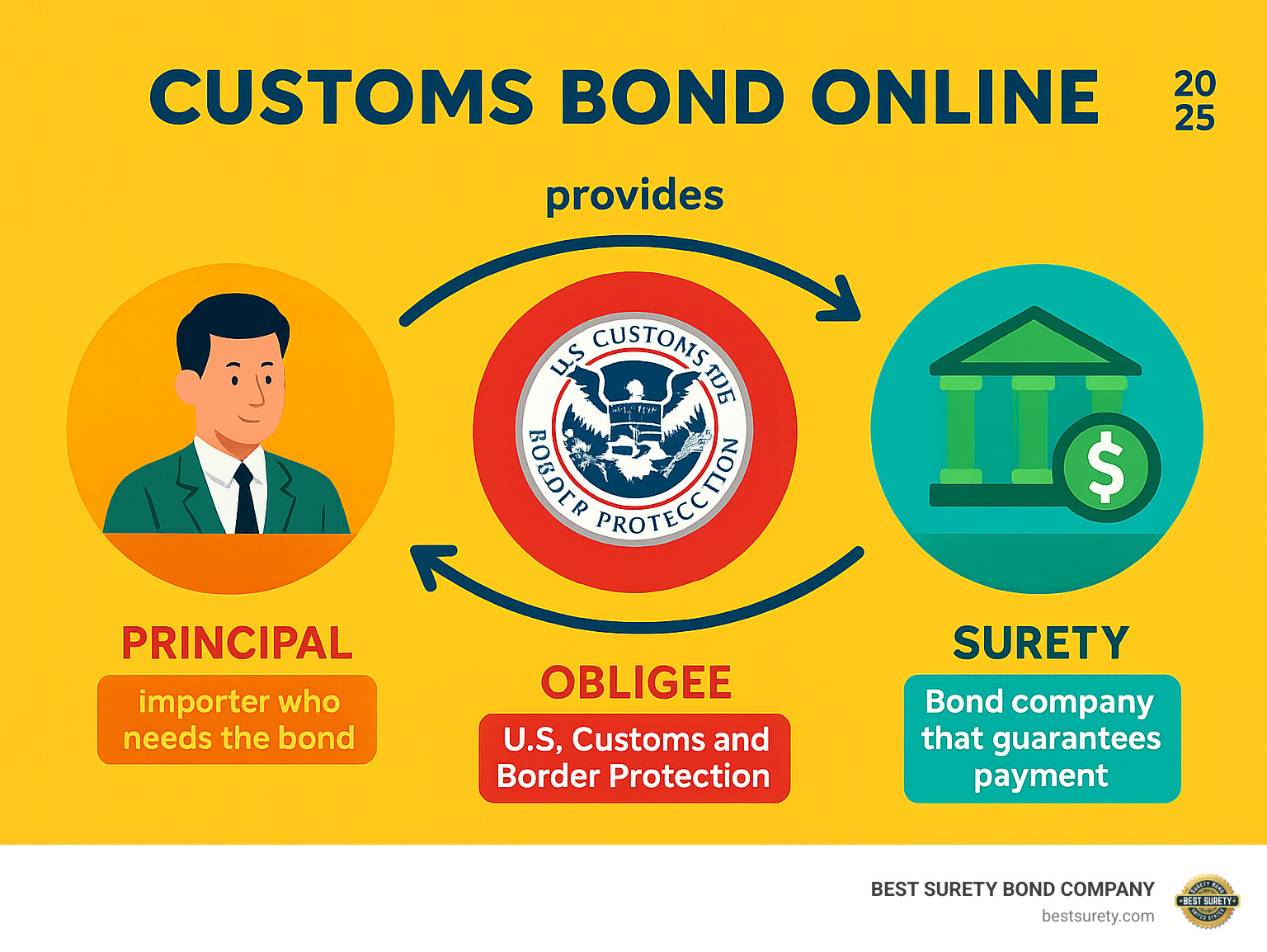
Think of a customs bond online as your business’s promise to Uncle Sam. It’s a three-way agreement between you (the importer), U.S. Customs and Border Protection (CBP), and a surety company that guarantees you’ll play by the rules and pay what you owe.
Here’s how it works: When your goods arrive at the Port of Houston or any U.S. port, CBP needs assurance that all duties and taxes will be paid, even if something goes wrong. The customs bond serves as that financial security. If you can’t pay your obligations, CBP can collect from the bond instead of chasing you down.
U.S. Customs and Border Protection requires these bonds for most commercial imports valued over $2,500. They’re also mandatory for certain regulated commodities like firearms, food products, or textiles – regardless of value. As the Importer of Record, you’re responsible for having this coverage in place before your shipment can be released.
The bond requirement isn’t just bureaucratic red tape. It protects the U.S. Treasury’s revenue and ensures import laws are followed. Without this system, the government would have no guarantee that importers would actually pay their bills.
Who Needs a Bond?
Most businesses bringing goods into the United States need a customs bond. Whether you’re a small tech startup in Austin importing components or a major retailer with distribution centers across Texas, the rules apply to you.
Importers are the most obvious candidates – if you’re bringing commercial merchandise into the U.S. for sale or distribution, you’ll need coverage. International carriers transporting cargo by ship, plane, or truck also need specific bonds. Warehouse operators who store imported goods before they’re cleared for U.S. commerce must be bonded too.
Even customs brokers – the professionals who handle import paperwork on behalf of businesses – need their own bonds to operate legally. These licensed agents are popular with businesses in Texas and nationwide because they steer the complex import process while you focus on running your company.
The bottom line: if you’re involved in moving or storing goods under CBP supervision, you need to be bonded. For detailed requirements, check out who needs a customs bond on CBP’s official site.
Penalties for Non-Compliance
Operating without a required customs bond is like trying to drive cross-country without car insurance – you might make it, but if something goes wrong, you’re in serious trouble.
Entry denial is often the first consequence. CBP can simply refuse to let your shipments into the country. Imagine having containers full of inventory sitting at the port while your customers wait for their orders.
Shipment seizure is even worse. CBP has the authority to confiscate your goods entirely, leading to massive financial losses. Financial penalties can pile up quickly too – Import Security Filing violations alone can cost $5,000 per incident.
For repeat offenders, CBP may impose suspension of import privileges. This nuclear option essentially puts you out of the import business until you can resolve the issues and prove you’re compliant.
All of these problems create business disruption that goes far beyond the immediate costs. Supply chain delays, damaged customer relationships, and reputation issues can hurt your business for years.
That’s exactly why we make getting your customs bond online fast, affordable, and hassle-free. Our Texas-based team understands how critical it is to keep your imports moving smoothly.
Comparing Customs Bond Types: Single Entry vs. Continuous
When you’re ready to get a customs bond online, you’ll face an important decision: Should you go with a Single Entry Bond or a Continuous Bond? The choice comes down to how often you import goods and what makes the most financial sense for your business.
Think of it this way – if you only import once or twice a year, you might consider a Single Entry Bond. But if you’re bringing in multiple shipments (which most businesses do), a Continuous Bond will save you both money and headaches.

The differences are pretty straightforward when you look at them side by side:
| Feature | Single Entry Bond (SEB) | Continuous Bond |
|---|---|---|
| Cost | Generally higher per shipment | More economical for frequent imports |
| Coverage | One specific import transaction/shipment | All imports by the same importer for a 12-month period |
| Duration | Expires after the specific shipment is cleared | Valid for 12 months, automatically renews annually |
| Best Use Case | Infrequent importers (1-2 shipments per year) | Frequent importers, multiple ports of entry, high volume |
| Flexibility | Limited to one transaction | Covers all entries, simplifies customs clearance |
| ISF Filing | Requires a bond for each ISF filing | One continuous bond covers all ISF filings |
Single Entry Bond (SEB)
A Single Entry Bond covers just one shipment – that’s it. Once your specific transaction clears customs, the bond expires. The bond amount is typically calculated based on the full value of your imported goods, plus any duties, taxes, and fees that might apply.
Here’s where it gets tricky: if you’re importing restricted or regulated commodities, CBP might require your bond amount to be three times the shipment’s value. That can add up quickly, especially for high-value goods coming through busy ports like Houston.
While Single Entry Bonds might seem appealing for occasional importers, they often come with hidden costs. CBP tends to scrutinize entries with SEBs more closely, which can slow down your cargo release. Plus, you’ll need to apply for a new bond every single time you import – not exactly efficient for growing businesses.
Continuous Bond
This is where most smart importers land, and for good reason. A Continuous Bond covers all your imports for an entire 12-month period, regardless of how many shipments you bring in or which ports of entry you use. Whether you’re importing through the Port of Houston, Los Angeles, or anywhere else in the U.S., you’re covered.
The minimum continuous bond amount is $50,000, but it could be higher depending on your import volume. CBP calculates this as 10% of the duties and taxes you paid last year, or 10% of what you expect to pay in the coming year – whichever is greater.
Here’s the real kicker: a $50,000 continuous customs bond can cost as little as $349 per year with the right provider. Compare that to buying multiple single entry bonds throughout the year, and the savings become obvious. Plus, continuous bonds typically renew automatically, so you don’t have to worry about gaps in coverage that could delay your shipments.
For Texas businesses importing regularly – whether you’re in Houston’s energy sector, Dallas tech companies, or Austin startups – a continuous bond offers the flexibility and cost-effectiveness you need to keep your supply chain moving smoothly.
How to Get Your Customs Bond Online Fast
Gone are the days of endless paperwork and waiting. Thanks to modern digital solutions, you can get your customs bond online with incredible speed and convenience. As a leading surety provider, we’ve streamlined the process to ensure fast approvals and same-day issuance for many of our clients, whether you’re in Texas or anywhere else in the nation.
Step 1: Gather Required Information
To begin your online customs bond application, you’ll need to have a few key pieces of information ready. This helps us process your request quickly and accurately:
- Business Details: Your legal business name, address, contact information, and years in business.
- Importer Number: This is your unique identification with CBP. If you’re not currently registered with Customs, we can often help you get your importer number registered for a one-time fee by completing CBP Form 5106.
- Estimated Duties and Taxes: For a continuous bond, you’ll need an estimate of the duties, taxes, and fees you expect to pay over the next 12 months.
- Harmonized Tariff System (HTS): While not strictly required for the bond application itself, understanding the Harmonized Tariff System (HTS) is vital for estimating your duties. The HTS provides duty rates for virtually every item, and the U.S. International Trade Commission offers an interactive Tariff Database to help you.
Step 2: Complete the Online Application
Once you have your information, the next step is to complete our secure online form. This is where the magic of getting your customs bond online truly happens.
Our application is designed to be user-friendly and efficient, typically taking only minutes to complete. You’ll provide the necessary details, including information that would traditionally go on a CBP Form 301. Rest assured, our process includes a soft credit pull, which won’t impact your credit score. Best of all, applying for a quote is entirely no-obligation, so you can explore your options without any pressure. We offer an easy-to-use online application and FAST approvals.
Step 3: eBond Filing and Approval
This is where speed meets efficiency. After you’ve completed your application and your bond is approved, we’ll electronically file it with CBP through the Automated Commercial Environment (ACE) eBond system.
The ACE eBond system has revolutionized customs bond processing. Sureties have reported confirmation of bonds being fully processed in ACE in as little as 30 seconds, a stark contrast to the previous 3-5 business days. This means your digital bond can be delivered and active almost instantly, expediting your cargo release. The eBond system allows for 24×7 submission capability, standardizes CBP-Trade interactions, and provides a single, centralized repository for all customs bonds. For more technical details on how it all works, you can explore ACE eBond Processing.
Decoding the Cost of Your Customs Bond
When considering a customs bond online, understanding the cost is naturally a top priority. The cost you pay, known as the bond premium, is typically a small percentage of the total bond amount. This premium is determined by several underwriting factors, including your import history, financial strength, and the specific type of merchandise you import. We aim for low rates and affordable premiums, making sure you get the best value.
How is the Customs Bond Online Cost Determined?
The premium for a customs bond typically ranges from 1% to 15% of the bond value. For example, a $50,000 continuous Customs bond can be as low as $349 per year for most customers. This rate applies whether you’re a USA-based importer or a non-USA based importer, though approval for non-USA based importers might take a few days longer.
The exact premium percentage also depends on the “Activity Code” of the bond, which relates to the specific type of customs activity it covers:
- Activity Code 2 bond (Custodian of Bonded Merchandise): The annual rate is 1.2% of the bond amount, including a 0.2% filing fee.
- Activity Code 3 bond (International Carrier Bond): The annual rate is 1.2% of the bond amount, including a 0.2% filing fee.
- Activity Code 4 bond (Foreign Trade Zone Operator Bond): The annual rate is 1% of the bond amount, including a 0.2% filing fee.
- Activity Code 11 Airport Customs Security Area bond: The annual rate is 2.25% of the bond amount, including a 0.2% filing fee.
- Activity Code 14 In-Bond Export Consolidation Bond: The annual rate is 2.25% of the bond amount, including a 0.2% filing fee.
How is the Bond Amount Calculated?
The bond amount, which is the maximum liability the surety company is willing to cover, is set by CBP. For a continuous bond, the minimum amount is $50,000. However, the amount is ultimately determined by the greater of:
- $50,000, or
- 10% of the total duties, taxes, and fees paid in the year prior, or
- 10% of the duties, taxes, and fees reasonably estimated to be paid in the next 12-month period.
CBP periodically reviews bonds to ensure they are adequate for revenue protection and compliance. If your import activity grows significantly, CBP may require an increase in your bond amount. Special circumstances, like goods subject to Section 301 tariffs, might also impact the required bond amount.
Frequently Asked Questions about Online Customs Bonds
How can a customs broker help with the bonding process?
Think of a customs broker as your personal guide through the maze of international trade regulations. These professionals are authorized agents of CBP who specialize in handling customs business on behalf of importers like you. While you’re not legally required to use a broker, they can be absolute lifesavers when it comes to navigating the complexities of getting your customs bond online.
A customs broker brings expertise that’s especially valuable for businesses in major trade centers like Houston, Texas, where the Port of Houston handles millions of tons of cargo annually. They understand the intricate details of entry filings, duty calculations, and bond requirements – knowledge that can save you from costly mistakes.
When it comes to bonding, brokers help ensure you’re getting the right type and amount of coverage. They know when a continuous bond makes more sense than single entry bonds and can spot potential issues before they become problems. For Houston importers dealing with everything from petrochemicals to consumer goods, this local expertise combined with regulatory knowledge is invaluable.
What are the key differences in bond requirements between the U.S. and Canada?
If you’re involved in cross-border trade, understanding these differences can save you significant headaches and delays.
In the United States, the rules are straightforward: commercial imports over $2,500 require a customs bond. This bond serves as your promise to CBP that you’ll pay all duties, taxes, and comply with import regulations. The system is well-established and getting your customs bond online through the eBond system is fast and efficient.
Canada has undergone a major change with their new CBSA Assessment and Revenue Management (CARM) system. The biggest change? Importers now post their own financial security instead of relying on their customs brokers to handle it. This shift means Canadian importers must directly manage their Release Prior to Payment (RPP) privilege through the CARM Client Portal.
Under CARM, you can provide security through either a customs/surety bond or a cash deposit. While this gives importers more control, it also means more responsibility for managing compliance directly with the Canada Border Services Agency.
How do I renew my continuous customs bond?
The beauty of continuous bonds lies in their simplicity when it comes to renewal. Your continuous bond is valid for 12 months and is designed to renew automatically, making your life easier year after year.
Here’s how the process typically works: Your surety provider will send you a renewal invoice about 30 days before your bond expires. Pay that invoice promptly, and your bond stays active with CBP without any interruption to your import operations. It’s that simple.
At BEST SURETY BOND COMPANY, we make renewal even smoother. We proactively notify our Texas clients and importers nationwide when their renewal is due, ensuring there’s never a gap in coverage. This ongoing compliance is crucial – a lapsed bond means stopped shipments, and nobody wants their cargo sitting at the Port of Houston or any other entry point because of an expired bond.
The automatic renewal feature is particularly valuable for busy importers who have enough to worry about without tracking bond expiration dates. Pay your premium, stay compliant, keep importing – that’s the continuous bond advantage.
Get Your Customs Bond Online Today
Ready to secure your customs bond online and keep your imports flowing smoothly? You’ve come to the right place. At BEST SURETY BOND COMPANY, we’ve made getting bonded as simple as ordering your morning coffee – but with much bigger benefits for your business.
Whether you’re shipping containers through Houston’s busy Port of Houston, managing imports in Dallas, or expanding your business nationwide, we’ve got you covered. Our speed and convenience set us apart from the competition. While other companies might keep you waiting for days, we deliver same-day approvals and lightning-fast processing through CBP’s eBond system.
Low rates are just the beginning. We believe every business deserves affordable customs bonds without sacrificing quality service. Our premiums start as low as $349 annually for a $50,000 continuous bond – rates that make sense for businesses of all sizes, from small Texas startups to established national importers.
What really makes the difference is our expert support. Our licensed agents understand the complexities of customs regulations and are ready to guide you through every step of the process. We’re not just another faceless online form – we’re your partners in compliance, serving Texas and all 50 states with the same commitment to excellence.
Don’t let customs bond requirements become a bottleneck in your supply chain. With our streamlined online process, you can focus on growing your business while we handle the paperwork. From gathering your documents to electronic filing with CBP, we make the entire experience seamless and stress-free.
Get Bonded Today and find why thousands of importers trust BEST SURETY BOND COMPANY for their customs bond needs. Your next shipment is waiting – let’s get you bonded and approved today.
