

Why Labor and Material Payment Bonds Are Essential for Construction Projects
A labor and material payment bond is a three-party surety agreement guaranteeing that subcontractors, suppliers, and laborers will be paid for their work and materials, even if the general contractor defaults on payment.
Quick Overview of Labor and Material Payment Bonds:
- Purpose: Protects subcontractors and suppliers from contractor non-payment.
- Required: Mandatory on federal projects over $100,000 (Miller Act) and many state/local public works.
- Cost: Typically 0.2% to 3% of the contract amount.
- Claim Period: Usually 120 days from last work/materials provided.
- Three Parties: Principal (contractor), Obligee (project owner), and Surety (bond company).
- Benefits: Prevents liens, ensures project continuity, and protects cash flow.
If a contractor fails to meet payment obligations, the surety company steps in to compensate unpaid parties up to the bond’s value. This financial safety net is crucial on public projects where mechanic’s liens cannot be filed against government property.
Construction projects involve complex networks of contractors and suppliers, all dependent on timely payment. Without payment bonds, a single contractor’s financial failure can cause a domino effect of unpaid bills, work stoppages, and project delays.
As an industry expert, I’m Haiko de Poel. Through my experience scaling companies in construction and financial services, including my work with MASS IMPACT®, I’ve seen how labor and material payment bonds are essential for project success and sustainable growth.
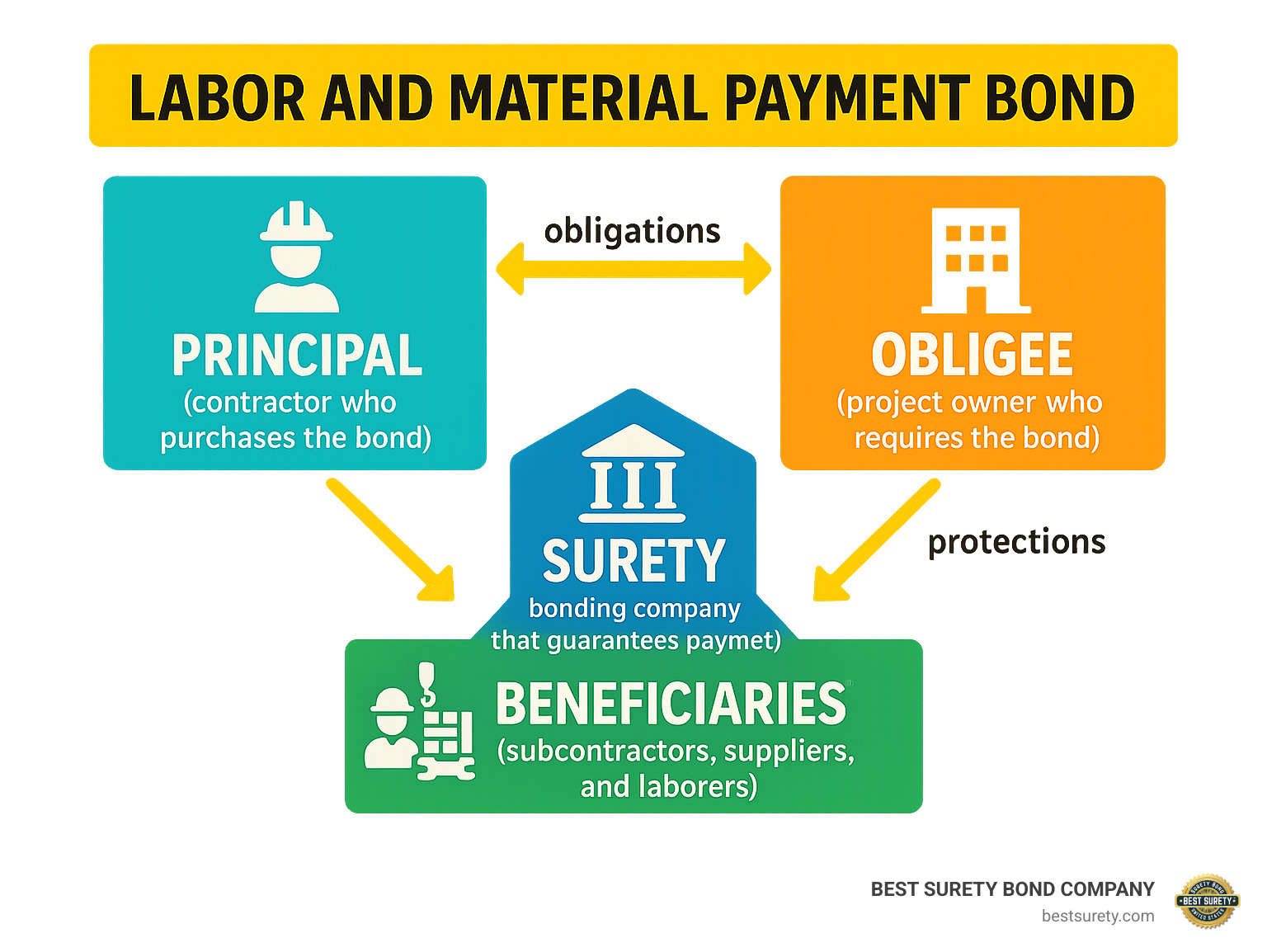
Labor and material payment bond vocab explained:
What is a Labor and Material Payment Bond and Who Does It Protect?
A labor and material payment bond is a financial safety net for construction projects. Its primary purpose is to guarantee that subcontractors, suppliers, and laborers are paid for their work and materials if the general contractor fails to do so.
For example, if an electrical subcontractor wires a building and the general contractor doesn’t pay the invoice, the sub’s own finances are at risk. With a payment bond, the surety company steps in to cover valid claims up to the bond amount, ensuring subcontractors and suppliers aren’t financially harmed by another’s default.
This protection is critical on public projects. On private jobs, unpaid parties can file a mechanic’s lien against the property. However, you cannot place a lien on public property like a school or highway. Labor and material payment bonds serve as the essential alternative, providing payment security without liens, which is why they are typically required by law on government contracts.
The Three Key Parties: Principal, Obligee, and Surety
Every labor and material payment bond involves three key players:
- The Principal: The contractor who purchases the bond and is responsible for all payment obligations.
- The Obligee: The project owner who requires the bond to ensure the project is free of payment disputes.
- The Surety: The bonding company (like BEST SURETY BOND COMPANY) that guarantees the contractor’s payment obligations. We promise, “If the contractor doesn’t pay, we will.”
Beyond these are the Beneficiaries (or claimants): the subcontractors, suppliers, and laborers who are protected by the bond and can file claims if they are not paid.
Who is Protected and Why It Matters
First-tier claimants—those with a direct contract with the general contractor—are the primary beneficiaries of a payment bond. If you signed a contract directly with the main contractor, you are covered.
Second-tier claimants, such as a supplier to a subcontractor, may or may not be protected, depending on the specific bond language. A direct contract is typically the key factor.
This protection is vital because it ensures steady cash flow throughout the project. When everyone is confident they will be paid, they can focus on quality work, creating a more stable and productive environment.
Federal projects follow The Miller Act, requiring payment bonds on contracts over $100,000. In Texas, our “Little Miller Act” extends similar protections to state and local public works, ensuring financial security for those building our communities.
How Project Owners Benefit
While payment bonds directly protect subs and suppliers, project owners also gain significant advantages:
- Reduced Legal Exposure: On private projects, bonds prevent property liens that can complicate sales or refinancing.
- Project Continuity: The surety handles payment disputes, preventing work stoppages and keeping the project on track.
- Competitive Bids: Subcontractors often provide better pricing when they know payment is guaranteed.
- Administrative Relief: The surety manages the investigation and resolution of claims, freeing the owner to focus on construction management.
Payment Bond vs. Performance Bond: Key Differences
On a construction project, two different problems can arise that require two distinct types of protection. Understanding the difference between a payment bond and a performance bond is crucial.
If your contractor stops paying subcontractors and suppliers, a labor and material payment bond is your lifeline. It ensures the people providing labor and materials get paid.
If your contractor abandons the project or delivers substandard work, a performance bond saves the day. It ensures the project gets completed according to the contract.
These two bonds work together but protect against different risks. Let’s clarify the distinction.
Purpose and Coverage
The easiest way to understand these bonds is to see what triggers them and who benefits:
| Feature | Labor and Material Payment Bond | Performance Bond |
|---|---|---|
| Primary Purpose | Guarantees subcontractors, suppliers, and laborers get paid. | Guarantees the contractor will complete the project as per contract terms. |
| Who Files Claim | Unpaid subcontractors, suppliers, and laborers. | The project owner (obligee). |
| What Triggers It | Contractor’s failure to pay for labor or materials. | Contractor’s failure to perform work or fulfill contractual obligations. |
| What It Covers | Cost of labor and materials supplied to the project. | Cost of completing the project, including remediation of defects or hiring a new contractor. |
| Typical Coverage | Often 50% or 100% of the contract amount, but can vary. | Usually 100% of the contract amount. |
In short, a labor and material payment bond protects the people doing the work, while a performance bond protects the project owner’s investment. One focuses on payment, the other on performance. A performance bond ensures the building gets built, but it doesn’t guarantee the suppliers get paid—that’s why both are necessary.
When and Why You Might Need Both
A labor and material payment bond is rarely issued alone. At BEST SURETY BOND COMPANY, we typically issue payment bonds as companion documents to performance bonds. They are designed to work together for comprehensive project protection.
For public projects in Texas and nationwide, both bonds are usually mandatory to protect taxpayer money. This ensures projects are completed and everyone gets paid.
Private developers and lenders increasingly require both bonds as a form of comprehensive risk management, knowing that unpaid subcontractors can derail a project just as quickly as a non-performing contractor. Requiring both is like having airbags and seatbelts—each serves a different purpose, but together they provide complete protection.
More info about Performance Bonds
The Claim Process: A Step-by-Step Guide
If you’re not getting paid on a construction project, knowing how to steer the labor and material payment bond claim process is essential for protecting your business. This guide provides actionable steps for subcontractors and suppliers.
Critical Deadlines: Notice Periods and Suit Limitations
In bond claims, timing is everything. Missing a deadline by a single day can forfeit your right to payment.
The clock starts from your last day of work or material delivery. Most payment bonds require you to provide formal notice of non-payment within 120 days of that date. This is a strict deadline.
After providing notice, you typically have just one year from when the bonded contractor stopped working on the project to file a lawsuit. This window closes quickly, so act promptly if you suspect a payment issue. These requirements can vary, and in Texas, our “Little Miller Act” has its own specific timelines.
How to Make a Claim: Requirements and Documentation
Filing a claim requires solid documentation to prove your case. The surety will investigate thoroughly before paying.
Your claim package should include:
- Written Contract: Your agreement with the general contractor, including any change orders.
- Invoices and Statements: Detailed records showing what you’ve billed, what you’ve been paid, and the outstanding balance.
- Proof of Work/Delivery: Delivery receipts, photos, time sheets, or work completion certificates.
- Statutory Declaration: If you’re a subcontractor, you may need to show you’ve paid your own subs and suppliers.
- Copy of the Bond: You have a legal right to request a copy from the contractor or project owner.
Your formal “Notice of Claim” must be comprehensive. Send this notice by registered mail to the surety, the general contractor, and the project owner to ensure you have proof of receipt.
For additional guidance, the Surety Association of Canada’s article on making a claim offers valuable insights, though laws vary by jurisdiction.
Potential Surety Defenses Against a Labor and Material Payment Bond Claim
Surety companies have legitimate defenses and will not pay claims without investigation. Understanding these can help you avoid them:
- Improper Notice: The most common defense. Your claim can be denied if the notice was late, incomplete, or sent to the wrong parties.
- Untimely Lawsuit: If you fail to file a lawsuit within the one-year limitation period, you lose your rights under the bond.
- Work Not Covered: The surety may argue that your specific labor or materials are not covered by the bond’s terms.
- Material Contract Changes: Significant changes to the original contract made without the surety’s consent can void the bond.
- Claimant Not Protected: The bond may only cover first-tier claimants, leaving second-tier subs or suppliers without protection.
- “Pay-When-Paid” Clauses: If your subcontract states you only get paid when the owner pays the contractor, the surety may argue payment is not yet due.
How to Obtain a Labor and Material Payment Bond
Securing your labor and material payment bond doesn’t have to be complicated. At BEST SURETY BOND COMPANY, we’ve streamlined the process to get Texas contractors and businesses nationwide bonded quickly and affordably. This guide shows you how to secure your bond.
The Application and Underwriting Process
Applying for a payment bond involves the surety company getting to know your business. Our fast approval process is based on the “Three C’s” of bonding: Character, Capacity, and Capital.
- Character: Your reputation, integrity, and history of paying bills on time.
- Capacity: Your experience, equipment, and personnel to handle the bonded project.
- Capital: Your financial strength, including working capital and net worth.
To get started, you’ll typically need to provide your company and personal financial statements, a list of completed projects, details about the current project, and your credit score. At BEST SURETY BOND COMPANY, we offer online applications and aim for same-day approvals for qualified applicants to keep your business moving.
What is the Typical Cost of a Labor and Material Payment Bond?
The cost of a labor and material payment bond is affordable, typically ranging from 0.2% to 3% of the contract price. For a $100,000 project, the premium would be between $200 and $3,000.
Several cost factors influence your rate:
- Contractor’s Financial Strength: Excellent credit and strong financials lead to the best rates.
- Project Size and Complexity: Larger or more specialized projects may have slightly higher premiums.
- Bond Amount: The total required bond amount directly impacts the cost.
- Work History: A proven track record can help secure more favorable pricing.
As a Texas-based surety expert, we leverage our industry relationships to secure the most competitive rates for contractors nationwide, ensuring you get bonded without breaking your budget.
Why Subcontractors and Suppliers Should Request a Copy
If you’re a subcontractor or supplier, be proactive: ask for a copy of the labor and material payment bond before a problem arises.
In Texas, the “Little Miller Act” gives you a right to information, granting you the legal right to request and receive a copy of the bond. This isn’t a courtesy; it’s the law.
Verifying the bond’s existence confirms that protection is in place. The document also contains crucial details about claim procedures, including deadlines and notification requirements. By noting the surety and deadlines upfront, you are prepared to act quickly if payment issues occur.
This proactive financial protection is a smart business practice. You hope you never need it, but if you do, you’ll be ready to protect your interests and your bottom line.
Frequently Asked Questions about Payment Bonds
Contractors, owners, and suppliers often have questions about labor and material payment bonds. Based on our experience helping clients across Texas and nationwide, here are answers to the most common inquiries we receive at BEST SURETY BOND COMPANY.
Are there different types of Labor and Material Payment Bonds?
Yes, bond forms vary by jurisdiction and project type, but all serve to guarantee payment for labor and materials.
Federal projects use standardized Miller Act forms. In Texas, public works projects require specific state forms under the “Little Miller Act,” which have different requirements than federal versions. Private projects may use industry-standard forms or custom documents from the project owner. While the core purpose remains the same, details like claimant rights and notice periods can differ, so always review the specific bond for your project.
What are the legal rights of subcontractors to view a bond?
In Texas and most other jurisdictions, you have a legal right to see the payment bond if you are a potential beneficiary.
Under Texas’s “Little Miller Act,” subcontractors and suppliers can legally request and receive a copy of the labor and material payment bond from the prime contractor or project owner. This transparency allows you to understand your protections, including claim procedures and deadlines. We always advise subcontractors to request a copy upfront as a smart business practice.
Can you get a payment bond with poor credit?
Yes, it is often possible to obtain a labor and material payment bond even with less-than-perfect credit. While strong credit leads to lower rates, it doesn’t automatically disqualify you.
Specialized surety programs exist for contractors with credit challenges. These may require higher premiums or additional collateral to mitigate the surety’s risk. At BEST SURETY BOND COMPANY, we work with a wide network of underwriters to find solutions. We focus on a contractor’s ability to perform quality work, not just their credit score, and have helped many contractors with diverse financial backgrounds secure the bonds they need.
Get Your Texas Project Bonded Fast

For construction projects across Texas—from Houston to Austin and Dallas—a labor and material payment bond is your project’s financial backbone. It prevents the nightmare of unpaid bills, work stoppages, and legal disputes.
A payment bond transforms trust into an ironclad guarantee. It ensures subcontractors are paid for their work, suppliers are compensated for their materials, and project owners are protected from liens. This bond protects everyone, from the crews pouring foundations to the family-owned businesses supplying materials.
The bond’s comprehensive protection allows project owners to avoid legal disputes, subcontractors to focus on quality work, and suppliers to extend credit confidently, keeping projects on schedule.
At BEST SURETY BOND COMPANY, we know time is money. We’ve streamlined our process to deliver fast approvals, competitive rates, and the expert service of a Texas-based team that understands your market. Our licensed agents have bonded thousands of projects across all Texas counties and are ready to protect yours.
Get Your Free Bond Quote Today
