
Why Protecting Resident Funds is Essential for Every Nursing Facility

A Nursing home bond, also called a Patient Trust Fund Bond or Nursing Facility Resident Trust Fund Bond, is a type of surety bond required by federal and state regulations to protect the personal funds that residents deposit with long-term care facilities. Here’s what you need to know:
Quick Answer: What is a Nursing Home Bond?
- Purpose: Guarantees that nursing facilities manage resident trust funds ethically and according to the law
- Required By: Federal regulation (Section 483.10(c)(7) of the Code of Federal Regulations) and state agencies
- Who Needs It: Nursing homes, assisted living facilities, and at-home care businesses that manage resident funds
- Typical Bond Amount: $50,000 (federal minimum, may vary by state)
- Cost: Usually 1-5% of the bond amount annually ($500-$2,500 for a $50,000 bond)
- Protects: Residents and their families from mismanagement, theft, or misuse of personal funds
When families entrust their loved ones to your care, they’re also trusting you with something deeply personal: their money. Whether it’s funds for daily expenses, personal items, or ongoing care costs, these trust funds must be managed separately, accounted for accurately, and protected completely. The nursing home bond exists to guarantee exactly that—it’s not optional paperwork, but a federally mandated safeguard that ensures vulnerable residents won’t lose their life savings to mismanagement or misconduct.
Operating without this bond isn’t just risky—it’s illegal. Facilities that fail to maintain proper bonding face daily fines that can reach thousands of dollars, license suspension or revocation, and permanent exclusion from Medicare and Medicaid programs. Even a brief lapse in coverage constitutes non-compliance and can trigger immediate regulatory action.
I’m Haiko de Poel, and through my work scaling companies across insurance, legal services, and compliance-heavy industries, I’ve seen how critical proper Nursing home bond coverage is for protecting both residents and facility operations. Whether you’re opening a new facility in Houston or maintaining compliance for an established operation, getting bonded quickly and affordably is non-negotiable.
What is a Nursing Home Bond and Why is it Required?

When a family places their loved one in your care, they’re trusting you with more than just their parent or grandparent’s wellbeing—they’re trusting you with their money. A Nursing home bond (also called a Patient Trust Fund Bond or Nursing Facility Resident Trust Fund Bond) exists to protect those personal funds that residents deposit with your facility for daily expenses, personal purchases, and ongoing care needs.
This isn’t a voluntary insurance policy or an optional safeguard. It’s a legally mandated financial guarantee that your facility will handle resident trust funds ethically, transparently, and according to strict federal standards. The legal requirement for these bonds comes directly from Section 483.10(c)(7) of the Code of Federal Regulations, which requires nursing facilities to “establish and maintain a system that assures a full, complete, and separate accounting” of each resident’s personal funds.
In practical terms, this means you’re acting as a fiduciary—someone entrusted with managing another person’s money with the highest standard of care. The bond guarantees you’ll maintain separate accounting for each resident, never comingle funds, and always act in your residents’ financial best interests. Whether you’re operating a large nursing home in Houston, a small assisted living facility in Dallas, or an at-home care business serving families across Texas, if you manage resident funds, you need this bond.
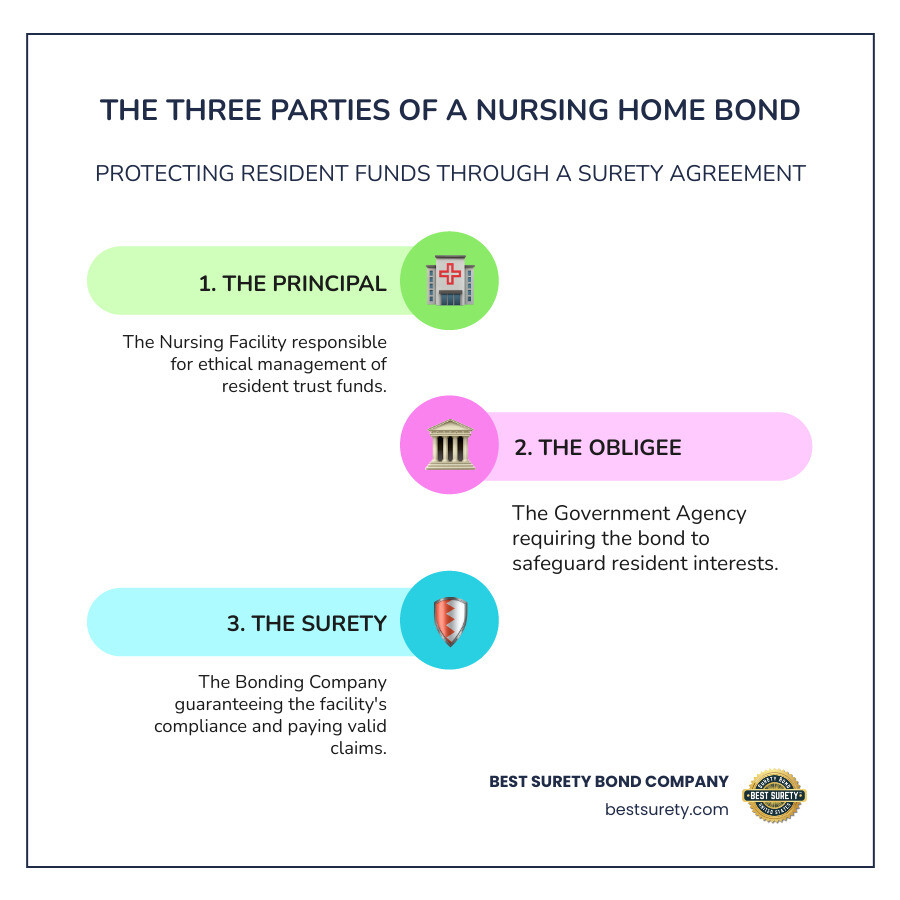
The structure of a Nursing home bond involves three parties working together to protect vulnerable residents. You, the facility owner, are the Principal—the party required to obtain the bond and obligated to manage funds properly. The Obligee is the government agency (federal or state) that requires the bond to protect residents and enforce compliance. The Surety—that’s where BEST SURETY BOND COMPANY comes in—is the financial institution that issues the bond and backs your promise to handle funds ethically.
Here’s how this three-party agreement protects everyone involved: If your facility mismanages resident funds and a valid claim is filed, the Surety pays the harmed resident or their family up to the full bond amount. But this isn’t free money for the facility—you’re then responsible for reimbursing the Surety for any claims paid. This structure creates powerful financial incentive to maintain proper accounting and ethical fund management at all times.
The bond serves as your facility’s commitment to financial responsibility and regulatory compliance. It demonstrates to residents, families, and state agencies that you take your fiduciary duties seriously. Without this protection in place, residents would have limited recourse if their funds disappeared or were misused—and your facility would be operating illegally, facing daily fines and potential license revocation.
Whether you’re opening a new facility or maintaining an existing operation, understanding your obligations under this bond is essential. It’s not just about checking a regulatory box—it’s about building trust with the families who depend on you for their loved one’s care and financial security. For more context on how surety bonds work across different industries, you can explore more info about commercial surety bonds.
Understanding Nursing Home Bond Requirements and Costs
If you’re running a nursing home, assisted living facility, or at-home care business that manages resident funds, you need to understand whether a Nursing home bond is required for your operation. The answer is almost certainly yes—and knowing exactly what’s required can save you from costly compliance issues down the road.
Nursing homes that provide round-the-clock medical care and assistance are the most common facilities requiring these bonds. But the requirement extends beyond traditional nursing homes. Assisted living facilities, which offer support with daily activities without skilled nursing care, also need this protection when they manage resident funds. Even at-home care businesses that handle financial matters for clients receiving care in their own residences fall under this requirement.
The rule of thumb is simple: if your business touches the personal funds of vulnerable individuals under your care, you need this bond. It’s not about the type of facility you run—it’s about the trust you’re being given with someone’s money.
The federal minimum bond amount is typically $50,000, which provides a solid foundation of protection for residents’ funds. But here’s where it gets important: this isn’t a one-size-fits-all number. Some states require higher amounts based on the total value of resident funds you manage, the number of residents in your care, or other state-specific regulations. That’s why working with a bonding company that understands your specific location is so valuable.

How Much Does a Nursing Home Bond Cost?
Here’s the good news: a Nursing home bond is far more affordable than most facility operators expect. The premium—the amount you actually pay—is just a small percentage of the total bond amount, not the full $50,000.
For a standard $50,000 bond, most facilities pay between 1% and 5% of that amount annually. That translates to an annual premium ranging from $500 to $2,500—a small price for regulatory compliance and resident protection.
What determines where you fall in that range? Your credit score plays the biggest role. Facilities or their principals with strong credit (typically 700 or higher) can often secure rates as low as 1-1.5%, meaning you might pay just $500-$750 per year. Your financial history matters too—a clean track record of fund management and no past claims will work in your favor. The overall financial health of your operation, including how long you’ve been in business and your operational history, all factor into your final rate.
At BEST SURETY BOND COMPANY, we specialize in affordable rates and fast approvals. We know that every dollar counts when you’re running a care facility, and we work hard to get you the lowest possible premium. Many of our clients with strong credit pay just 1-2% annually, and we can often provide instant online approval so you’re bonded the same day you apply.
State-Specific Regulations: Texas and Beyond
While federal regulations set the baseline requirements for Nursing home bonds, each state adds its own layer of rules and requirements. What’s required in Texas might differ from California or New York, and understanding these nuances is critical for staying compliant.
In Texas, facilities must follow state-specific guidelines for patient trust funds that work alongside federal mandates. For nursing homes and assisted living facilities in Houston, Dallas, San Antonio, Austin, and throughout Texas, these requirements are part of your daily compliance checklist. The good news? We’re Texas-based experts who live and breathe these regulations. We know exactly what Houston facilities need, and we can get you bonded quickly without the confusion.
But our expertise doesn’t stop at the Texas border. We’re licensed in all 50 states, so whether you’re opening a new facility in Seattle or maintaining compliance for an established operation in Miami, we can guide you through your state’s specific requirements. For comprehensive guidance on nursing home regulatory requirements, the Interpretive Guidance for Nursing Homes provides detailed federal standards that apply nationwide.
Understanding state variations can feel overwhelming, but it doesn’t have to be. Whether you need help with Texas-specific compliance or requirements in another state, our team is ready to walk you through exactly what you need. No confusing jargon, no hidden requirements—just straightforward guidance that gets you bonded fast.
The Bond in Action: Claims, Violations, and Getting Bonded Fast
A Nursing home bond isn’t just paperwork you file away and forget about—it’s an active guarantee that springs into action whenever a resident’s trust is broken. Understanding how this protection works, what triggers a claim, and how quickly you can get bonded is essential for every facility manager.
When a resident or their family entrusts personal funds to your facility, the bond serves as their safety net. If those funds are mismanaged, misappropriated, or simply can’t be accounted for, the bond provides a direct path to financial recovery. This protection is especially crucial for elderly residents who may lack the capacity to monitor their own accounts or pursue legal remedies on their own.
The bond guarantees that your facility will manage all trust funds ethically and responsibly. This means maintaining separate accounts for resident funds—never commingling them with your operational money. It means keeping meticulous, accurate records of every deposit, withdrawal, and transaction. It means residents or their designated representatives can access their funds promptly when requested. And it means full compliance with both federal regulations and your state’s specific requirements.
As the Principal on the bond, your facility commits to several non-negotiable obligations. You must maintain completely separate accounts for resident trust funds, provide full and accurate accounting of each resident’s personal money, disburse funds only as directed by residents or their legal representatives, and remain transparent with families about the status of their loved ones’ accounts. These aren’t suggestions—they’re binding commitments backed by the financial guarantee of the bond.
When Things Go Wrong: Claims and Consequences

What happens if your facility violates these terms? Perhaps funds go missing, or you can’t produce adequate records, or you’ve delayed returning money to a resident who requested it. In these situations, a claim can be filed against your Nursing home bond.
The claims process begins when a resident, their family member, or even a regulatory agency files a formal claim with the surety company—in our case, BEST SURETY BOND COMPANY. We then launch a thorough investigation, reviewing documentation, interviewing involved parties, and assessing the actual financial loss. If we determine the claim is valid, we’ll pay the harmed resident or their family up to the full bond amount, ensuring they’re compensated even if your facility can’t immediately make things right.
Here’s the critical part that distinguishes surety bonds from insurance: after we pay a valid claim, your facility must reimburse us. This is called indemnification, and it’s legally binding. The bond essentially acts as a guarantee or line of credit, not an insurance policy that simply covers losses. You remain financially responsible for any violations.
The consequences of bond violations extend far beyond just repaying the surety. Financial penalties from regulatory agencies can reach thousands of dollars per day. Your operating license can be placed on provisional status, suspended, or permanently revoked—shutting down your facility entirely. You may be excluded from Medicare and Medicaid reimbursement programs, which can be financially devastating for most facilities.
Perhaps worst of all is the reputational damage. When citations and violations become public record, they’re essentially “dirty laundry hung out for everyone to see,” as one facility administrator put it. Families researching care options will find these records, and rebuilding trust can take years—if it’s possible at all. Beyond regulatory actions, you may face civil lawsuits from affected residents or their families seeking additional damages.
Getting Bonded Quickly and Easily
The good news? Obtaining your Nursing home bond is straightforward when you work with the right partner. At BEST SURETY BOND COMPANY, we’ve streamlined the process to get you bonded fast—often the same day you apply.
Start by contacting our Houston-based team to discuss your specific needs. We’ll help determine the exact bond amount required in your state and walk you through any Texas-specific requirements if you’re operating here. Our simple application asks for your facility’s basic information—legal name, address, bed count, license details, and financial information. For facility owners and principals, we’ll review personal financial statements and credit history to determine your premium rate.
Once you submit your application, we provide a competitive quote immediately. Our fast approval process means you won’t spend days waiting. Accept the quote, purchase your bond, and we’ll issue it right away. You’ll receive a digital copy instantly for your records, and we’ll mail the original signed bond for submission to your regulatory agency.
We offer instant online approval for most applicants, with same-day issuance as standard practice, not a premium service. For facilities throughout Houston, Dallas, San Antonio, Austin, and across all of Texas—plus nationwide—we provide the fastest turnaround in the industry. We understand compliance deadlines don’t wait, and neither should you. Learn about the license and permit bond process and find how quickly we can help your facility maintain full compliance.
Getting bonded doesn’t have to be complicated or time-consuming. With the right surety partner, you can secure your Nursing home bond and focus on what matters most: providing excellent care to your residents.
Frequently Asked Questions about Patient Trust Fund Bonds
What is the difference between a nursing home surety bond and liability insurance?
This is one of the most common questions we hear, and it’s an important distinction to understand. While both involve financial protection, they’re actually very different tools serving different purposes.
A Nursing home bond exists primarily to protect residents and their families—not your facility. It’s a three-party agreement where the surety company (that’s us) guarantees to the government (the Obligee) that your facility (the Principal) will manage resident trust funds ethically and according to the law. Here’s the crucial part: if something goes wrong and the surety pays out a claim to a harmed resident, your facility is legally required to reimburse the surety for every dollar paid. Think of it as a line of credit or a financial guarantee—it’s not covering your losses, it’s guaranteeing your ethical behavior to others.
Liability insurance, on the other hand, protects your facility from claims of negligence, malpractice, or other operational liabilities. It’s a two-party contract between you and the insurance company. When the insurer pays a covered claim, you don’t have to pay them back (beyond your deductible and premiums)—they assume the risk of loss. That’s the fundamental difference.
In short: the Nursing home bond ensures you do right by residents’ money. Liability insurance protects you when things go wrong in your operations. You need both, but they serve completely different functions.
Can a nursing home in Texas operate without a surety bond?
The simple answer is no—absolutely not. Any nursing home in Texas (or anywhere in the United States) that manages resident funds must maintain a Nursing home bond. This isn’t a suggestion or a best practice; it’s federal law under 42 CFR 483.10(c)(7), reinforced by Texas state regulations.
We’ve seen facilities try to operate without proper bonding, and the consequences are severe and swift. Daily fines accumulate rapidly, sometimes reaching thousands of dollars per day. State licensing boards don’t hesitate to suspend or revoke operating licenses, which means you’re out of business. Even more damaging, your facility can be excluded from Medicare and Medicaid programs—and for most nursing homes, that’s a death sentence financially.
Beyond the regulatory penalties, operating without a bond exposes your facility to direct legal liability for any mishandling of resident funds. Without the bond’s protection, lawsuits from affected families can target your facility’s assets directly. And the reputational damage? That’s nearly impossible to recover from. Word travels fast in the eldercare community, especially when compliance violations become public record.
The only scenario where you might not need this specific bond is if your facility has a strict policy of never managing any resident funds whatsoever—but that’s highly impractical for most nursing homes and assisted living facilities. For all practical purposes, if you’re caring for residents and handling any of their personal money, the bond is mandatory, non-negotiable, and essential for legal operation.
How is a US Patient Trust Fund Bond different from foreign aged care deposits?
This question comes up more often than you might think, especially from operators with international experience or families researching care options across different countries. The US Nursing home bond system is quite different from aged care financial arrangements in countries like Australia or the United Kingdom.
Our US Patient Trust Fund Bond is a surety product—a regulatory compliance tool that guarantees your facility will manage resident funds ethically. It’s not a deposit from the resident, and it’s not a payment for accommodation. Instead, it’s a financial guarantee purchased by your facility from a surety company (like BEST SURETY BOND COMPANY) that protects residents from mismanagement or misconduct. If your facility mishandles funds, the surety pays the harmed resident, then seeks reimbursement from your facility. It’s a third-party safeguard required by law.
In contrast, countries like Australia use direct financial arrangements between residents and facilities. The Refundable Accommodation Deposit (RAD) is a lump-sum payment—often quite substantial, averaging around $470,000—that the resident pays directly to the facility for their accommodation. It functions like an interest-free loan and is typically refundable when the resident leaves. Alternatively, residents can choose a Daily Accommodation Payment (DAP), which is a non-refundable daily fee calculated from the RAD amount and government interest rates.
The fundamental difference is this: the US Nursing home bond is a regulatory safeguard against facility misconduct, backed by a third-party surety. Foreign systems like Australia’s RAD are direct payments from resident to facility for accommodation services. Our bond protects against unethical handling of funds already entrusted to the facility—it’s not part of the payment structure itself, but rather a guarantee that all payments and personal funds will be managed properly. It’s a different financial instrument serving a different purpose, designed specifically for the US regulatory environment.
Get Your Texas Nursing Home Bond with Confidence
When you’re running a nursing home or assisted living facility, the safety and financial security of your residents isn’t just a priority—it’s everything. Meeting regulatory requirements isn’t optional paperwork you can put off; it’s the foundation of ethical care and legal operation. The Nursing home bond stands at the center of this commitment, protecting the vulnerable individuals who trust you with their care and their money, while simultaneously safeguarding your facility’s operations, license, and reputation.
We get it. You didn’t go into healthcare to become an expert in surety bonds and federal compliance regulations. You’re here to care for people, and that’s exactly where your focus should be. That’s why we’ve built BEST SURETY BOND COMPANY to handle the bonding side of things quickly, affordably, and without the headaches you might expect from financial paperwork.

As a Houston-based, surety-only agency, we combine the local expertise you’d expect from a Texas company with the authority and reach of a nationwide provider. We’re licensed in all 50 states, which means whether you’re managing a small assisted living facility here in Houston, operating a nursing home in Dallas or San Antonio, or running a multi-state chain, we’ve got you covered. We understand the specific requirements for Texas facilities, and we know exactly what you need to stay compliant with both state and federal regulations.
What makes working with us different? Speed and affordability, without sacrificing service. We offer instant online quotes and same-day bond issuance because we know compliance deadlines don’t wait. Our rates are among the most competitive in the industry—facilities with strong financial credentials often pay just 1-5% of the bond amount annually. And our licensed agents? They’re real people who actually answer the phone and are ready to walk you through state-specific requirements, whether you’re a first-time applicant or renewing your bond.
The bottom line is this: protecting your residents and ensuring your compliance should never be a source of stress or uncertainty. With a Nursing home bond from BEST SURETY BOND COMPANY, you’re not just checking a regulatory box—you’re partnering with experts who genuinely want to see your facility succeed.
Ready to get bonded? Get started with our services now, or give us a call for an instant, no-obligation quote. We’re here to make getting your Patient Trust Fund Bond the easiest part of your compliance checklist, so you can get back to what matters most: caring for your residents with confidence and peace of mind.
