

Understanding Probate Surety Bonds in Estate Administration
A surety bond probate is a critical financial safeguard in estate administration, ensuring that fiduciaries—executors, administrators, and others—properly manage assets and fulfill their legal duties. When someone passes away, probate courts often require these bonds to protect heirs, beneficiaries, and creditors from potential mismanagement or fraud.
Quick Answer: What You Need to Know About Probate Surety Bonds
- Purpose: A financial guarantee that fiduciaries will perform their duties lawfully.
- Who Needs Them: Executors, administrators, guardians, and trustees appointed by Texas courts.
- Cost: Typically 0.5% to 3% of the bond amount; the estate usually pays.
- Duration: Remains active until the estate is closed and the fiduciary is released.
- Protection: Covers heirs, beneficiaries, and creditors against misconduct.
The probate process is complex and emotional. A probate bond is a key step, especially in Texas, where courts in Houston, Dallas, San Antonio, and Austin regularly require them to ensure proper estate administration.
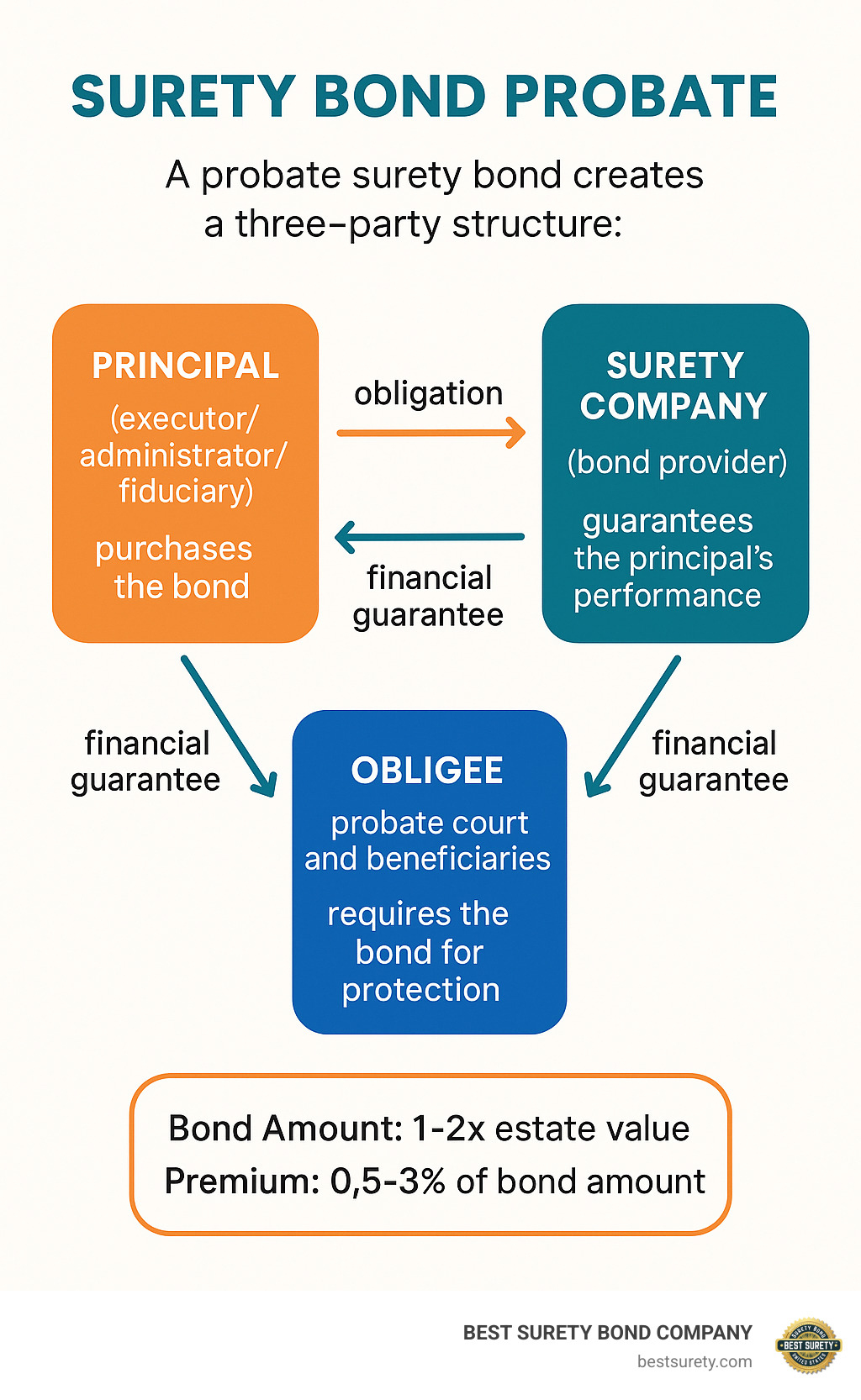
A probate surety bond is a three-party agreement between the principal (fiduciary), the obligee (court or beneficiaries), and the surety company. If the fiduciary fails to perform their duties, the bond provides financial recourse for those harmed.
I’m Haiko de Poel. My experience in financial services helps me simplify the bonding process for families during difficult times, ensuring fiduciaries understand their obligations and get bonded quickly.
What is a Probate Bond and Why is it Required?
When someone passes away, Texas probate courts need assurance that the person handling the estate will act responsibly. A surety bond probate serves as a financial safety net for everyone involved.
Think of it as a promise backed by money. It’s a court bond guaranteeing the appointed fiduciary—an executor, administrator, guardian, or trustee—will handle their duties ethically and lawfully. This three-party agreement involves the principal (the fiduciary), the obligee (the court, protecting heirs and creditors), and the surety (the bond company, like BEST SURETY BOND COMPANY, providing the financial guarantee).
Texas probate courts, especially in busy hubs like Houston, Dallas, San Antonio, and Austin, often require these bonds. The requirement is common for large estates, when family members disagree, or when there is no will. The bond amount is set by the court based on the estate’s value and remains in place until the estate is settled. These requirements are governed by the Texas Estates Code, which outlines the specific bonding obligations for fiduciaries. For a deeper understanding of how surety bonds work, explore our guide on What is a Surety Bond?.

Who a Probate Bond Protects
A probate bond creates a protective shield for several interested parties:
- Heirs and beneficiaries are the primary group protected. The bond ensures they receive their rightful inheritance, safeguarding assets from mismanagement or theft by the fiduciary.
- Creditors of the estate are also protected. The bond guarantees that the estate’s legitimate debts are paid before assets are distributed to heirs.
- In guardianships, the bond protects the ward (a minor or incapacitated adult) by ensuring the guardian manages their finances and property responsibly.
The bond is a powerful deterrent against fraud and mismanagement, creating real financial consequences for fiduciaries who fail to act in the estate’s best interests.
The Fiduciary’s Role and Responsibilities
Being a fiduciary is a serious legal responsibility. The bond underscores the importance of these duties:
- Acting in the estate’s best interest: This is the core duty. Every decision must preserve and protect the estate’s value, putting its needs first.
- Inventorying assets: This involves finding and listing all property, from bank accounts and real estate to digital assets and collectibles.
- Paying debts and taxes: The fiduciary must verify and pay all legitimate claims, like final bills and taxes, according to Texas law before distributing assets.
- Distributing remaining assets: This is the final step. The fiduciary must follow the will or Texas intestacy laws precisely.
- Adhering to the will and court orders: This is mandatory and includes filing reports, meeting deadlines, and keeping detailed records.
Failure in these duties can lead to claims against the bond, making the fiduciary personally liable for any losses.
The Mechanics of a Surety Bond for Probate in Texas
When you’re appointed as a fiduciary in Texas, understanding how a surety bond probate works is key. Here is a step-by-step overview.
How a Probate Bond Works in Practice
The process starts when the probate court appoints you and issues an order requiring a bond as a safety net. The court sets the bond amount, typically based on the estate’s personal property value and expected income. You then apply with a surety company like BEST SURETY BOND COMPANY. Our fast online application simplifies this step.
Once approved, you pay the premium, receive the bond, and file it with the Texas probate court (e.g., in Houston, Dallas, San Antonio, or Austin). This allows you to officially begin your duties. Probate bonds are annual contracts, requiring yearly renewal and premium payment until the estate is closed and the court formally releases you.
If a claim is filed against the bond for mismanagement, the surety investigates. If the claim is valid, the surety pays the claimant up to the bond amount, and you are then legally required to reimburse the surety. The bond protects others, not you.
For a comprehensive look at how these bonds function, explore our guide on Probate Bonds Explained.

Determining the Bond Amount and Duration
Texas probate courts use a methodical approach to set bond amounts, ensuring adequate protection.
The value of personal property (cash, bank accounts, investments, vehicles) is the primary factor. Real estate is often excluded. The estate’s estimated annual income from sources like rent or investments is also included in the calculation.
Texas Probate Code guidelines and local court rules in Houston, Dallas, San Antonio, and other Texas counties set the framework. The bond amount is often one to two times the personal estate’s value. For example, an estate with $200,000 in personal property may require a $200,000 to $400,000 bond.
Other risk factors like family disputes or complex business interests can also increase the required bond amount.
As for duration, the bond remains active for the entire probate process, which can last from months to several years. It only ends when the court issues an official order discharging you from your duties. Annual premiums are due until the end, but the estate typically reimburses this as an administrative cost.
For detailed information, check out our Probate Bond Requirements guide.
Types, Costs, and Waivers for a Surety Bond Probate
Understanding the different types of surety bond probate, their costs, and potential waivers can help you steer the process. The bond you need depends on your specific role.
BEST SURETY BOND COMPANY provides the full spectrum of probate bonds required by Texas courts in Houston, Dallas, and beyond. Common types include:
- Administrator Bonds: For cases with no will.
- Executor Bonds: When a will names an executor.
- Guardianship & Conservatorship Bonds: To protect the financial interests of a minor or incapacitated adult.
- Trustee Bonds: For managing assets within a trust.
- Personal Representative Bonds: A general term used by many Texas courts.
You can explore these bond types in our guide on Types of Probate Bonds.

Calculating the Cost of a Surety Bond Probate
Clients often ask, “What will this surety bond probate cost?” It’s important to distinguish the bond amount (the total court-required coverage) from the premium (the actual price you pay).
Premiums for qualified applicants are typically 0.5% to 3% of the bond amount annually. A $200,000 bond might cost $1,000 to $6,000 per year. Your credit score is the biggest factor; excellent credit yields lower rates (0.5%-1%), while challenged credit can increase them. Estate complexity and value also affect the premium.
Good news: the estate typically pays for the bond. The premium is an administrative expense, so you can be reimbursed from estate assets.
For detailed pricing, see our Probate Bond Costs page.
When a Bond Requirement Can Be Waived
Not every probate case requires a bond. A waiver may be possible in these situations:
- The will explicitly states no bond is required. This is a common estate planning tool.
- Unanimous consent from all heirs can convince a court, especially in harmonious family situations.
- Simple estates with minimal assets and no debt may not require a bond if the risk is low.
However, Texas probate courts have the final say. A judge in Houston, Dallas, San Antonio, or Austin might still require a bond despite a waiver if there are risk factors, such as beneficiary conflicts or an out-of-state fiduciary. Even with a waiver, the fiduciary remains fully legally responsible for their actions.
How to Get a Probate Bond Quickly in Texas
Dealing with a loved one’s estate is hard enough without complex paperwork. BEST SURETY BOND COMPANY understands this, which is why we’ve streamlined our process to make getting a surety bond probate simple and stress-free.
Our Texas-based team helps fiduciaries across Houston, Dallas, San Antonio, and Austin get bonded quickly. With our fast online application, you can apply anytime. Many clients receive instant quotes, and we often provide same-day issuance to meet tight court deadlines.
Our local Texas expertise ensures your bond will be accepted the first time. No delays, no rejections, no headaches.
For step-by-step guidance, check out our guide on How to Get a Probate Bond.

The Application Process Step-by-Step
Getting your probate bond is straightforward with our efficient process:
- Gather court documents. You’ll need the court order, estate value, and details about the deceased. Our team can help you identify the necessary paperwork.
- Complete our fast online application. Our intuitive form takes less than 10 minutes and guides you through the essential questions.
- Undergo a quick underwriting review. We assess your application based on credit and estate details. Most probate bonds don’t require collateral.
- Pay the premium and get your bond. Once approved, you can receive your bond instantly. File it with the court to begin your fiduciary duties.
Why Choose a Texas-Based Surety Specialist?
Our knowledge of local Texas probate courts in Houston, Dallas, San Antonio, and Austin is a key advantage. We know each court’s specific requirements, ensuring your bond is accepted without delay.
Our experience and underwriter relationships lead to faster processing times. We often provide same-day approval and issuance.
We provide access to the best rates. As a high-volume producer, we shop your application to find the most competitive premium for your low-cost surety bond probate.
We also find solutions for applicants with credit challenges. We work with specialized underwriters to find a solution that makes bonding accessible when you need it most.
We’re licensed in all 50 states, giving you the confidence of national authority with our core focus here in Texas.
Frequently Asked Questions about Probate Bonds
When you’re dealing with estate administration, questions about surety bond probate requirements are common. Here are answers to the questions we hear most from our clients in Houston, Dallas, San Antonio, and beyond.
For a more extensive list, check out our Probate Bond FAQs.
Can I get a probate bond with bad credit?
Yes, and it’s a common concern. Surety bond probate approval isn’t based solely on your credit score. While good credit helps secure low rates, sureties consider the whole picture: your financial stability, relationship to the deceased, and estate complexity.
At BEST SURETY BOND COMPANY, we partner with sureties specializing in diverse credit profiles. We can offer solutions like joint control agreements, where the surety oversees major financial transactions to reduce risk. This approach often makes bonding possible even when traditional approval seems unlikely. We encourage you to apply online to see what options are available.
Is the probate bond premium refundable?
No, the premium is non-refundable. It is the fee for the financial guarantee provided by the surety for the coverage period (usually one year). Once the service is rendered, the fee is considered earned.
However, there’s an important silver lining: the estate typically reimburses you for the bond cost. The premium is a legitimate administrative expense, like attorney fees, so you can be reimbursed from estate assets, reducing your personal financial burden.
How is a probate bond different from an insurance policy?
This is a crucial distinction. While both involve premiums, they function very differently.
- Insurance protects you, the policyholder. If your car insurer pays a claim, they don’t seek reimbursement from you.
- A surety bond probate protects the court, heirs, and creditors from your actions. It guarantees your performance as a fiduciary.
The most critical difference is that if the surety pays a claim due to your negligence, you must reimburse them fully, including any legal costs. The bond holds you accountable, protecting others from potential financial harm you might cause. This system incentivizes careful, ethical management of the estate.
Conclusion
Navigating the probate process in Texas is easier when you understand how a surety bond probate serves as a critical safeguard. These bonds are more than a court requirement; they protect everyone involved in estate administration, from family members to creditors.
Probate bonds act as guardrails, ensuring fiduciaries act with integrity. Whether in Houston, Dallas, San Antonio, or Austin, these bonds provide peace of mind that assets are managed properly.
At BEST SURETY BOND COMPANY, we transform a stressful situation into a manageable process through speed, affordability, and reliability. Our instant online quotes and same-day issuance capability ensure you meet court deadlines without hassle.
Our deep understanding of Texas probate requirements, combined with our national reach, gives you the best of both worlds: local expertise with the resources of a national provider. We know the nuances of different county courts and how to get your bond approved quickly.
The probate process is emotionally challenging. Don’t let bond requirements add unnecessary stress. We’re here to make this part simple, fast, and affordable, so you can focus on honoring your loved one’s legacy.
Ready to get started? We’re standing by to help you secure the bond you need today.
Get Your Free Probate Bond Quote Today!
