

Understanding Texas Payment & Performance Bonds: Essential Protection for Construction Projects
A texas payment and performance bond is a three-party financial guarantee between a contractor (Principal), project owner (Obligee), and insurance company (Surety) that protects construction projects. Here’s what you need to know:
Quick Facts:
- Performance Bonds: Guarantee project completion per the contract.
- Payment Bonds: Ensure subcontractors and suppliers are paid.
- Texas Public Project Thresholds: $100,000+ for performance bonds, $25,000+ for payment bonds.
- Cost: Typically 1–5% of the bond amount.
- Approval Time: Most bonds approved within 24–48 hours.
In the vital Texas construction industry, these bonds provide crucial financial protection when a contractor defaults or fails to pay workers. Performance bonds shield project owners, while payment bonds protect subcontractors and suppliers. Together, they form a safety net that keeps projects on track and ensures all parties are paid.
As Haiko de Poel, I’ve guided countless contractors through the complexities of texas payment and performance bond requirements. My experience has shown that the right financial protections are essential for the success of any construction business in Texas.
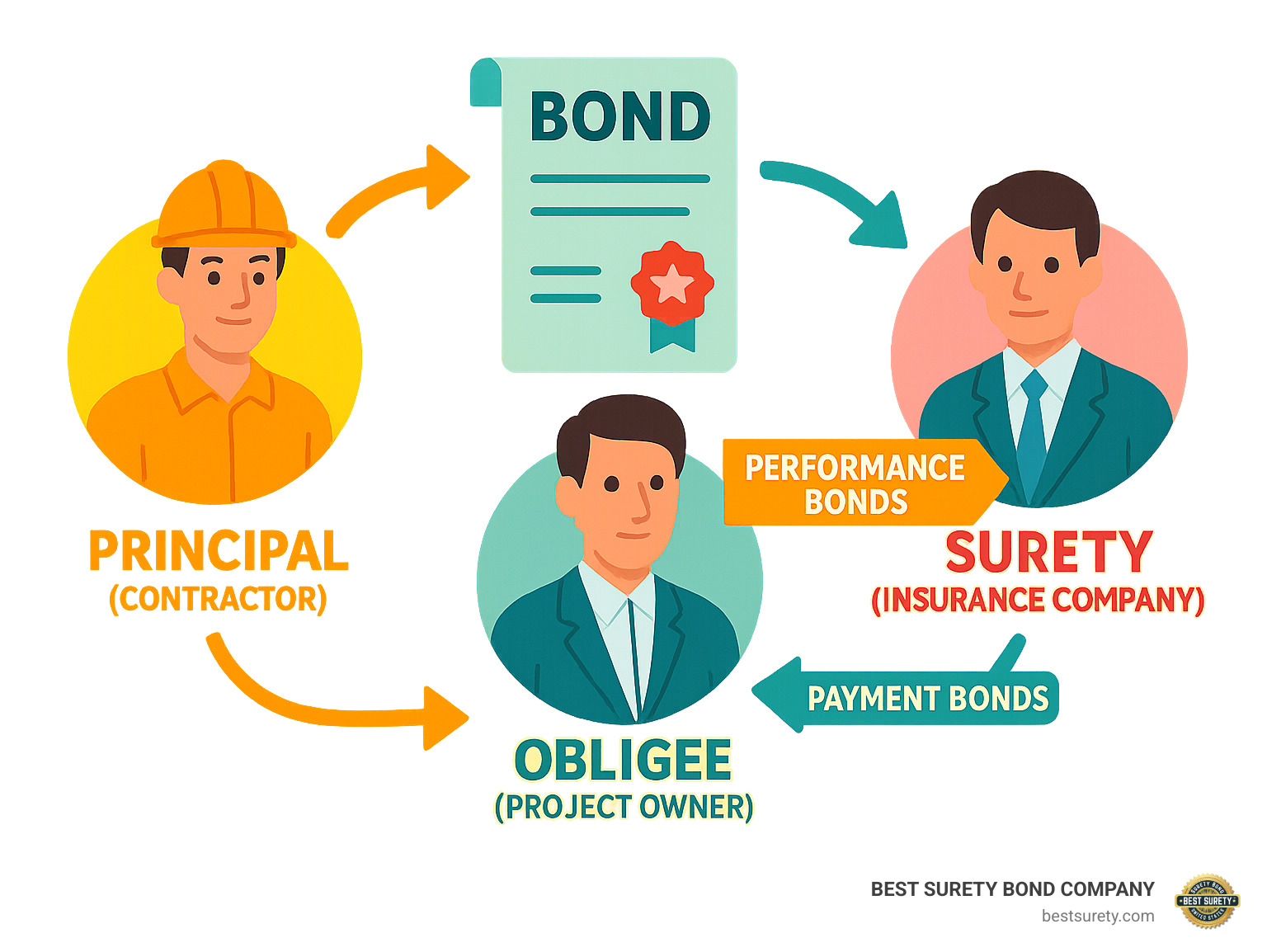
Simple texas payment and performance bond word guide:
The Role of a Performance Bond
A performance bond guarantees a project owner (the Obligee) that the contractor (the Principal) will finish the job as promised. It’s a guarantee from a surety company that the contractor will fulfill all contractual obligations. If the contractor defaults, abandons the project, or delivers substandard work, the bond protects the owner from financial loss. The surety steps in to ensure project completion, either by hiring a new contractor or compensating the owner for the costs to finish the work. We help Texas contractors in cities like Houston and Dallas secure these vital bonds quickly and at competitive rates.
To learn more about this crucial protection, visit our detailed guide: What is a Performance Bond?.
The Role of a Payment Bond
While a performance bond protects the project owner, a payment bond safeguards the subcontractors, laborers, and material suppliers. On public projects where mechanic’s liens are not an option, payment bonds are absolutely critical.
A payment bond assures that everyone who provides labor and materials gets paid. If the prime contractor fails to pay, these parties can file a claim against the bond. The surety investigates and, if the claim is valid, pays the claimants directly. This prevents financial hardship for smaller businesses and keeps the project free of payment disputes. Our fast approval process and low rates mean Texas contractors can easily secure the payment bonds they need.
For a deeper dive into payment bonds, check out: What is a Payment Bond?.
Key Differences at a Glance
Performance and payment bonds serve distinct purposes but are both essential for a smooth construction project.
Here’s a quick comparison:
| Feature | Performance Bond | Payment Bond |
|---|---|---|
| Purpose | Guarantees the contractor will complete the project. | Guarantees subcontractors and suppliers will be paid. |
| Who is Protected | The project owner (Obligee). | Subcontractors, laborers, and material suppliers. |
| What is Guaranteed | Project completion according to contract terms. | Payment for labor and materials furnished. |
| Main Risk Addressed | Contractor default or non-performance. | Non-payment to lower-tier parties. |
Understanding these differences is key to navigating construction contracts. Both are crucial components of a comprehensive texas payment and performance bond strategy.
For a more comprehensive look at their distinctions, explore our detailed comparison: Performance Bond vs. Payment Bond.
Legal Requirements for a Texas Payment and Performance Bond
Navigating the legal landscape of texas payment and performance bond requirements is crucial for any contractor in the Lone Star State. Understanding the statutes governing these bonds is key, whether you’re on a federal project, a new state building, or a private development.

Texas Public Projects: The “Texas Miller Act”
Texas public works projects are governed by Texas Government Code Chapter 2253, also known as the “Texas Miller Act.” This law protects public funds by mandating bonds on state and local government projects.
- A performance bond is required for public work contracts over $100,000.
- A payment bond is required for contracts over $25,000. This threshold increases to $50,000 for municipalities or certain joint boards.
These thresholds are critical. If a government entity fails to secure a required payment bond, it can become liable for unpaid claims from subcontractors and suppliers. We specialize in helping Texas contractors meet these state requirements with fast approvals and competitive rates.
You can dig into the specific legal text here: GOVERNMENT CODE CHAPTER 2253. PUBLIC WORK PERFORMANCE AND PAYMENT BONDS.
Federal Projects in Texas: The Miller Act
For federal public works projects in Texas, the federal Miller Act applies. This 1935 law mandates bonding for all federal construction contracts.
The Miller Act requires both a payment and a performance bond for federal projects valued at $100,000 or more. The performance bond ensures the contract is completed, while the payment bond protects subcontractors and suppliers from non-payment. This is vital as mechanic’s liens cannot be placed on federal property. We have extensive experience with federal bonding requirements and can guide you through the process for projects at a military base in San Antonio or a federal building in Austin.
For more details on the federal requirements, refer to: The Miller Act.
Private Projects in Texas
For private construction projects in Texas, texas payment and performance bonds are not always required by law; it’s often the project owner’s decision.
However, many savvy owners require a payment bond under Chapter 53 of the Texas Property Code. This is a smart move, as a statutory payment bond can relieve the owner from withholding retainage and protect their property from mechanic’s liens. By requiring a bond, owners ensure subcontractors have a direct path for payment, avoiding costly disputes. We work with private owners and contractors across Texas, from Houston to Dallas, to secure the right construction bonds for financial security.
Find more about how these bonds function in private construction: Construction Bonds.
How to Get Bonded for Your Texas Construction Project
Securing a texas payment and performance bond doesn’t have to be complicated. At BEST SURETY BOND COMPANY, we make it easy and fast for Texas contractors. We want you focusing on your Houston job site, not drowning in paperwork!

The Application and Underwriting Process
The application process is our way of getting to know your business to find you the best rates quickly. You’ll generally need to provide:
- A completed application form with company and project details.
- The contract and notice of award letter.
- Financial statements, including business (and sometimes personal) financials and tax returns. Keeping these updated with a construction-focused CPA is a great tip for a smooth process.
- Credit check authorization. We have programs for various credit profiles, so don’t worry if your credit isn’t perfect.
- Company history and experience to show your track record.
Our goal is efficiency. Most Texas contractors get approved within 24 hours because we know time is money in construction.
Ready to take the first step for your performance bond? Visit: How to Get a Performance Bond?.
Understanding the Cost of a Texas Payment and Performance Bond
One of the first questions we hear is, “How much will a texas payment and performance bond cost?” The premium is usually a small percentage of the total bond amount, making it a smart investment.
The cost for payment and performance bonds in Texas typically ranges from 1% to 5% of the bond’s value. Rates can vary based on project size:
- Jobs under $800,000: 2–3%
- Projects from $800,000 to $1,500,000: 1.5–3%
- Jobs over $1,500,000: 1–3%
Lower rates are often available for “Merit clients”—contractors with strong financials and good credit. If your credit is lower or you have less financial history, the rate might be higher, up to 5%.
Factors influencing your premium include credit scores, company financial health, contract size and type, and perceived job risk. We are dedicated to finding the lowest premiums possible for our Texas contractors.
Timeline, Refunds, and Expiration
When you need a bond, you need it fast. Getting a texas payment and performance bond is surprisingly quick. Most of our clients receive bond approvals within a day or two, and we offer same-day issuance whenever possible.
Regarding refunds, performance bonds are generally non-refundable. Once issued, the surety takes on the risk, and the premium is considered “earned,” even if a project is canceled.
Finally, bonds have expiration dates. It’s crucial to track these! An expired bond can lead to a breach of contract. Project owners may require an extension or a new bond. We advise tracking expiration dates closely and being proactive about renewals. We’re here to help you stay on top of your bonding needs, ensuring continuous coverage for your projects across Texas.
To get started with securing your payment bond quickly, visit: How to Get a Payment Bond?.
Filing a Claim on a Texas Bond: A Contractor’s Guide
When a project goes sideways, knowing how to file a claim on a texas payment and performance bond is critical. The process is unforgiving when it comes to deadlines and notice requirements.

Think of bond claims like a legal dance with specific steps. Miss one, and you could lose your right to recover payment. We advise our Texas clients to document everything and meet every deadline.
Perfecting Your Claim on a Texas Public Project Bond
Texas public projects have strict claim rules under Government Code Chapter 2253. Deadlines are not suggestions, whether you’re on a job in Dallas or Austin.
- Second-Month Notice: You must send a preliminary notice to the general contractor by the 15th day of the second month after providing labor or materials (e.g., work in January, notice due by March 15th).
- Third-Month Notice: The official bond claim notice is due by the 15th day of the third month after your work (e.g., work in January, notice due by April 15th). This must be sent via certified or registered mail to the prime contractor and the surety.
- Required Documentation: Your claim must include a notarized sworn statement of account detailing what you’re owed, along with supporting documents like invoices.
- Retainage Claims: The deadline is 90 days after the project’s final completion.
The Claim Process for Private and Federal Projects
Private projects in Texas follow a similar principle: strict deadlines matter. With a statutory payment bond under Texas Property Code Chapter 53, you’ll generally follow the same timeline as lien requirements.
- Notice: Send notice to the owner, general contractor, and surety by the 15th day of the third month after providing labor or materials. A sworn statement of account is still required.
Federal projects under the Miller Act are simpler but just as strict.
- Notice: You have 90 days after your last day of work to send notice to the prime contractor. While a sworn statement isn’t explicitly required, providing detailed documentation is always a smart move.
What Happens After a Claim is Filed?
Once you file a claim on a texas payment and performance bond, the surety investigates its validity. They will review your documentation, check for compliance with notice requirements, and look for any possible defenses from the contractor.
If your claim is valid, the surety will pay claimants up to the bond’s limit. However, the contractor is ultimately responsible for reimbursing the surety for any money paid out on claims.
Time is still critical. If a surety doesn’t pay a valid claim, you have one year from the date you mailed your notice to file a lawsuit on Texas payment bonds. For performance bonds and Miller Act claims, the deadline is typically one year from project completion or your last day of work. We always recommend consulting with legal counsel when filing a claim, as the rules are complex and the stakes are high.
Frequently Asked Questions about Texas Construction Bonds
We understand that texas payment and performance bonds can seem complex. Many contractors and project owners across Texas have similar questions, and we’re here to provide clear answers.
What is a 100% performance and payment bond?
When you hear “100 percent performance and payment bond,” it means the bond covers the full value of your construction contract. This type of texas payment and performance bond is a complete safety net that guarantees two things:
- Performance: It assures the project owner that the contractor will complete the project according to the contract.
- Payment: It guarantees that all subcontractors, suppliers, and laborers will be paid for their work.
These 100% bonds are common for large public works projects in Texas, offering the highest level of financial security and protecting taxpayer funds.
What’s the difference between a surety bond and other financial guarantees?
While they seem similar, surety bonds, bank letters of credit (LOCs), and insurance are fundamentally different.
- Surety Bond: A three-party agreement (Contractor, Project Owner, Surety). The surety prequalifies the contractor and guarantees their performance. If the surety pays a claim, the contractor must reimburse the surety. This is about guaranteeing a promise, not expecting losses, which often makes it more cost-effective.
- Bank Letter of Credit (LOC): A two-party agreement where a bank guarantees payment but requires the contractor to tie up cash or collateral. It provides liquidity but lacks the prequalification and performance assurance of a surety bond.
- Insurance: A two-party agreement that protects you from unexpected, accidental losses. Insurers expect to pay claims and price premiums accordingly. It’s about risk transfer, not guaranteeing contractual performance.
For Texas construction, surety bonds are the preferred solution, offering a unique mix of financial protection, contractor prequalification, and risk mitigation.
What happens if a government entity in Texas fails to get a required bond?
This is a critical point for governmental entities across Texas. The Texas Government Code Chapter 2253 is clear: if a governmental entity fails to obtain a required payment bond from a prime contractor, it can become directly liable for any unpaid amounts.
This means an unpaid subcontractor or supplier can pursue a claim directly against the governmental entity, as if it were the surety. This puts taxpayer funds at risk and creates a powerful incentive for public entities to enforce bonding requirements diligently. We help both governmental entities and contractors in Houston, Dallas, and Austin steer these regulations to ensure compliance and smooth project execution.
Key Takeaways for Texas Contractors
Navigating texas payment and performance bonds is a clear path to project success with the right knowledge. For contractors in Houston, Dallas, Austin, and across the state, understanding these bonds is smart business.

Your Checklist for Success
To ensure your projects run smoothly, keep this checklist handy:
- Verify Bond Requirements Early: Before bidding, confirm if a bond is needed and understand the specific project thresholds (federal, state, private).
- Maintain Strong Financials: Work with a construction CPA to keep records updated. Good financials lead to better bond rates and capacity.
- Know Your Deadlines: Master the notice deadlines for your project type (Miller Act, Texas public, or private). Missing one can void your claim.
- Document Everything: Keep meticulous records of contracts, change orders, invoices, and communications to support any potential claim.
- Partner with a Reliable Surety Agent: Choose an agent with deep Texas construction experience to guide you through the process and find the best rates.
Get Your Texas Payment and Performance Bond Today
At BEST SURETY BOND COMPANY, we are your trusted partner for all texas payment and performance bond needs. We understand the Texas construction market and offer:
- Fast Online Quotes: Get an instant quote in minutes.
- Low Rates for Texas Contractors: Our relationships allow us to secure competitive rates.
- Expert Agents: Our licensed experts in Houston and across Texas are here to guide you.
- Digital Convenience: Apply online, get approved quickly, and manage your bonds with ease.
Don’t let bonding requirements slow you down. Partner with us for fast, affordable, and reliable texas payment and performance bond services.
Surety Bonds for Contractors | Get Your Free Bond Quote Now
