

Why Understanding Surety Bond Costs Matters for Your Business

Surety bond cost typically ranges from 0.5% to 10% of the total bond amount, meaning a $50,000 bond might cost you anywhere from $250 to $5,000 annually. Here’s what you need to know:
Quick Cost Breakdown:
- Excellent credit (675+): 0.5% – 3% of bond amount
- Average credit (600-675): 3% – 5% of bond amount
- Poor credit (under 600): 5% – 10% of bond amount
Key factors affecting your rate:
- Your personal credit score
- Type of bond required
- Bond amount needed
- Industry risk level
- Business financials
One of the first questions potential clients ask is “Can you get me a surety bond?” followed immediately by “How much will that cost?” If you’re facing licensing requirements or project demands, you’re probably asking the same thing.
Here’s the thing most people don’t understand: The bond amount isn’t what you pay. If you need a $25,000 contractor license bond, you’re not writing a check for $25,000. You’re paying a small percentage – your premium – to guarantee that full amount.
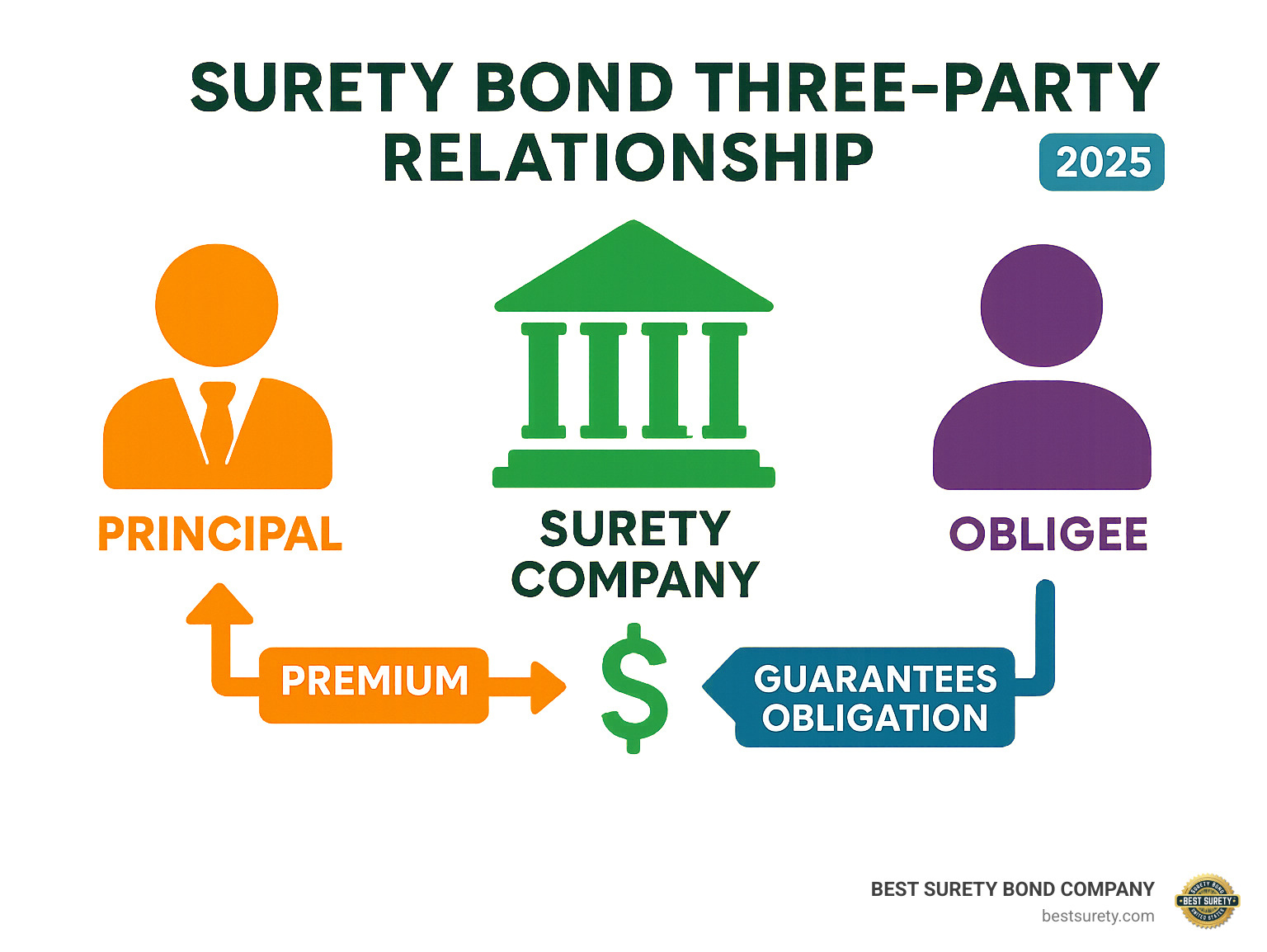
A surety bond is a three-party agreement where:
- You (the principal) get the bond to meet requirements
- The obligee (whoever requires the bond) gets protection
- The surety company backs your promise and sets your rate
This isn’t insurance you’ll hopefully never use. It’s a financial guarantee that transfers risk – and that risk assessment determines exactly what you’ll pay.
How a Surety Bond Works & Why Cost ≠ Coverage
Understanding how surety bonds work is crucial to grasping why the surety bond cost is only a fraction of the coverage amount. When you purchase a surety bond, you’re not buying traditional insurance – you’re obtaining a financial guarantee backed by a surety company.
Here’s how the mechanics work: If a valid claim is filed against your bond, the surety company initially pays out to the obligee (the party requiring the bond). However, you remain ultimately responsible for reimbursing the surety company for any payments made, plus associated costs. This is called the principle of indemnity.
The penal sum is the maximum amount the surety will pay on a claim – this is your bond amount. The premium is what you pay annually to maintain this guarantee. Think of it like this: you’re essentially renting the surety company’s financial backing and creditworthiness.
| Bond Amount | Excellent Credit Premium | Average Credit Premium | Poor Credit Premium |
|---|---|---|---|
| $10,000 | $50 – $300 | $300 – $500 | $500 – $1,000 |
| $25,000 | $125 – $750 | $750 – $1,250 | $1,250 – $2,500 |
| $50,000 | $250 – $1,500 | $1,500 – $2,500 | $2,500 – $5,000 |
| $100,000 | $500 – $3,000 | $3,000 – $5,000 | $5,000 – $10,000 |
Difference Between Bond Amount & Surety Bond Cost
The surety bond cost confusion often stems from mixing up these two numbers. The bond amount (or penal sum) represents the maximum financial guarantee – it’s the coverage limit. Your actual cost is the premium, calculated as a percentage of this amount.
For example, if you need a $20,000 contractor license bond and qualify for a 1.5% rate, your annual premium is $300. You’re not paying $20,000 – you’re paying $300 to guarantee $20,000. This percentage rate is determined by your risk profile, with rates typically ranging from 0.5% to 10% of the bond amount.
Parties in the Bond & Their Roles in Pricing
Each party in the surety bond triangle plays a role in determining your cost:
The Principal (You): Your creditworthiness, experience, and financial strength directly impact pricing. Strong principals get better rates because they present lower risk to the surety company.
The Obligee: The party requiring the bond (government agency, project owner, etc.) sets the bond amount and type requirements. They don’t directly affect your rate, but their requirements determine the risk category.
The Surety: The company issuing the bond evaluates your risk and sets your premium rate. They’re essentially lending you their financial credibility and want to ensure they can collect if they have to pay a claim.
The Indemnitor: Often the same as the principal, this party agrees to reimburse the surety for any losses. Sometimes spouses or business partners serve as additional indemnitors to strengthen the application.
12 Key Factors That Drive Surety Bond Cost
Understanding what drives surety bond cost helps you anticipate your premium and potentially improve your rate. Here are the twelve most significant factors:

- Credit Score: Accounts for roughly 80% of your rate determination for most commercial bonds under $50,000
- Bond Type: License bonds carry different risk than performance bonds or court bonds
- State Requirements: Some states mandate specific bond amounts or have flat-rate pricing
- Industry Risk: Construction and financial services typically pay more than notaries
- Business Financials: Strong balance sheets and cash flow can reduce rates
- Experience: Seasoned professionals in their field get better pricing
- Claim History: Previous bond claims significantly increase future premiums
- Bond Term Length: Multi-year terms sometimes offer discounts
- Underwriting Class: Filed rates vs. individually negotiated account rates
- Collateral: Posting security can reduce rates for high-risk applicants
- Agent Fees: Some agents charge additional fees beyond the premium
- Economic Cycles: Market conditions affect overall pricing trends
How Credit Score Impacts Surety Bond Cost
Your credit score is the single most important factor in determining surety bond cost for most commercial bonds. Here’s how the tiers typically break down:
Excellent Credit (675+): You’ll likely pay 0.5% to 3% of the bond amount. A $10,000 bond might cost $50 to $300 annually. These applicants often qualify for instant-issue programs with no additional underwriting.
Average Credit (600-675): Expect to pay 3% to 5% of the bond amount. That same $10,000 bond would cost $300 to $500 annually. You’ll likely need to provide some financial documentation.
Poor Credit (Under 600): Rates typically range from 5% to 10% of the bond amount, meaning $500 to $1,000 for a $10,000 bond. However, 99% of applicants are still approved through specialized bad-credit programs.
Bond Type Matters: License, Contract, Court & More
Different bond types carry different risk profiles, which directly affects your premium:
License & Permit Bonds: Generally the lowest risk, with rates typically 1% to 4% of the bond amount. These protect the public from violations of licensing requirements.
Contract Bonds (Performance & Payment): Usually cost 0.5% to 4% of the contract amount. Bid bonds are often provided free after underwriting approval.
Court Bonds: Often have the lowest rates at 0.5% to 1% for well-qualified applicants, as they’re typically short-term and backed by court oversight.
Fidelity Bonds: Protect against employee dishonesty, with rates typically 0.5% to 1% of the coverage amount.
Does Your State Change the Price Tag?
State requirements can significantly impact your surety bond cost in two ways: the required bond amount and whether rates are regulated.
For example, auto dealers face vastly different requirements by state. Arizona requires a $100,000 bond while South Dakota only requires $25,000. Even at the same percentage rate, the Arizona dealer pays four times more.
Some states also have statutory bonds with flat rates. Florida’s notary bond costs $69 for a $7,500 four-year term, while Wisconsin’s $500 four-year notary bond costs just $20. These rates are set by state regulation rather than individual underwriting.
Surety Bond Cost Ranges & Real-World Examples
Now let’s get specific about what you can expect to pay. Surety bond cost varies significantly based on the factors we’ve discussed, but here are the typical ranges:
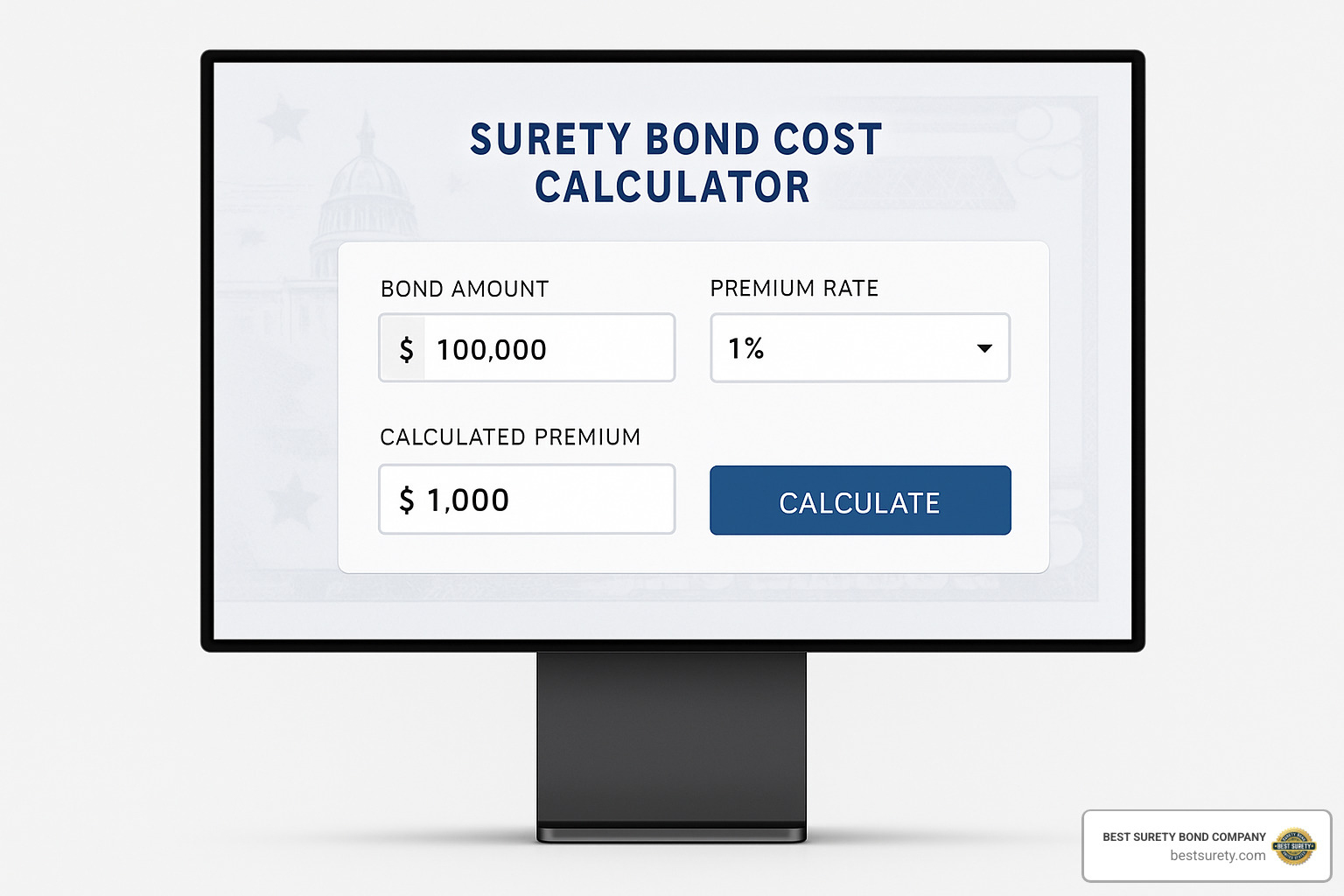
Performance and Payment Bonds: 0.5% to 4% of the contract price. A $250,000 contract at a 2.5% rate costs $6,250 annually.
Commercial License Bonds: 1% to 10% of the bond amount, with most falling between 1% and 3.5% for applicants with decent credit.
Court Bonds: 0.5% to 1% for qualified applicants, with rates decreasing as bond amounts increase due to sliding scale pricing.
Fidelity Bonds: 0.5% to 1% of the coverage amount for most applicants.
Typical Percentage Premiums You Can Expect
Here’s what you can realistically expect to pay based on your credit profile:
Excellent Credit (675+): Most surety bond cost falls between 1% and 3% of the bond amount. You might even qualify for rates as low as 0.5% on certain low-risk bonds.
Average Credit (600-675): Expect to pay 3% to 5% of the bond amount. You’ll likely need to provide financial statements or other documentation to support your application.
Challenged Credit (Under 600): Rates typically range from 5% to 10% of the bond amount. Some high-risk situations might see rates up to 15%, but specialized programs can often get you approved.
Dollar Examples: $10K, $25K, $50K, $100K, $1M
Let’s look at real-world examples across different bond amounts:
$10,000 Bond Examples:
- Notary bond: $50-$125 (often flat rate)
- Contractor license bond: $100-$1,000 depending on credit
- Business service bond: $125 (flat rate)
$25,000 Bond Examples:
- Auto dealer bond: $250-$2,500 depending on credit and state
- Contractor license bond: $250-$1,250
$50,000 Bond Examples:
- DMEPOS bond: $500-$5,000 depending on credit
- Mortgage broker bond: $500-$2,500
$100,000 Bond Examples:
- Auto dealer bond: $1,000-$10,000 depending on credit
- ERISA fidelity bond: $500-$3,000
$1,000,000 Bond Examples:
- Performance bond: $10,000-$30,000 for excellent credit
- Money transmitter bond: $10,000-$100,000 depending on risk factors
Cutting Your Premium: Strategies, Financing & Refund Rules
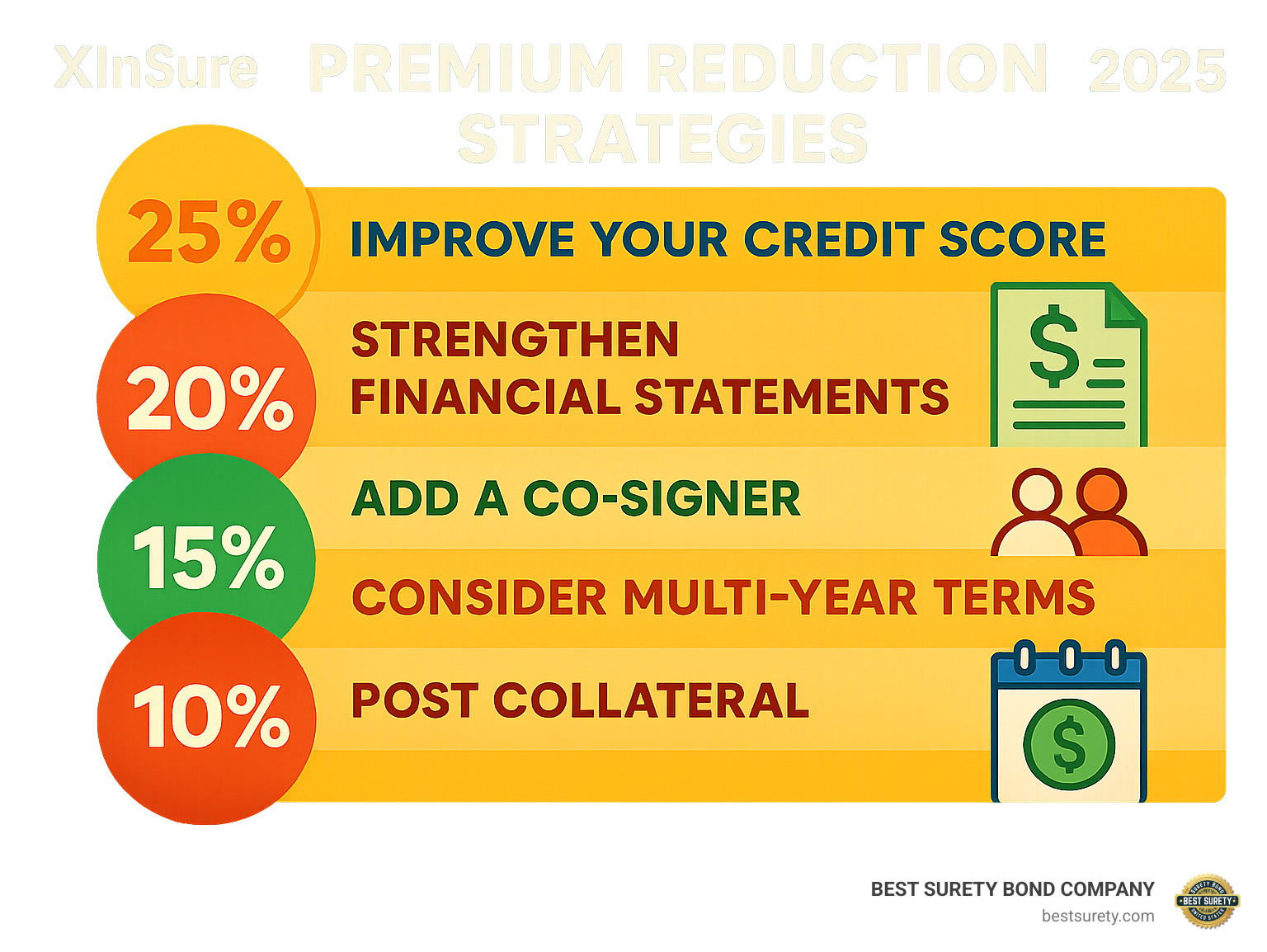
There are several legitimate ways to reduce your surety bond cost and manage the financial impact:
Improve Your Credit Score: This is the most effective long-term strategy. Even a 50-point improvement can significantly reduce your premium at renewal.
Strengthen Your Financial Statements: Provide CPA-prepared statements when possible. Strong financials can sometimes overcome marginal credit.
Add a Co-signer: A financially strong co-signer can help you qualify for better rates, especially if your credit is challenged.
Consider Multi-year Terms: Some bonds offer discounts for two or three-year terms, potentially saving 10-30% over annual renewals.
Collateral Substitution: For high-risk applicants, posting collateral can sometimes reduce premium rates.
Choose the Right Provider: Shop around for providers offering multi-year discounts and no processing fees.
Can You Get Bonded With Bad Credit?
Yes! The good news is that 99% of applicants are approved for surety bonds, even with poor credit. Specialized bad-credit bonding programs exist specifically for higher-risk applicants.
What to Expect with Bad Credit:
- Higher premium rates (typically 5-10% of bond amount)
- Additional documentation requirements
- Possible collateral requirements for very large bonds
- Opportunity for rate reduction at renewal with credit improvement
Strategies for Bad Credit Applicants:
- Provide additional financial documentation
- Include a resume showing industry experience
- Consider adding a financially strong co-signer
- Focus on improving credit for future renewals
Financing Options & Payment Plans
Premium financing can help manage the upfront cost of your surety bond. Here’s how it typically works:
Down Payment: Usually 30-40% of the total premium upfront
Payment Period: Balance spread over 4-6 months
Eligibility: Available for most bond types over certain premium thresholds
For example, if your annual premium is $5,000, you might pay $2,000 upfront and $750 monthly for four months. This can significantly help with cash flow, especially for seasonal businesses or new ventures.
Important Note: Surety bond premiums are generally non-refundable once the bond is issued. The premium is fully earned by the surety company regardless of whether any claims are filed.
Surety Bond Cost FAQ (Top 3 Questions)
What does a surety bond cost for a $50,000 requirement?
A $50,000 surety bond typically costs between $250 and $5,000 annually, depending on your credit score and the type of bond. Here’s the breakdown:
- Excellent credit (675+): $250-$1,500 (0.5%-3%)
- Average credit (600-675): $1,500-$2,500 (3%-5%)
- Poor credit (under 600): $2,500-$5,000 (5%-10%)
The exact rate depends on factors like bond type, industry risk, and your overall financial profile.
Are surety bond premiums refundable if I cancel early?
No, surety bond premiums are typically non-refundable once the bond is issued. The premium is considered fully earned by the surety company from the moment the bond becomes active, regardless of whether any claims are filed.
There are rare exceptions, such as when legislation changes eliminate the bond requirement and no claims have been filed, but these situations are uncommon. This is why it’s important to understand your exact bond requirements before purchasing.
How often do I pay my surety bond premium?
Most surety bonds require annual premium payments, though the payment structure varies by bond type:
Commercial/License Bonds: Usually annual premiums with the option for multi-year terms
Contract Bonds: Often a one-time premium for the life of the contract
Court Bonds: Typically annual, but may be required for the duration of court proceedings
Some providers offer multi-year discounts (2-3 year terms) that can reduce your overall cost by 10-30%.
Conclusion & Next Steps
Understanding surety bond cost doesn’t have to be complicated. Remember these key points:
- You pay a small percentage (0.5%-10%) of the bond amount, not the full amount
- Your credit score is the biggest factor in determining your rate
- Different bond types carry different risk levels and pricing
- 99% of applicants can get approved, even with poor credit
- Premiums are generally non-refundable once issued
At BEST SURETY BOND COMPANY, we simplify the entire process. Our experienced team can help you understand your exact requirements, estimate your costs, and find the most competitive rates available.
Ready to get started? We offer:
- Free quotes with no obligation
- Instant online applications for many bond types
- Specialized programs for challenged credit
- Multi-year discounts and competitive rates
Don’t let uncertainty about surety bond costs hold back your business. Get the clarity you need with a free quote today.
