

Why Understanding Bond Types Matters for Your Business
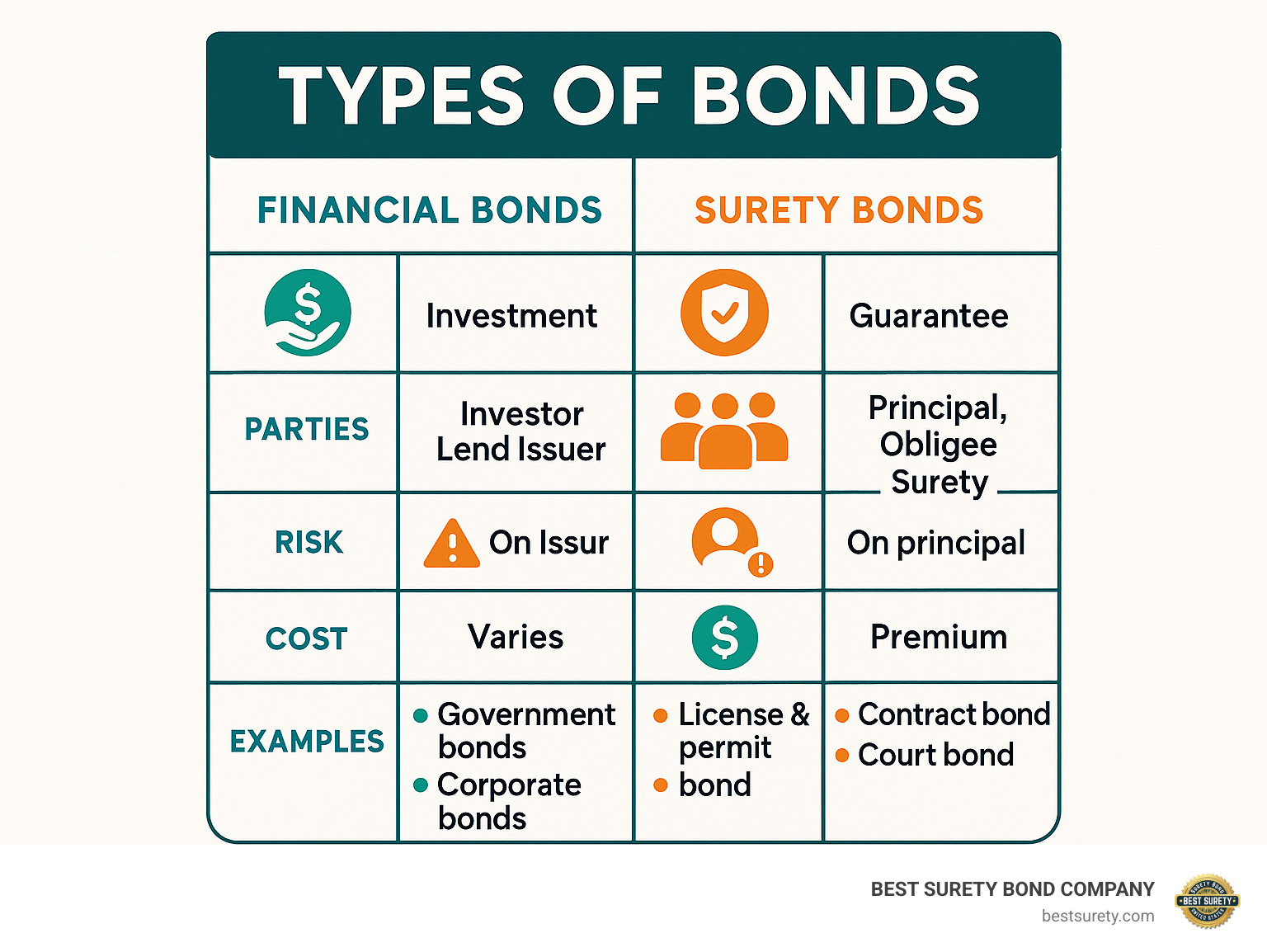
When people search for types of bonds, they typically encounter two completely different financial instruments that share only a name. Understanding this distinction is crucial for business owners, contractors, and professionals who need to steer licensing requirements, project bids, or court proceedings.
Quick Answer: The Two Main Categories of Bonds
- Financial Bonds (Investment bonds) – Debt securities where you lend money to governments or corporations in exchange for interest payments
- Surety Bonds (Guarantee bonds) – Three-party agreements that guarantee you’ll fulfill your legal or contractual obligations
Financial Bonds Include:
- Government bonds (U.S. Treasury, municipal)
- Corporate bonds (investment-grade, high-yield)
- Zero-coupon bonds
- Convertible bonds
Surety Bonds Include:
- License & permit bonds
- Contract bonds (performance, bid, payment)
- Court bonds (appeal, probate, guardianship)
- Fidelity bonds
The confusion between these bond types costs business owners time and money. Financial bonds help you grow wealth through predictable income and portfolio diversification. Surety bonds help you get bonded to meet Texas state requirements, win contracts, or fulfill court orders.
For small business owners and contractors in Texas, surety bonds aren’t optional – they’re often legally required to operate, bid on projects, or handle fiduciary responsibilities.
As Haiko de Poel, I’ve helped countless businesses steer the complex landscape of types of bonds through my work scaling companies across fintech, legal services, and franchise development. My experience with both financial instruments and regulatory requirements gives me unique insight into why understanding bond distinctions matters for your bottom line.
Financial Bonds: The Investment-Grade Landscape
When people hear types of bonds, they usually think of financial bonds. These are investment tools, essentially IOUs from governments and corporations. You lend them money, and they promise to pay you back with interest. They are used to build wealth and preserve capital.
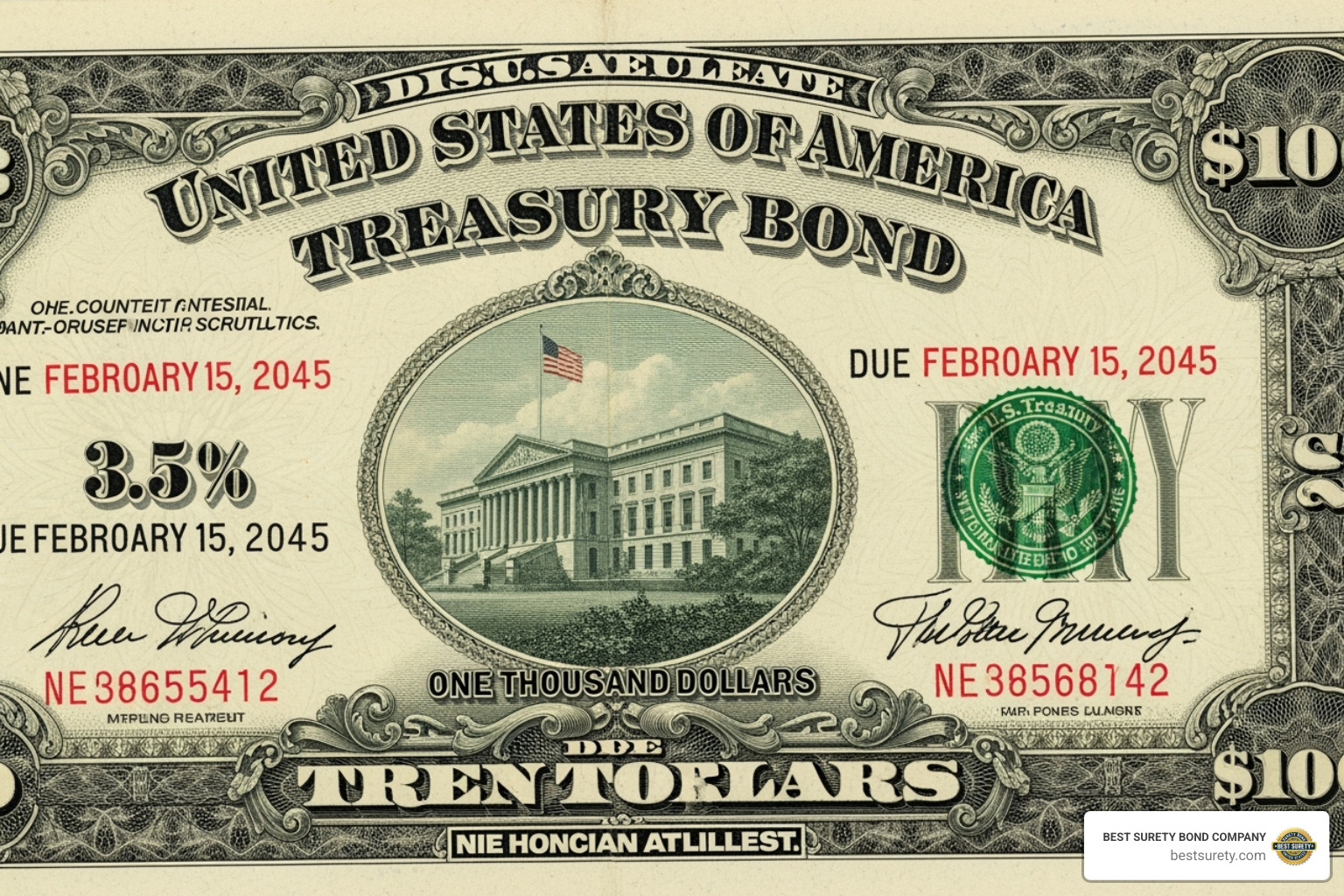
When you buy a bond, you become a lender. The issuer—like the U.S. Treasury, the city of Houston, or a corporation—pays you regular interest (the coupon rate) and returns your original investment (the principal) at the maturity date.
Common types include:
- Government bonds: U.S. Treasuries are backed by the federal government, making them very safe. Municipal bonds, issued by cities like Austin or Dallas, often have tax advantages for Texas residents.
- Corporate bonds: Companies issue these for capital. They range from safer investment-grade bonds to riskier high-yield bonds (or junk bonds) that offer higher returns.
- Other types: Zero-coupon bonds are bought at a discount and pay out the full face value at maturity without regular interest. Convertible bonds can be exchanged for company stock.
How Investment Bonds Work and Their Role in a Portfolio
The mechanics are simple: a $1,000 bond with a 5% annual interest rate pays you $50 per year. However, they carry risks like credit risk (the issuer might default), interest rate risk (rising rates can lower your bond’s value), and inflation risk. For more details, FINRA’s guide on Understanding Bond Risks is a useful resource.
In an investment portfolio, financial bonds provide capital preservation and portfolio diversification. Their predictable income stream and low correlation with stocks help balance riskier assets. This dynamic is a cornerstone of modern investment strategy, as explained in this analysis of stock/bond correlations.
While financial bonds are for investing, they are not what most Texas business owners and contractors need for their operations. The bonds that matter for your business are surety bonds, which serve a completely different purpose.
Surety Bonds: The Three-Party Guarantee for Business
While financial bonds are for investing, surety bonds are for getting bonded. For Texas business owners, contractors, and professionals, this distinction is critical for legal operation.

A surety bond is not an investment; it’s a financial guarantee. It’s a three-party promise between you (the Principal), the entity requiring the bond (the Obligee), and the bond company (the Surety). For example, a Houston school district (Obligee) might require a contractor (Principal) to get a performance bond from us (the Surety) to guarantee a project’s completion.
If the Principal fails to meet their obligation, the Surety steps in to protect the Obligee from financial loss. However, unlike insurance, the Principal is ultimately responsible for reimbursing the Surety for any claims paid. It’s more like a co-signed loan than an insurance policy.
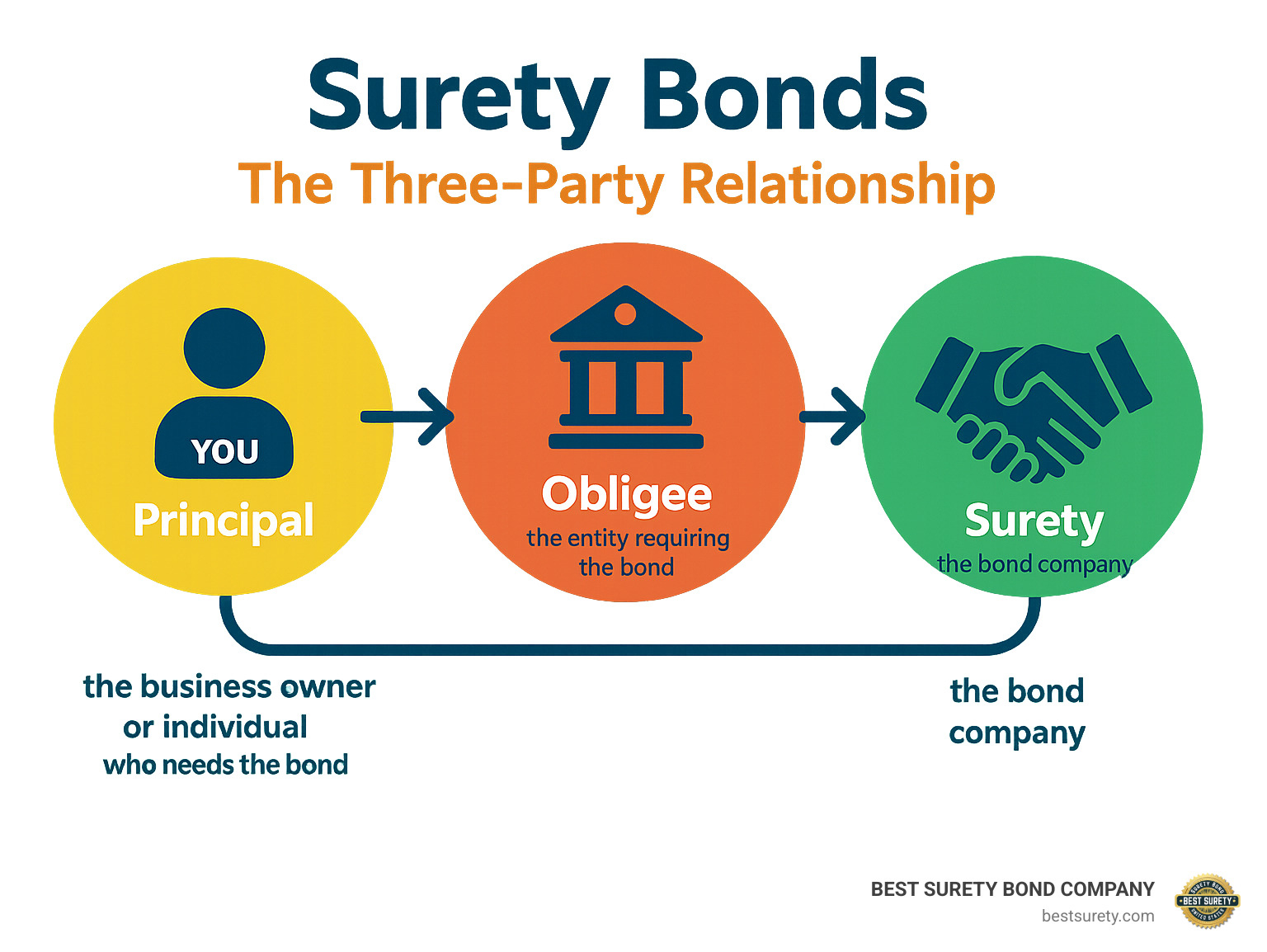
This three-party structure builds trust, protects the public, and gives project owners confidence. The bond signals that a reputable company guarantees your work.
Why You Might Need a Surety Bond in Texas
In Texas, surety bonds are often required by state, county, and city agencies to ensure businesses follow the rules.
- Licensing: Many professions require license and permit bonds to operate. This includes auto dealers in Dallas, mortgage brokers in Austin, and freight brokers in Houston.
- Public Construction: Contractors bidding on public projects, like a highway in San Antonio, need contract bonds (bid, performance, and payment bonds) to guarantee their work and payments.
- Court Proceedings: Courts require court bonds for roles like estate executors or legal guardians to protect assets under their care.
- Private Contracts: Some private project owners also require contractors to be bonded as an extra layer of protection.
In short, being bondable is often essential to being hireable in Texas. We help businesses across the state steer these requirements quickly and affordably.
Key Categories of Surety Bonds
Surety bonds fall into several main categories based on their purpose:
- License & Permit Bonds: Ensure you follow industry rules.
- Contract Bonds: Guarantee project completion and payment to subcontractors.
- Court Bonds: Ensure you handle legal duties properly.
- Commercial Bonds: Cover other business obligations, like paying sales tax.
- Fidelity Bonds: Protect your business from employee theft.
Each type creates trust and accountability. At BEST SURETY BOND COMPANY, we handle all these types of bonds, providing Texas businesses with the fast, affordable coverage they need.
A Deep Dive into Common Types of Bonds for Professionals
Understanding the specific types of bonds you need in Texas can save you time and money. At BEST SURETY BOND COMPANY, we’ve streamlined the bonding process to get you approved fast with the lowest rates possible, so you can get back to business.
License & Permit Bonds
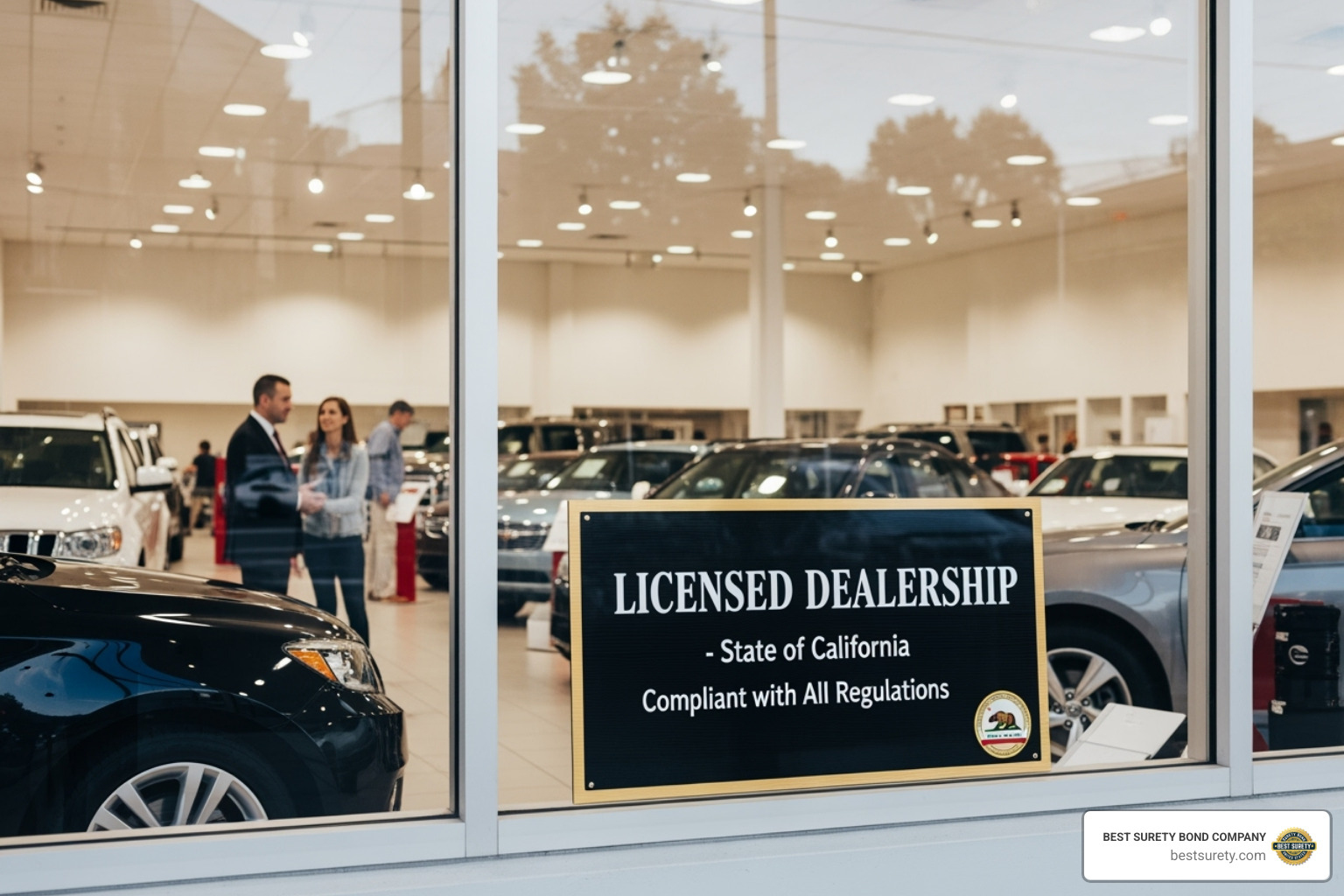
These are the most common types of bonds for Texas businesses. They are your promise to operate according to state and local rules, protecting the public from misconduct.
- Auto Dealer Bonds: Required to sell cars in Texas, this bond protects consumers from fraud. We help Houston-area dealers get bonded quickly, often with same-day approval.
- Contractor License Bonds: For plumbers, electricians, and general contractors, these bonds ensure you follow building codes. We know the specific requirements across Texas, ensuring faster processing.
- Sales Tax Bonds: Guarantees that businesses collecting sales tax (especially on alcohol, tobacco, or fuel) will remit the funds to the state.
- Mortgage Broker and Lender Bonds: Protects consumers by ensuring mortgage professionals act ethically. We have a streamlined process for this high-demand bond in Texas’s real estate market.
- Freight Broker Bonds (BMC-84): A federal requirement for freight brokers to prove financial responsibility. Essential for operating in Texas’s transportation network.
Our online application helps you meet regulatory compliance and build trust without bureaucratic headaches.
Contract Bonds for Texas Projects
For contractors bidding on public works projects from Austin to Houston, contract bonds are essential. These types of bonds guarantee you’ll fulfill your contractual obligations.
- Bid Bonds: Prove you’re a serious bidder. This bond guarantees that if you win the bid, you will enter into the contract and provide the necessary follow-up bonds.
- Performance Bonds: Guarantees you will complete the project according to the contract’s terms and timeline, protecting the project owner financially.
- Payment Bonds: Ensures your subcontractors, laborers, and material suppliers get paid, preventing liens on the project.
- Maintenance Bonds: Extends your guarantee after project completion, covering any defects for a specified period.
We’ve bonded contractors for projects of all sizes across Texas and understand state and federal requirements, helping you meet bidding deadlines.
Court & Fiduciary Bonds
These types of bonds are for legal proceedings and ensure you handle fiduciary duties properly.
- Appeal Bonds (Supersedeas Bonds): Guarantees payment of a judgment if your appeal fails, allowing the appeal process to proceed.
- Guardianship Bonds: Protects the assets of a minor or incapacitated adult by ensuring the appointed guardian acts responsibly.
- Probate Bonds: Required for estate administrators, this bond ensures assets are distributed according to law and the deceased’s wishes.
- Other Court Bonds: We also handle Bankruptcy Trustee Bonds, Injunction Bonds, and Replevin Bonds. Our team understands the urgency of court matters and provides quick approvals for tight deadlines.
Understanding Bond Risks and Getting Bonded Fast
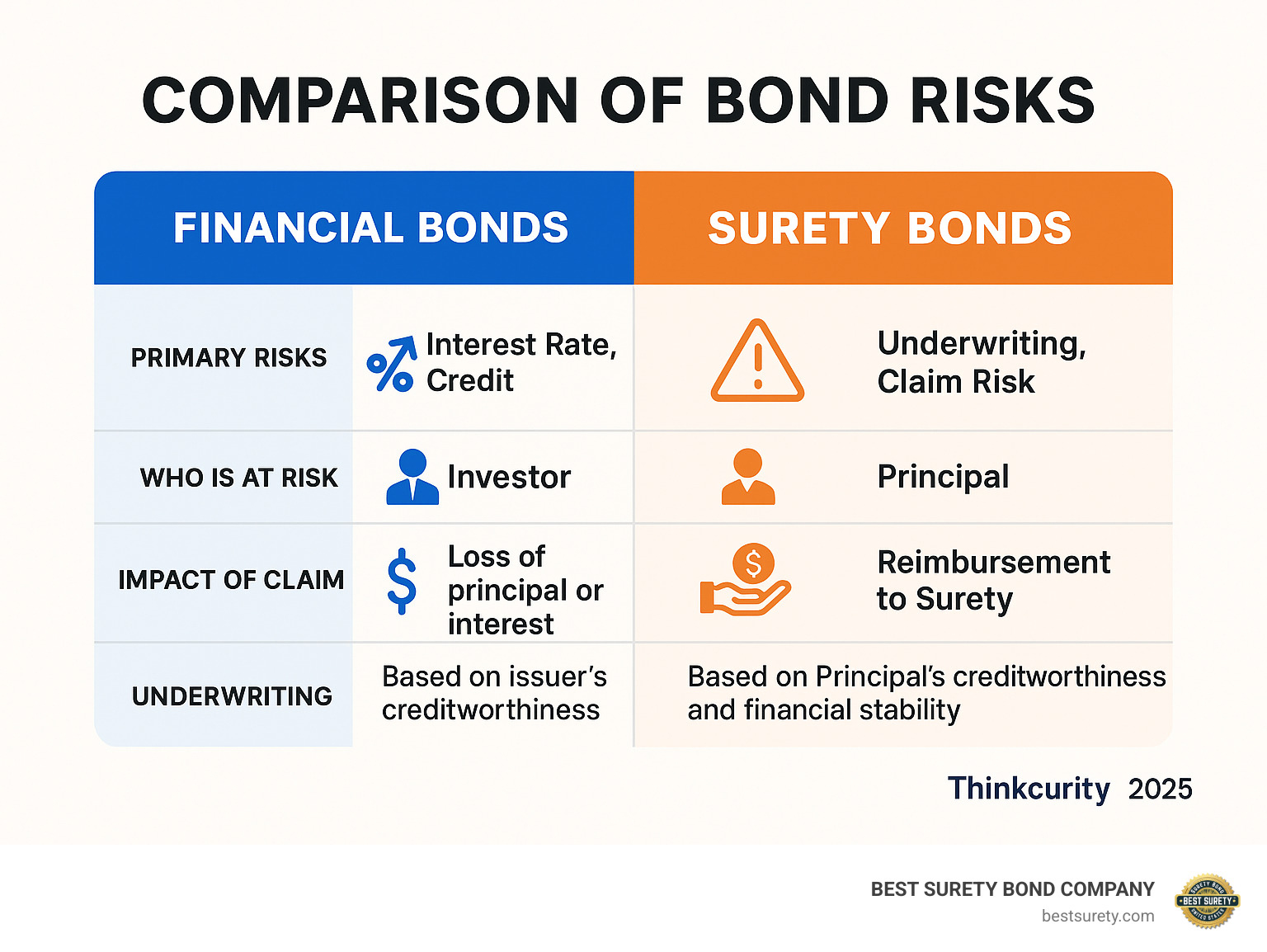
The risks involved with types of bonds depend entirely on which kind you’re dealing with. With financial bonds, you are the investor taking on risks like interest rate changes or issuer default. With surety bonds, the risk profile is flipped.
You aren’t investing; you’re getting a guarantee. The main risk is failing to meet your obligation, which could trigger a claim. If the surety company pays a claim, you must reimburse them per the indemnity agreement you sign. Think of it as a co-signer for your professional commitments. Our underwriting process assesses your creditworthiness and stability to manage this risk.
Fortunately, claims are rare. Getting bonded with BEST SURETY BOND COMPANY provides peace of mind, allowing you to operate legally and win more business.
How are Surety Bond Costs Determined?
Surety bond costs are a small percentage of the bond amount, based on risk. Key factors include:
- Your credit score: This is the biggest factor for most types of bonds. Excellent credit (700+) can mean paying just 1-3% of the bond amount annually. A $10,000 license bond could cost only $100. We work with all credit profiles.
- The bond type and amount: A simple license bond carries less risk and costs less than a large construction performance bond.
- Business financials: For larger contract bonds, we review your company’s financial health, work history, and bonding capacity. Strong financials lead to better rates.
- Location: As a Texas-based company serving Houston and beyond, we understand local market conditions and secure competitive rates for Texas businesses.
Our goal is to find you the best rates in Texas by shopping your bond across multiple surety markets.
The Process for Getting Your Surety Bond
We know delays cost you money, so we’ve made our process fast and simple.
- Apply Online in Minutes: Our simple application asks for basic information about you, your business, and the bond you need.
- Get Instant Approval: Many common license and permit bonds for applicants with good credit are approved within minutes.
- Receive Same-Day Issuance: Once approved and paid, we can issue your bond the same day. We prioritize rush orders.
- Use Electronic Delivery: We deliver many types of bonds instantly via email. Just print and submit.
Our Houston-based experts are always here to help. Licensed agents who understand Texas requirements can guide you through any complex situations. We combine technology and personal service to give you the best of both worlds.
Frequently Asked Questions about Bond Types
As a Houston-based surety bond company, we hear these questions daily from Texas business owners. Here are the answers to the most common ones.
What is the main difference between a surety bond and an insurance policy?
The key difference is who is protected. An insurance policy is a two-party agreement that protects you from your own losses. A surety bond is a three-party agreement that protects a third party (the obligee) from you failing to meet an obligation. With insurance, the insurer covers the loss. With a surety bond, if the surety pays a claim, you are responsible for reimbursing the surety.
How much does a surety bond cost in Texas?
The cost is an annual premium, typically 0.5% to 3% of the total bond amount for common license and permit bonds. For a $10,000 bond, a person with good credit might pay just $50 to $300 per year. The final cost depends on your credit score, the bond type, and the bond amount. As a Texas-based agency, we shop multiple markets to find you the most competitive rates, even if your credit isn’t perfect.
Are all types of bonds used for investment?
No. This is a common point of confusion. Financial bonds (like U.S. Treasuries or corporate bonds) are investments used to earn interest. Surety bonds are not investments. They are a form of credit used to guarantee you will meet a legal or contractual requirement, such as getting a business license or bidding on a construction project. When Texas businesses need a “contractor bond” or “license bond,” they need a surety bond, which is our specialty.
Your Trusted Partner for All Surety Bond Needs
Throughout this comprehensive guide, we’ve explored the fascinating world of types of bonds and uncovered a crucial distinction that often trips up business owners. While financial bonds serve as investment vehicles to help you build wealth through predictable returns and portfolio diversification, surety bonds are the essential guarantees that keep your business running legally and successfully.
For business owners, contractors, and professionals across Texas, understanding this difference isn’t just academic—it’s practical and profitable. Surety bonds aren’t optional extras; they’re the keys that open up business licenses, win lucrative contracts, and satisfy court requirements from Houston to El Paso.
At BEST SURETY BOND COMPANY, we’ve built our reputation on making the bonding process as painless as possible for Texas businesses. We know that when you need a bond, you usually needed it yesterday. That’s why we’ve streamlined everything from fast approvals that get you bonded quickly to low rates that protect your bottom line.
Our Texas-based expertise sets us apart. Our licensed agents don’t just understand the various types of bonds—they understand the specific requirements for businesses across the Lone Star State. Whether you’re an auto dealer navigating Houston’s competitive market, a contractor bidding on Dallas infrastructure projects, or handling court proceedings in Austin, we speak your language.
The beauty of working with us lies in our combination of online convenience and human expertise. You can apply for your bond and receive quotes online anytime, but when you need guidance on complex requirements or have questions about which of the many types of bonds fits your situation, our licensed agents are just a phone call away.
We provide comprehensive coverage across all major bond categories. From the license and permit bonds that get you legally operating, to the contract bonds that help you win and complete projects, to the court bonds that satisfy judicial requirements—we’ve got you covered with competitive rates and lightning-fast service.
Don’t let bond requirements become roadblocks to your success. Partner with the team that combines cutting-edge digital tools with old-fashioned Texas hospitality and expertise.
Get Your Instant Surety Bond Quote Today and find why thousands of Texas businesses trust BEST SURETY BOND COMPANY for all their bonding needs!
